Maneki-neko
In its own language: 招き猫
A lucky cat figurine, paw raised, kept by shop doors and in homes across Japan

The maneki-neko is a Japanese figurine of a seated cat, one paw lifted in a beckoning pose, kept near the entrance of shops and homes to draw customers, money and luck. Most accounts trace it to Edo-period Tokyo and the Imado potters of Asakusa, though several temples and shrines tell rival tales.
When is Maneki-neko kept?
Maneki-neko is kept on all year round, by shop entrances and indoors at home; not tied to any festival day.
A small cat figure, usually ceramic or plastic, sits near the door of countless Japanese shops, restaurants and homes. One paw is lifted in the Japanese way of beckoning, and the other often holds a gold coin. People keep it to invite customers, money and good fortune. Its history is bound up with Edo-period Tokyo, though several temples and shrines tell rival stories about where it began.
What it is
The figure shows a seated cat, most often a calico Japanese Bobtail. Its raised paw looks like a wave to visitors from outside Japan, but the pose copies a local gesture: the hand goes up with the palm facing down and the fingers fold toward the palm, again and again. Many versions carry a koban, an old oval gold coin, against the chest. Ceramic and plastic are the usual materials now. Older ones may be carved wood, stone, metal, cast iron or hand-made porcelain. The colour carries meaning. White invites general good fortune, black turns away harm, red is kept for health, gold for wealth, pink for love.
Origins and history
Nobody knows exactly when the figure appeared. It is widely held to come from Tokyo, called Edo in earlier centuries, and sometimes from Kyoto instead. A common theory links it to Imado ware, pottery sold at Asakusa. Potters in Imado had clay from the Tenshō years, and later craftsmen arrived from Mikawa Province and expanded the trade. Dolls made there in the Genroku era are thought to have led to the cat. The oldest surviving description is of a type called marushime-neko. An Edo chronicle mentions the figure in 1852, the same year a print by Utagawa Hiroshige showed such cats for sale at Sensō-ji. A newspaper noted them in 1876, and an advertisement from 1902 shows they were already popular.
Tales of the cat
Several Buddhist temples and Shinto shrines are named as the cat's birthplace, and each tells a story. The best known is set at Gōtoku-ji, where a cat at the gate beckoned the lord Ii Naotaka and his party inside during the Kan'ei years. A fierce storm broke, the travellers were unharmed, and the temple gained a powerful patron. Another tale follows Ōta Dōkan, who fought the Toshima clan at Ekodahara and Numabukuro, was outnumbered and lost his way. A cat called him into Jishōin Temple, where he turned the fighting around. He gave the temple a carving in thanks. A third tale tells of an old woman by Imado Shrine who sold a clay cat, and a fourth of a courtesan whose pet cat saved her from a snake.
In shops and homes
Small businesses put the cat by the entrance: restaurants, bars, cleaners, laundries, hotels, pachinko parlours, casinos, nightclubs. Families also keep one indoors. Which paw goes up is read differently depending on period and region. A raised left paw is meant to draw customers, so it suits a shop. A raised right paw is meant to draw money, so it suits a house. Some figures move their arm, driven by a small motor, a battery or a solar cell. People say the cat calls buyers through the door and carries fortune and prosperity into a household. One account describes it as a vessel for fertile, life-giving cat energy.
Today and change
Because the charm is common among Chinese communities, and in the Chinatowns of the United States, many people take it for a Chinese object and call it a Chinese lucky cat, or jīnmāo, meaning golden cat. In China itself it is known as zhāocáimāo. Cat charms turn up far beyond shop counters: keyrings, money boxes, air fresheners, plant pots, and a great deal of merchandise. Hikone City adopted Hikonyan, a mascot drawn from the Ii Naotaka tale. Japanese and international media borrow the figure, among them the Pokémon Meowth, Turbo Granny in Dandadan, and a Joker card in the game Balatro.
How Maneki-neko is kept
A shopkeeper buys the figure or receives it as a gift, then sets it near the door, facing outward so that it greets each person who comes in. Households place one on a shelf or by an entrance. Owners choose a side for the raised paw: left for trade, right for the home. Some models have an arm that moves, worked by a motor, a battery or a solar panel. No words or prayers are required. The cat simply stands, and visitors often stop to photograph it.
When and where
There is no set date. The figure stays out all year, at a shop door or indoors at home. Only its history is dated: the Edo period, the 1852 chronicle entry, the 1876 newspaper mention and the 1902 advertisement that shows it had become popular.
Japan is its home, and it is strongest in Tokyo, where the Asakusa potters worked, with Kyoto and Osaka also named in its story. It also appears widely in China, where it is called zhāocáimāo, and among Chinese communities elsewhere, including American Chinatowns.
What Maneki-neko means
People read the cat as an invitation: customers through a shop door, money into a till, luck into a household. The raised paw carries that meaning. Each colour says something too: white for general fortune, black against harm, red for health, gold for wealth and pink for love, a scheme that Feng Shui ideas helped to shape. A folktale tells of a shopkeeper who fed a hungry stray and was repaid when the cat sat outside and drew customers in. Some describe the figure as a holder of fertile, life-giving cat energy.


Questions people ask about Maneki-neko
When is Maneki-neko kept?
Maneki-neko is kept on all year round, by shop entrances and indoors at home; not tied to any festival day.
What is a maneki-neko?
It is a Japanese figurine of a seated cat with one paw lifted. Usually made of ceramic or plastic, it stands in shops and homes as a charm for luck. Many hold a koban, an old oval gold coin, and most show a calico Japanese Bobtail.
Where did it come from?
Tokyo is the usual answer, with Kyoto sometimes named instead. A common theory traces it to Imado ware from Asakusa. Temples and shrines such as Gōtoku-ji, Jishōin and Imado Shrine each claim it as their own, so the question has no single settled answer.
What does the raised paw mean?
It copies a Japanese beckoning gesture, hand up and fingers folding inward, which outsiders may read as a wave. A left paw is generally for attracting customers to a business, a right paw for money at home. The reading changes with time and place.
Why is it sometimes called a Chinese lucky cat?
The figure is popular in China and in Chinese communities abroad, including American Chinatowns, so many people assume it is Chinese. In China it is known as zhāocáimāo, and the nickname jīnmāo means golden cat. Its origin, however, is Japanese.
See also
 Friday the 13thA Western folk superstition regarding the unluckiness of a Friday falling on the 13th.
 Jack-o'-lanternA carved pumpkin lantern lit with a candle to brighten and protect Halloween nights
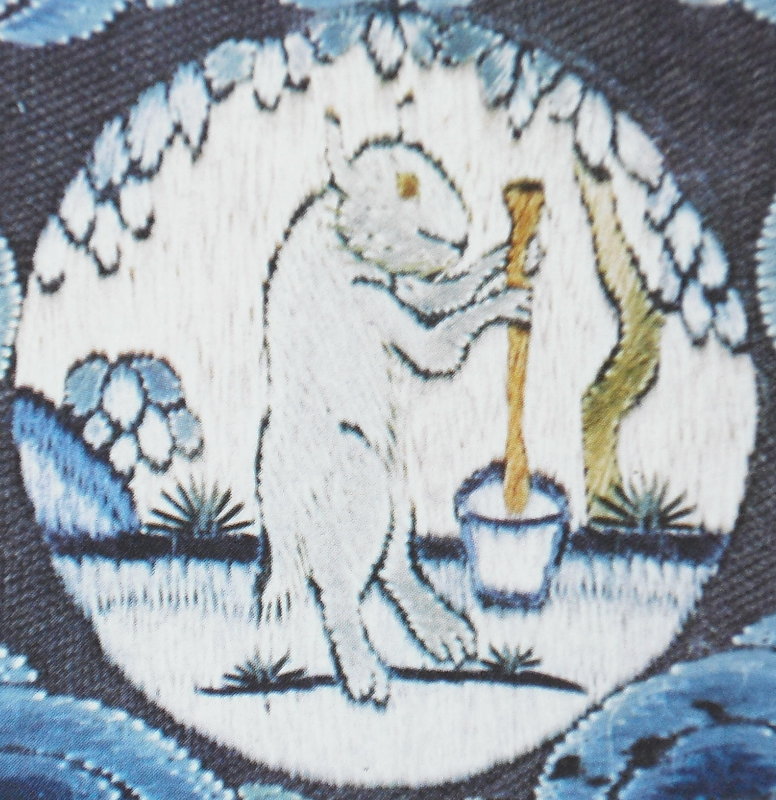 Moon rabbitA hare seen in the Moon's dark patches, pounding rice cakes or the elixir of life
 Daruma dollA round Japanese wishing doll: fill one eye to set a goal, the other to mark it done.
Good reading and sources
- Maneki-neko on WikipediaEncyclopedia
- More photos on Wikimedia CommonsPhotos and video
- Wikidata recordOpen data
The facts on this page come from the Wikipedia article "Maneki-neko", written by its contributors and used under the CC BY-SA 4.0 licence, and from its Wikidata record (CC0). EveryParampara rewrote the text in its own words, with AI assistance, and compares every page with the article to make sure no passage is copied. It may be reused under the same CC BY-SA 4.0 licence with a link back.
It may contain mistakes. Traditions differ from one family, village and community to the next, and the people who keep them know them best. If something is wrong, tell us. Last refreshed 2026-10-05.
More from Japan
All the traditions of Japan
🇯🇵 Takasaki, JapanDaruma doll達磨 (daruma)
A round Japanese wishing doll: fill one eye to set a goal, the other to mark it done.Folklore
🇨🇳 China and 5 moreMoon rabbit月兔
A hare seen in the Moon's dark patches, pounding rice cakes or the elixir of lifeFolklore
 🇨🇳 Luoyang, China and 1 moreYin and yang陰陽
Two opposite but complementary forces that Chinese thought sees in all thingsFolklore
🇨🇳 Luoyang, China and 1 moreYin and yang陰陽
Two opposite but complementary forces that Chinese thought sees in all thingsFolklore
 🇮🇪 Ireland and 5 moreFairy ring
A natural ring of mushrooms formed by fungal growth, surrounded by folklore across Europe and beyond.Folklore
🇮🇪 Ireland and 5 moreFairy ring
A natural ring of mushrooms formed by fungal growth, surrounded by folklore across Europe and beyond.Folklore
The same idea elsewhere
Healing, luck and protection compared 🇩🇪 Germany and 5 moreChristmas tree
A decorated evergreen or artificial tree placed indoors to mark the Christmas season.Festival
🇩🇪 Germany and 5 moreChristmas tree
A decorated evergreen or artificial tree placed indoors to mark the Christmas season.Festival
 🇫🇷 France and 5 moreCandlemas
A Christian feast of candle blessings marking the end of the Christmas seasonSpiritual
🇮🇪 Ireland and 2 moreJack-o'-lantern
A carved pumpkin lantern lit with a candle to brighten and protect Halloween nightsFolklore
🇺🇸 United States and 4 moreFriday the 13th
A Western folk superstition regarding the unluckiness of a Friday falling on the 13th.Folklore
🇫🇷 France and 5 moreCandlemas
A Christian feast of candle blessings marking the end of the Christmas seasonSpiritual
🇮🇪 Ireland and 2 moreJack-o'-lantern
A carved pumpkin lantern lit with a candle to brighten and protect Halloween nightsFolklore
🇺🇸 United States and 4 moreFriday the 13th
A Western folk superstition regarding the unluckiness of a Friday falling on the 13th.Folklore