Crafts and makingSub-Saharan Africa
Adinkra symbols
Symbols of the Akan people, stamped on cloth, each one carrying a proverb

Adinkra are symbols of the Akan peoples of Ghana, each standing for a proverb, an idea or a part of life. They are stamped on cloth, carved on stools and pottery, and cast on goldweights, and adinkra cloth is worn for funerals; Ntɔnso, near Kumasi, is still the main centre where the cloth is printed.
When is Adinkra symbols kept?
Adinkra symbols is kept at funerals and other special occasions, with no fixed date.
Adinkra are symbols of the Akan peoples of Ghana. Each one stands for an idea, a proverb or a part of life, and they are stamped on cloth, carved on stools and cast on goldweights. People wear adinkra cloth at funerals and on special days. Ntɔnso, a town near Kumasi, is still the main centre where the cloth is made.
Symbols and meanings
Adinkra symbols do two things at once. They decorate a surface, and they carry a message. Many of them stand for a proverb, so one stamped shape can hold a whole piece of advice. Others point to an animal, a plant, a drum, a star or something in the world around them. Because of this, they turn up on more than cloth. They are painted on walls, pressed into pottery, used in logos, carved on stools kept at home and in rituals, and cast on the small brass weights once used to weigh gold dust. The philosopher Kwame Anthony Appiah wrote that they helped carry a body of practice and belief that is complex and full of shades of meaning.
Origins and debate
One account told in Akan oral tradition says the symbols began with the Bono people of Gyaman, whose king, Nana Kwadwo Agyemang Adinkra, gave them his own name. In that telling, his cloth was worn by the Gyaman court, and after Gyaman was defeated, craftsmen were made to pass the skill on to the Asante. The king's eldest son, Apau, is said to have taught a man named Kwaku Dwaku near Kumasi. This story has a problem: the war it describes ran from 1818 to 1819, but Thomas Bowdich had already seen adinkra cloth being made in Kumasi in 1817. Other traditions point to Denkyira. The exact origin is not settled.
The oldest cloths
Two early pieces survive. The older one was made in 1817 and carries fifteen stamped patterns, among them stars, double dono drums and diamonds. Its maker used stamps cut from calabash and a dye taken from plants. Thomas E. Bowdich brought it to Britain, and it has been kept at the British Museum since 1818. The second cloth left Elmina Castle in 1825, sent to a royal collection in The Hague, most likely arranged by Major Friedrich Last for William I of the Netherlands, which explains why the Dutch coat of arms sits at its centre. Its other motifs are older adinkra patterns. It is now shown at the National Museum of Ethnology in Leiden.
Making adinkra cloth
The stamps are cut from the base of a calabash. Each is five to eight centimetres square, with a handle on the back, and the face is slightly curved so the printer can roll it over the cloth rather than press it flat. The dark ink, Adinkra aduro, is made from the badie tree, Bridelia ferruginea. Material from the trunk and roots is soaked, crushed and boiled over a wood fire; once the colour has come out, the liquid is strained and then boiled again for hours until it thickens. Ntɔnso, about 20 km northwest of Kumasi, is the present centre of traditional production, and cloth is also made in Ivory Coast.
Wearing and change
In the past, adinkra cloth belonged to royalty and to spiritual leaders, and it was worn at funerals and on other special days. Pieces were hand printed on cotton that was left undyed or dyed red, dark brown or black, according to the occasion and the wearer's place. Factory printing now puts the patterns on lighter, brighter cloth as well. Visitors have also pushed the symbols into new uses: T-shirts, jewellery and other goods made for sale. In 2020 a school board in York, Pennsylvania, in the United States, barred a children's colouring book that used the symbols. The ban was later reversed.
How Adinkra symbols is kept
Adinkra is kept by Akan craftspeople and by the families and chiefs who wear the cloth. Work starts with the stamps, cut from calabash shells, and with the dye, boiled from the badie tree. Printers lay the cotton out and roll the stamps across it by hand. The finished cloth is worn mainly at funerals, where it marks mourning and respect, and at other serious gatherings. The same symbols are carved on stools, cast on goldweights and painted on walls. Visitors now buy smaller items carrying the patterns.
When and where
There is no fixed date. Adinkra cloth is worn for funerals and other special occasions, and in earlier times it was reserved for royalty and spiritual leaders. The oldest surviving cloth dates from 1817, and the cloth was already being made in Kumasi by then.
The tradition belongs to the Akan peoples of Ghana, among them the Asante, Fante, Akuapem and Akyem. Ntɔnso, about 20 km northwest of Kumasi, is the present centre of traditional production, and cloth is also made in neighbouring Ivory Coast. Early examples are held in museums in Britain and the Netherlands.
What Adinkra symbols means
Each adinkra symbol is a short statement. It may carry a proverb, a warning, a praise name or a remark about the natural world, and because the meaning is fixed, the same shape says the same thing wherever it appears. Wearing the cloth at a funeral therefore says something without words. For the Akan, the symbols are a way of holding on to wisdom and handing it down through the generations.


Questions people ask about Adinkra symbols
When is Adinkra symbols kept?
Adinkra symbols is kept at funerals and other special occasions, with no fixed date.
What are adinkra symbols?
They are symbols of the Akan people of Ghana, each one standing for an idea, an object or a proverb. They are stamped on cloth and carved on stools, pottery, walls and the brass goldweights once used in Akan lands.
Where is adinkra cloth made today?
Ntɔnso, a town about 20 km northwest of Kumasi in Ghana, is the present centre of traditional production. Cloth is also made in Ivory Coast, and Akan communities more widely use the symbols.
Is the Gyaman origin story accepted?
Not fully. Oral tradition credits the Bono king Nana Kwadwo Agyemang Adinkra of Gyaman, but Thomas Bowdich saw adinkra cloth in Kumasi in 1817, a year before the Gyaman war began. Some accounts point to Denkyira instead, and the exact origin remains unclear.
Does the word adinkra mean the symbols?
The word adinkra, in Akan or Twi, names the cloth rather than the symbols. It is still called Ntiamu Ntoma, stamped cloth, in Asokwa and Ntɔnso. An account given to the researcher Kojo Arthur says King Adinkra's body was found wrapped in stamped cloth, and the name adinkra stuck to the cloth after that.
See also
 Shell moneyTraditional currency made from cowries, ground clam beads, and carved sea shells
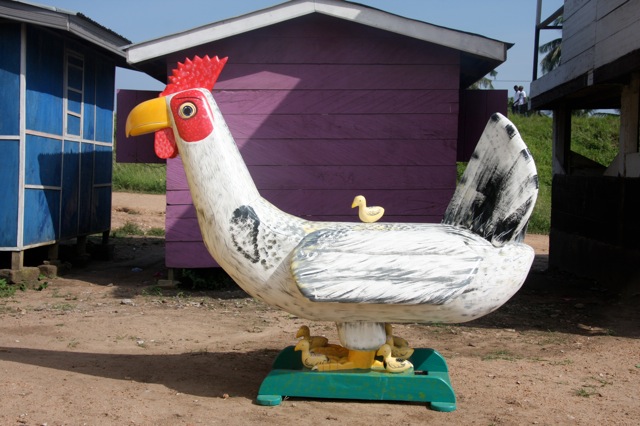 Fantasy coffinsCustom hand-carved burial caskets shaped as animals, tools and symbols in southern Ghana
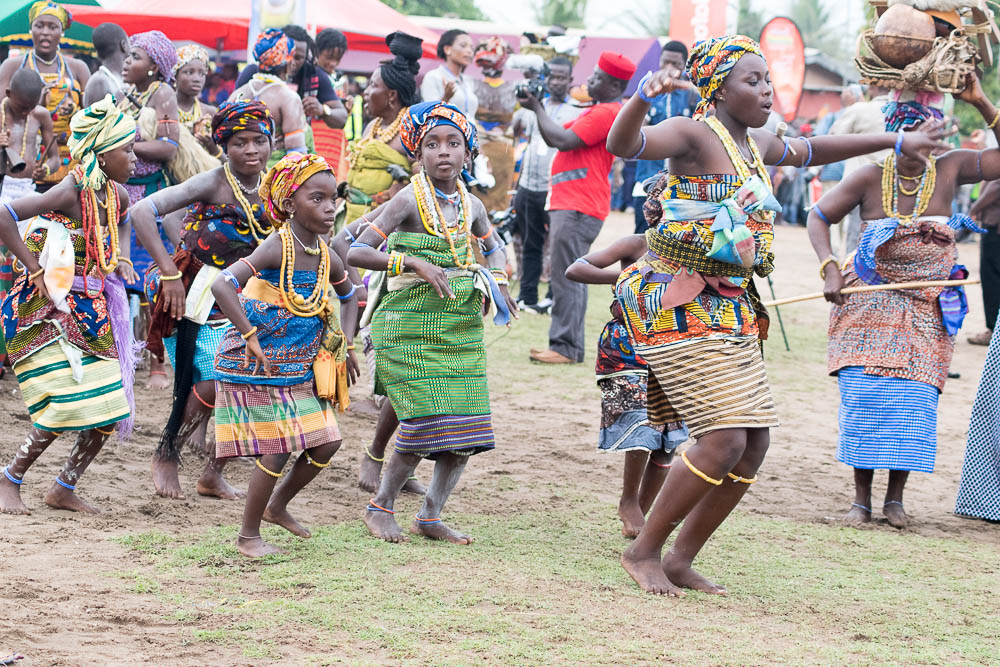 AgbadzaAn Ewe music and dance, born of war songs and kept for funerals, weddings and festivals
 Damba festivalA Ghanaian celebration of royal authority, ancestral memory, music and dance
Good reading and sources
- Adinkra symbols on WikipediaEncyclopedia
- More photos on Wikimedia CommonsPhotos and video
- Wikidata recordOpen data
The facts on this page come from the Wikipedia article "Adinkra symbols", written by its contributors and used under the CC BY-SA 4.0 licence, and from its Wikidata record (CC0). EveryParampara rewrote the text in its own words, with AI assistance, and compares every page with the article to make sure no passage is copied. It may be reused under the same CC BY-SA 4.0 licence with a link back.
It may contain mistakes. Traditions differ from one family, village and community to the next, and the people who keep them know them best. If something is wrong, tell us. Last refreshed 2026-10-05.
More from Ghana
All the traditions of Ghana
🇵🇬 Papua New Guinea and 5 moreShell money
Traditional currency made from cowries, ground clam beads, and carved sea shellsCraft
🇬🇭 Ghana and 2 moreAgbadza
An Ewe music and dance, born of war songs and kept for funerals, weddings and festivalsPerformance
🇬🇭 Accra, GhanaFantasy coffinsAbebuu adekai
Custom hand-carved burial caskets shaped as animals, tools and symbols in southern GhanaRite of passage
🇬🇭 Ghana and 3 moreDamba festivalDamba chuɣu
A Ghanaian celebration of royal authority, ancestral memory, music and danceFestival
The same idea elsewhere
Death and mourning compared 🇨🇳 Puyang, ChinaFeng shui風水
The Chinese spatial practice of aligning homes and graves with natural energyFolklore
🇨🇳 Puyang, ChinaFeng shui風水
The Chinese spatial practice of aligning homes and graves with natural energyFolklore
 🇮🇩 Bali, Indonesia and 5 moreIkat
A resist-dyeing craft from Southeast Asia, where yarns are tied and dyed before weavingCraft
🇮🇩 Bali, Indonesia and 5 moreIkat
A resist-dyeing craft from Southeast Asia, where yarns are tied and dyed before weavingCraft
 🇹🇴 Tonga and 1 moreTaʻovala
A waist mat worn in Tonga for weddings, funerals and formal daysDress
🇹🇴 Tonga and 1 moreTaʻovala
A waist mat worn in Tonga for weddings, funerals and formal daysDress
 🇹🇭 Bangkok, ThailandThai funeral
Buddhist rites in Thailand featuring water blessings, temple chanting and cremation.Rite of passage · Breakfast
🇹🇭 Bangkok, ThailandThai funeral
Buddhist rites in Thailand featuring water blessings, temple chanting and cremation.Rite of passage · Breakfast