Life-cycle ritesSub-Saharan AfricaIndigenous and traditionalChristian
Fantasy coffins
In its own language: Abebuu adekai
Custom hand-carved burial caskets shaped as animals, tools and symbols in southern Ghana
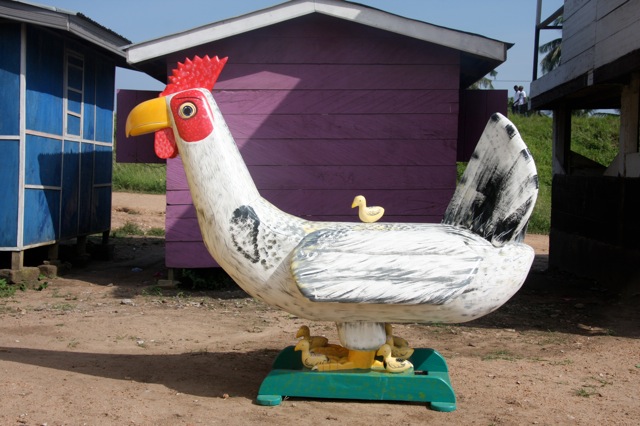
Sculpted and painted by specialized carpenters in southern Ghana, figurative coffins honour the deceased during Ga burial ceremonies. Families commission these custom wooden caskets in the shape of animals, tools, or status symbols to reflect a person's life and ensure their standing among the ancestors.
When is Fantasy coffins kept?
Fantasy coffins is kept on the day of burial following a death.
Fantasy coffins are custom, hand-carved burial caskets crafted by specialized woodworkers in coastal Ghana, most notably among the Ga community. Designed in the likeness of animals, vehicles, tools, and proverbs, each piece celebrates the deceased person's trade, status, or clan heritage. Displayed on the day of burial, these vivid sculptures help send departed relatives into the afterlife, where ancestors continue to watch over and influence the living.
Beliefs and meaning
In Ga religious belief, existence continues in the next realm in the exact same manner as on earth. Deceased ancestors hold immense power, far surpassing the living, and can actively influence their surviving relatives. A person's standing among the ancestors depends partly on the funeral and the exclusivity of the coffin used for burial. Casket designs frequently depict the occupation of the deceased or convey traditional proverbs. Sacred emblems such as stools and swords carry religious and royal significance, reserved solely for individuals of elevated rank. Similarly, animal figures like lions, cockerels, and crabs embody clan totems, which only family heads possess the right to use for their final journey.
Origins and history
The practice evolved from sculpted palanquins used to carry Ga rulers during public events and later used for their interments. Early in the twentieth century, Ga chiefs and priests were the only people entombed in figurative structures. Custom caskets spread more broadly around 1950, becoming embraced by Christian communities and settling into regional funeral rites by about 1960. While local lore often credits Seth Kane Kwei with originating the custom in Teshie, scholars note that woodworkers such as Ataa Oko in La produced figurative palanquins and caskets from about 1945. Over subsequent decades, workshops spread across towns like Nungua, training generations of apprentices who preserved and expanded the craft.
Workshop and craft
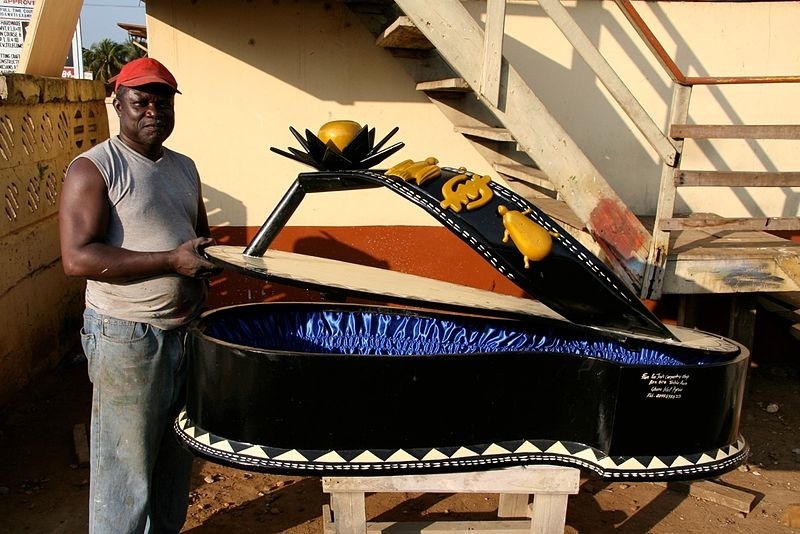
Every coffin is made to order in an artisan workshop. A master carpenter guides one or several apprentices, who handle substantial portions of the construction so multiple commissions can proceed together. Builders rely on basic hand tools without electricity, shaping the body from native wawa timber. Depending on complexity, building a casket takes from two to six weeks, though teams join forces when an urgent funeral deadline approaches. The finishing paintwork takes up to two days, completed by workshop masters or local signboard painters. These painters, famed for commercial cinema posters, collaborate closely with carpenters to select bright pigments and decorative motifs suitable for the deceased.
International recognition
In addition to their funerary role in Ghana, figurative coffins have entered global museums as contemporary sculpture. International attention expanded after works by Kane Kwei and Paa Joe were featured at the 1989 exhibition Les Magiciens de la terre in Paris, followed by major showcases in American and European institutions. Contemporary masters such as Eric Adjetey Anang, Kudjoe Affutu, Eric Kpakpo, and Daniel Mensah have exhibited widely and engaged in international artist residencies. When building items destined for foreign galleries, artisans typically substitute local wawa wood with durable hardwoods like mahogany. This prevents splitting and protects against pest damage in diverse climates.
How Fantasy coffins is kept
When a community member dies, relatives commission a customized casket from a specialized workshop, selecting a design that mirrors the person's status, clan lineage, or life work. Master carpenters and apprentices construct the wooden piece by hand over several weeks, and sign painters apply vibrant coats of paint. On the burial day, the elaborate coffin is presented publicly for the community to admire during funeral ceremonies. The deceased is laid inside the sculpture, and the coffin is finally buried in the earth, escorting the spirit into the ancestor realm.
When and where
This tradition is observed upon the death of an individual. Funerals are scheduled after the passing of a family member, and the casket itself is displayed only on the single day of the burial service before being lowered into the ground.
The custom is rooted in southern Ghana, concentrated within the Greater Accra Region. Workshops and burials are especially prominent in coastal Ga settlements including Teshie, Nungua, and La, with some workshops also operating in the Central Region.
What Fantasy coffins means
For the Ga, a figurative coffin connects the earthly world to the next life. Because existence continues unchanged beyond death, a striking casket honors the deceased and helps secure their social rank among powerful ancestors. The designs express the person's trade, moral proverbs, or sacred lineage, with stool and sword motifs signifying royal authority and animal sculptures representing protective clan totems.


Questions people ask about Fantasy coffins
When is Fantasy coffins kept?
Fantasy coffins is kept on the day of burial following a death.
What is a fantasy coffin?
A fantasy coffin is a functional, hand-carved wooden casket made in southern Ghana. Sculpted in the form of animals, tools, or status symbols, each coffin reflects the profession, clan identity, or social standing of the deceased person for their funeral.
Where is this funeral tradition practiced?
The custom is centered in southern Ghana, particularly among Ga communities in the Greater Accra Region. Major carpentry workshops and burials take place in coastal towns such as Teshie, Nungua, and La.
Why do the Ga people use figurative coffins?
The Ga believe life continues in the spirit realm much like on earth. Because ancestors hold great power over the living, families use exclusive coffins to honor the deceased and secure high social status for them in the afterlife.
Who is allowed to be buried in specific coffin designs?
Certain designs carry strict cultural restrictions. Regalia shapes like swords and stools are reserved for priests and royals, while animal totems such as cockerels, crabs, and lions may only be used for the burial of clan family heads.
See also
 Shell moneyTraditional currency made from cowries, ground clam beads, and carved sea shells
 HomowoA harvest festival of the Ga people in Ghana to remember surviving famine
 Damba festivalA Ghanaian celebration of royal authority, ancestral memory, music and dance
 Fetu AfahyeA harvest festival of cleansing, boat races and royal durbars in Cape Coast, Ghana
Good reading and sources
- Fantasy coffin on WikipediaEncyclopedia
- More photos on Wikimedia CommonsPhotos and video
- Wikidata recordOpen data
The facts on this page come from the Wikipedia article "Fantasy coffin", written by its contributors and used under the CC BY-SA 4.0 licence, and from its Wikidata record (CC0). EveryParampara rewrote the text in its own words, with AI assistance, and compares every page with the article to make sure no passage is copied. It may be reused under the same CC BY-SA 4.0 licence with a link back.
It may contain mistakes. Traditions differ from one family, village and community to the next, and the people who keep them know them best. If something is wrong, tell us. Last refreshed 2026-10-04.
More from Ghana
All the traditions of Ghana 🇬🇭 Odumase Krobo, GhanaDipo
An annual Ghanaian coming-of-age ceremony welcoming Krobo girls into womanhoodRite of passage
🇬🇭 Odumase Krobo, GhanaDipo
An annual Ghanaian coming-of-age ceremony welcoming Krobo girls into womanhoodRite of passage
 🇬🇭 Ghana and 2 moreAgbadza
An Ewe music and dance, born of war songs and kept for funerals, weddings and festivalsPerformance
🇵🇬 Papua New Guinea and 5 moreShell money
Traditional currency made from cowries, ground clam beads, and carved sea shellsCraft
🇬🇭 Ghana and 2 moreAgbadza
An Ewe music and dance, born of war songs and kept for funerals, weddings and festivalsPerformance
🇵🇬 Papua New Guinea and 5 moreShell money
Traditional currency made from cowries, ground clam beads, and carved sea shellsCraft
The same idea elsewhere
Death and mourning compared 🇨🇳 Puyang, ChinaFeng shui風水
The Chinese spatial practice of aligning homes and graves with natural energyFolklore
🇨🇳 Puyang, ChinaFeng shui風水
The Chinese spatial practice of aligning homes and graves with natural energyFolklore
 🇹🇭 Bangkok, ThailandThai funeral
Buddhist rites in Thailand featuring water blessings, temple chanting and cremation.Rite of passage · Breakfast
🇹🇭 Bangkok, ThailandThai funeral
Buddhist rites in Thailand featuring water blessings, temple chanting and cremation.Rite of passage · Breakfast
 🇹🇴 Tonga and 1 moreTaʻovala
A waist mat worn in Tonga for weddings, funerals and formal daysDress
🇹🇴 Tonga and 1 moreTaʻovala
A waist mat worn in Tonga for weddings, funerals and formal daysDress
 🇪🇬 Thebes, EgyptAncient Egyptian funerary practices
Rites for the dead in ancient Egypt: preserving the body, spells and grave goodsRite of passage
🇪🇬 Thebes, EgyptAncient Egyptian funerary practices
Rites for the dead in ancient Egypt: preserving the body, spells and grave goodsRite of passage