Spiritual and religiousSoutheast AsiaIndigenous and traditionalBuddhist
Baci
In its own language: ບາສີ (Lao)
A Lao rite that calls the soul home and ties a thread on the wrist for good luck

Baci is a ceremony from Laos, also kept in Isan and northern Thailand, in which the kwan, or soul parts, are called back to the body. It is held for births, weddings, ordination as a monk, partings, returns and the start of a new year, and it usually takes place in the morning.
When is Baci kept?
Baci is kept on arranged on any day of the year for a particular occasion, normally in the morning before noon.
Baci is a Lao ceremony that gathers the kwan, the soul spirits believed to live in the body, and settles them there again. A thread is knotted on the wrist of the person being honoured, and on the wrists of everyone who came to wish them well. Households hold it for weddings, new babies, ordination, journeys, homecomings and the turning of the year.
What it is
Baci belongs to Satsana Phi, the older Lao system of spirit belief, and it is a rite rather than a festival with a fixed date. Those who keep it hold that a person is made of 32 parts, and that the kwan, or soul spirits, guard each part. When the kwan drift away, illness or misfortune can follow. The ceremony calls them back and settles them in the body again. A senior member of the community leads it, someone who has spent time as a Buddhist monk, and the rite is treated as a national custom in Laos.
Origins and history
People in Laos were holding this ceremony long before Buddhism arrived there, and the rite survived alongside it. Older and newer practices mixed as the two traditions met, so chants in Lao and Pali sit together with calls to Buddhist devas, local deities and spirits. Writers on the subject describe the ceremony as carrying both Hindu and Buddhist elements. It is not only a Lao practice: neighbouring parts of Southeast Asia share the same heritage, and a related way of calling the soul appears among the Ahom in their Rik-khwan rite and in the wider khwan culture of the region.
How it is kept
The family or village prepares a tray, usually silver, with a cone or horn shaped from banana leaf standing at the centre. Elder women of the household or community generally arrange it, dressing it with flowers chosen for their own meanings, and with thread in white silk or cotton fixed to a bamboo pole to look like little flags. Guests gather around the tray. Younger people first show respect to their elders, then each person touches the tray. The officiant recites chants while the kwan are asked to come home. At the end, food and rice wine are shared, followed by music and dancing.
Threads and their meaning
After the chants, a thread is knotted onto the right wrist of the person being blessed, and later onto the wrists of the guests who came to wish them well. Whoever is being tied holds the hand at chest height as a mark of respect. White is the usual colour, and people read it as a wish for calm and accord, for luck and health, and for the warmth that holds a family and a community together. The thread stays on for at least three days and is never cut, and many people prefer to let it fall off by itself. Yellow, red and black threads are also used now: red for courage, yellow for faith, black for a loss.
The marriage legend
Lao marriage custom ties the Baci thread to an old story. According to that legend, matches are settled in heaven under what is called nene, or love karma. In a garden above, every person has a tree whose branches hold the soul of their partner. Those paired trees come down to earth as people, their wrists bound by a cotton thread, and a wind that acts like scissors cuts the thread so that each is born alone. On earth they look for one another, marry, and have the thread tied again in the Baci. If it holds for three days, the marriage is thought fortunate.
How Baci is kept
A senior man or woman leads, someone who has been a monk at some point. Elder women of the house prepare the flower tray. Guests gather round it. The young greet the elders first. Each person touches the tray while the leader chants in Lao and Pali, asking the kwan to come back and calling on devas, local deities and spirits. Then the leader knots a white thread on the right wrist of the person being honoured, and ties threads on the guests too. A meal follows, with rice wine, then music and dance. The threads stay on for at least three days and are left to fall off.
When and where
There is no fixed date. A household chooses the day that suits the event it is marking, so a Baci can fall on almost any day of the year. What the sources do record is the hour: it is normally held in the morning, before noon. The same rite is used for weddings, births, ordination, partings and returns, and for the start of a new year.
Baci is kept across Laos, where it is described as a national custom, and it is strongest in the family and the village. The same ceremony belongs to Isan, the northeastern part of Thailand, and to northern Thailand. It is also practised in Sipsong Panna. Lao people, Isan people and northern Thai people are all named as those who observe it.
What Baci means
For those who keep it, the ceremony is about wholeness. The 32 kwan are gathered back into the body so that the person stands in balance, and the gathering of relatives and neighbours is meant to renew the bond between them. Calling the soul home is also a way of saying that someone matters to a household and a village. The thread on the wrist carries that wish out into the days that follow, and the shared meal and dancing close the ceremony on a note of goodwill.


Questions people ask about Baci
When is Baci kept?
Baci is kept on arranged on any day of the year for a particular occasion, normally in the morning before noon.
What is Baci?
It is a Lao ceremony of the Satsana Phi tradition. It calls the kwan, the soul spirits believed to guard the 32 parts of a person, back to the body, and a white thread is tied on the wrist to hold the good wishes in place. Families hold it for births, weddings, ordination, journeys, returns and the start of a new year.
Who leads the ceremony?
A senior member of the community, usually someone who has been a Buddhist monk at some point. This person recites the chants in a mix of Lao and Pali, invokes Buddhist devas, local deities and spirits, and ties the threads. Elder women of the household or village prepare the flower tray beforehand.
What happens to the thread afterwards?
It stays on the wrist, usually for at least three days, and is not cut. People let it wear through and fall off by itself. A thread that holds for three days is taken as a good sign, and the same period matters in the marriage legend attached to the ceremony.
Where is it kept?
In Laos, where it is a national custom, and in Isan and northern Thailand. Lao people, Isan people and northern Thai people are named as those who practise it, and the ceremony is also found in Sipsong Panna. It has long been shared across parts of Southeast Asia.
See also
 IkatA resist-dyeing craft from Southeast Asia, where yarns are tied and dyed before weavingThai solar calendarThe official solar calendar of Thailand, numbered in the Buddhist Era
 VesakA day to honor the birth, awakening, and passing of the Buddha, kept by Buddhists across Asia.
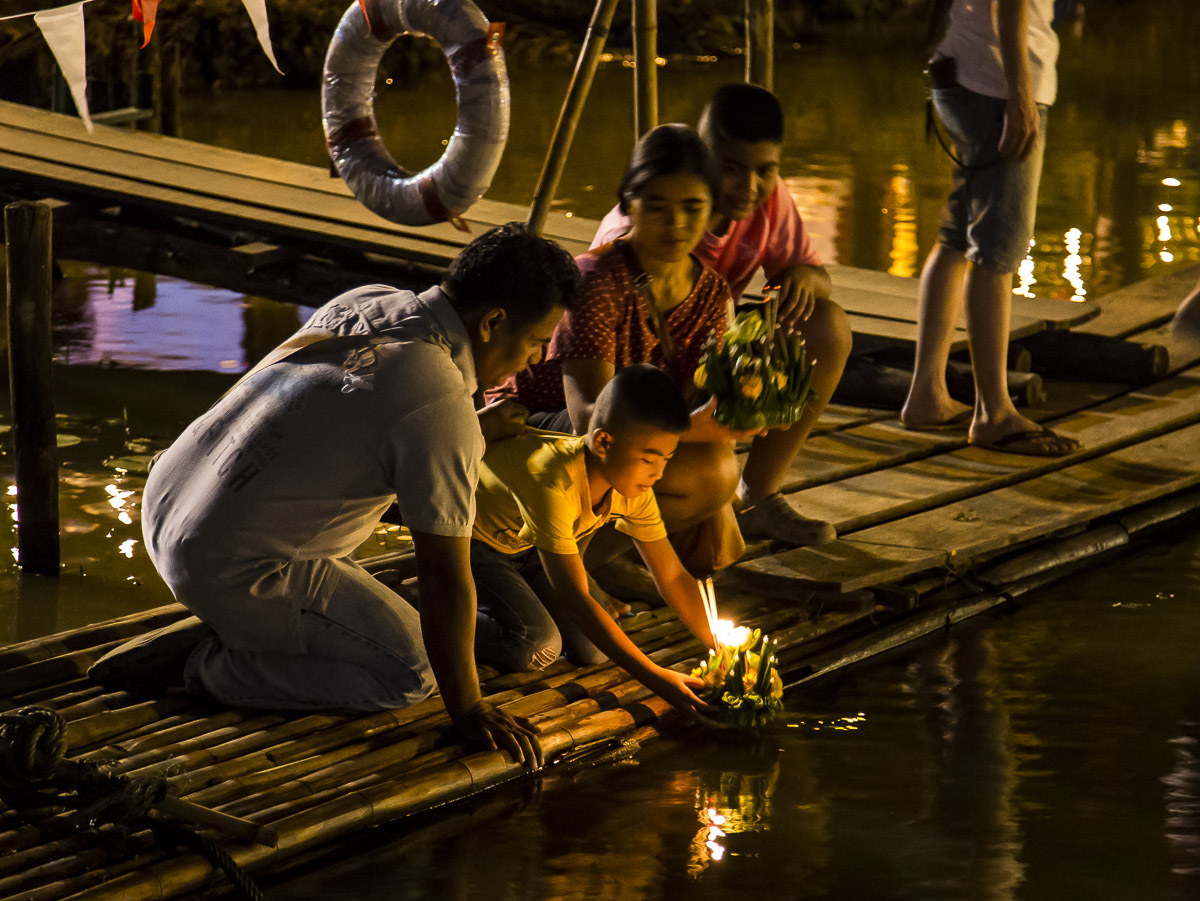 Loy KrathongA Thai festival of floating leaf baskets on rivers to honor water and release negativity.
Good reading and sources
- Encyclopaedia BritannicaArticle
- Individual case studyUNESCO, Heritage listing
- Individual case studyUNESCO, Article
- Baci on WikipediaEncyclopedia
- More photos on Wikimedia CommonsPhotos and video
- Wikidata recordOpen data
The facts on this page come from the Wikipedia article "Baci", written by its contributors and used under the CC BY-SA 4.0 licence, and from its Wikidata record (CC0). EveryParampara rewrote the text in its own words, with AI assistance, and compares every page with the article to make sure no passage is copied. It may be reused under the same CC BY-SA 4.0 licence with a link back.
It may contain mistakes. Traditions differ from one family, village and community to the next, and the people who keep them know them best. If something is wrong, tell us. Last refreshed 2026-10-05.
More from Laos
All the traditions of Laos 🇲🇲 Mandalay, Myanmar and 2 moreSand pagodaသဲပုံစေတီ (Burmese), พระเจดีย์ทราย (Thai)
Temporary sand or mud structures built by Theravada Buddhists to cultivate merit and honor the Buddha.Spiritual
🇲🇲 Mandalay, Myanmar and 2 moreSand pagodaသဲပုံစေတီ (Burmese), พระเจดีย์ทราย (Thai)
Temporary sand or mud structures built by Theravada Buddhists to cultivate merit and honor the Buddha.Spiritual
 🇹🇭 Thailand and 7 moreSpirit house
A small roofed shrine on a pillar, kept in homes and villages across Southeast Asia to honour protective spirits.Spiritual
🇹🇭 Thailand and 7 moreSpirit house
A small roofed shrine on a pillar, kept in homes and villages across Southeast Asia to honour protective spirits.Spiritual
 🇹🇭 Thailand and 5 moreMāgha Pūjāមាឃបូជា
A Buddhist holy day honoring monastic unity, moral guidance and spiritual fellowshipSpiritual · Fasting and breaking the fast
🇹🇭 Thailand and 5 moreMāgha Pūjāមាឃបូជា
A Buddhist holy day honoring monastic unity, moral guidance and spiritual fellowshipSpiritual · Fasting and breaking the fast
 🇹🇭 Thailand and 5 moreKathina
A Buddhist season of offering new robes and gifts to monks after the rains retreatSpiritual
🇹🇭 Thailand and 5 moreKathina
A Buddhist season of offering new robes and gifts to monks after the rains retreatSpiritual
The same idea elsewhere
Weddings compared 🇨🇳 ChinaChinese paper cutting剪紙 / 剪纸 (jiǎnzhǐ)
Chinese cut paper pictures, pasted on windows and doors for luck at New YearCraft
🇨🇳 ChinaChinese paper cutting剪紙 / 剪纸 (jiǎnzhǐ)
Chinese cut paper pictures, pasted on windows and doors for luck at New YearCraft
 🇷🇺 Russia and 5 moreBread and saltхлеб-соль
Bread and salt offered to a guest: a welcome kept from Russia to AlbaniaEtiquette
🇷🇺 Russia and 5 moreBread and saltхлеб-соль
Bread and salt offered to a guest: a welcome kept from Russia to AlbaniaEtiquette
 🇱🇰 Sri LankaKiribathකිරිබත්
Rice cooked in coconut milk, the dish of Sinhalese New Year and family beginningsTable custom · Breakfast
🇱🇰 Sri LankaKiribathකිරිබත්
Rice cooked in coconut milk, the dish of Sinhalese New Year and family beginningsTable custom · Breakfast