Games, sport and playEast Asia
Bo Bing
In its own language: 博餅 (Bóbǐng)
A dice game played at Mid-Autumn, where mooncakes of many sizes are the prizes

Bo Bing is a dice game from southern Fujian, played as part of Mid-Autumn Festival celebrations, the festival also called the Mooncake Festival. Two or more players roll six dice in a wide bowl, and the prizes are mooncakes, so the game is kept by Hokkien families in China, Taiwan and the Chinese Filipino community.
When is Bo Bing marked?
Bo Bing is kept as part of Mid-Autumn Festival, which is on Wednesday, 15 September 2027.
Every autumn, when the Mid-Autumn Festival comes round, people in southern Fujian sit down with six dice and a wide china bowl. They play Bo Bing, and the prizes are mooncakes. The game is easy to follow and noisy to play, and Hokkien families have carried it from the towns of Fujian to Taiwan and to Chinese communities in the Philippines.
What it is
Bo Bing is a folk dice game with roots in southern Fujian. It asks for very little: six dice, a bowl with a wide mouth, and a table of people. The bowl is often china, and the clatter of dice against it is part of the fun. Players take turns, and every roll matches a named place on a prize list. The game belongs to the Mid-Autumn Festival, which many people also call the Mooncake Festival, so it turns up wherever that festival is kept. China lists Bo Bing as a national-level intangible cultural heritage, a status granted in 2008.
Origins and history
Tradition places the game's beginnings in the 1600s and connects them with Koxinga, who led Southern Ming forces, and with Hong Xu, an officer beneath him. The troops were camped at Amoy, today's Xiamen, getting ready to besiege Fort Zeelandia and take Formosa from the Dutch, who had held it since 1624. The men were far from home at Mid-Autumn, and the game is said to have been a way of lifting their spirits. It caught on around Amoy and settled into ordinary life as a folk game.
Prizes and mooncakes
The old prize list is all mooncakes, and it is built on halving. A full set runs to 63 cakes. Thirty-two are the smallest size, then comes half that number of the next size up, and the count keeps shrinking until a single large cake is left, the champion cake, or Chiōng-gôan-piáⁿ. The Hokkien name for the game means gambling for cakes, which says plainly what is at stake. In mainland China the rules are often printed on mooncake packaging, and prizes now include cash or goods for the home. Chinese Filipino players often play for money and household items, with toys, school supplies and snacks for younger players.
Big throws and chasing
The prize names are ranked, and the biggest ones draw the loudest reaction. They include 状元, the champion roll, along with 对堂 and 三红. A player who rolls six fours makes the ultimate throw and collects every mooncake from sixth place up to first, even the ones already handed out. A group may leave that rule out so that each person wins something. Large prizes can be chased: once a set of cakes has been taken completely, another player who rolls that set's combination may claim it from whoever holds it. The champion cake, being a single prize, changes hands only for a higher champion roll.
Luck and ritual
Many players treat the game as more than chance. Some keep small rituals that they believe bring luck and a good year ahead. The person who takes the champion prize sometimes puts on a champion hat, a sign of success. That same winner may be asked to buy the mooncakes for the next year's game, so the good fortune is spread around. Players also speak of rolling with one hand or two, and of calling out "Chiong Wan" as the dice land. None of this is fixed law; it varies from table to table.
How Bo Bing is kept
Usually two or more people play, and a bowl plus six dice is all that is needed. The oldest or most senior player settles who begins by rolling two dice and counting clockwise around the group until that total is reached. From there, each person in turn rolls the six dice in the bowl, and the combination decides the prize. Play moves clockwise, one throw after another, until nothing is left to win. If a die leaves the bowl or bounces out, that turn is void and the player also loses the next turn.
When and where
The game has no separate date of its own. It belongs to the Mid-Autumn Festival, also called the Mooncake Festival, and it is played when that festival comes round, at the gatherings and meals that go with it. The festival sets the time; the game simply follows it.
Bo Bing comes from southern Fujian, and it is best known in and around Amoy, now called Xiamen. It spread through mainland China, and it is also played in Taiwan. In the Philippines it has a strong home among Chinese Filipinos, who know it as the Mooncake Festival Dice Game or Pua Tiong Chiu.
What Bo Bing means
For the people who play it, the game carries the feeling of Mid-Autumn: being together, and remembering those who are far away. Its history is told as a story about homesick soldiers, so the dice and the shared cakes stand for company and comfort. The champion hat, and the winner's gift of next year's mooncakes, turn a lucky roll into something passed on to others.

Days Bo Bing is marked
Questions people ask about Bo Bing
When is Bo Bing marked?
Bo Bing is kept as part of Mid-Autumn Festival, which is on Wednesday, 15 September 2027.
What is Bo Bing?
Bo Bing is a dice game from southern Fujian, played at the Mid-Autumn Festival, which is also called the Mooncake Festival. Six dice and a wide bowl are all it needs, and the prizes are mooncakes. China recognises it as a national-level intangible cultural heritage.
Where is it played?
Its home is southern Fujian, and it is best known around Amoy, now Xiamen. It is also played in mainland China and in Taiwan, and it has a long place among Chinese Filipinos in the Philippines, where it is often called Pua Tiong Chiu.
What can a player win?
Traditionally a set of 63 mooncakes, graded by size, from 32 of the smallest up to one large champion cake. Many groups now give other prizes: money or useful goods for adults, and toys, school supplies or snacks for younger players. In the Philippines, mooncakes may still appear among the prizes.
What happens if someone rolls six fours?
That is the ultimate throw. The player takes all the remaining mooncakes from sixth place to first, including any that have already been given out. Some groups agree to leave this rule aside, so that everyone ends up with a prize.
See also
 PunnukA tug of war in a river at harvest's end, kept by Tuwali-speaking villages in Ifugao
 OvooA stone cairn on a peak or pass, circled by travellers and honoured in sky worship
 Water lanternSmall lamps floated on water to honour the dead and ask for good fortune
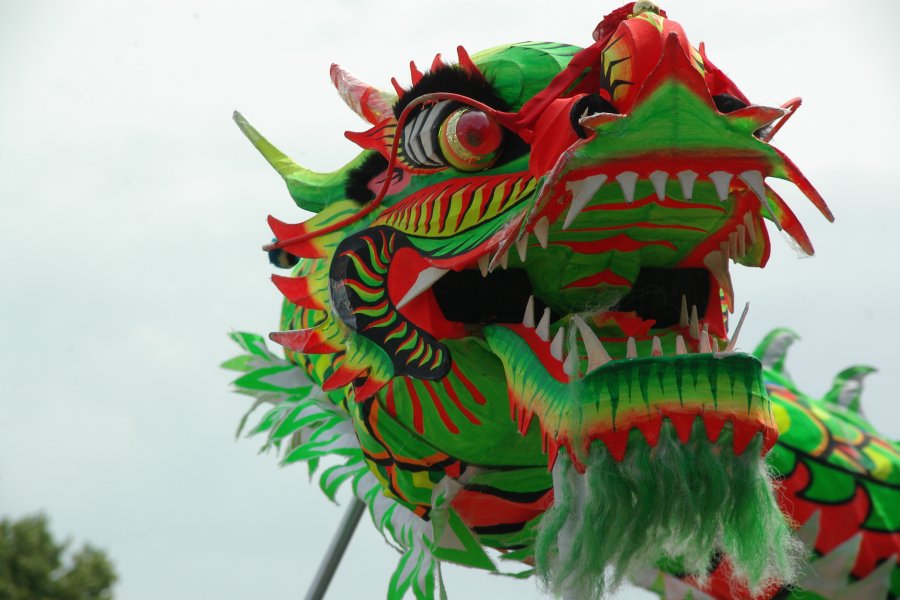 Dragon danceA long dragon puppet on poles, danced by a team at Chinese New Year and other festivals
Good reading and sources
- Bo Bing (game) on WikipediaEncyclopedia
- More photos on Wikimedia CommonsPhotos and video
- Wikidata recordOpen data
The facts on this page come from the Wikipedia article "Bo Bing (game)", written by its contributors and used under the CC BY-SA 4.0 licence, and from its Wikidata record (CC0). EveryParampara rewrote the text in its own words, with AI assistance, and compares every page with the article to make sure no passage is copied. It may be reused under the same CC BY-SA 4.0 licence with a link back.
It may contain mistakes. Traditions differ from one family, village and community to the next, and the people who keep them know them best. If something is wrong, tell us. Last refreshed 2026-10-11.
More from China
All the traditions of China 🇲🇳 Ulaanbaatar, Mongolia and 2 moreMongolian wrestlingBökh
A traditional folk wrestling style of the Mongols, kept as a central part of Naadam festivals across Mongolia and neighbGame
🇲🇳 Ulaanbaatar, Mongolia and 2 moreMongolian wrestlingBökh
A traditional folk wrestling style of the Mongols, kept as a central part of Naadam festivals across Mongolia and neighbGame
 🇨🇳 China and 2 moreCuju蹴鞠
An ancient Chinese kicking game played without hands using a stuffed or air-filled ballGame
🇨🇳 China and 2 moreCuju蹴鞠
An ancient Chinese kicking game played without hands using a stuffed or air-filled ballGame
 🇲🇳 Ölgii, Mongolia and 3 moreHunting with eagles
The Central Asian tradition of hunting foxes and hares from horseback with golden eagles.Game
🇲🇳 Ölgii, Mongolia and 3 moreHunting with eagles
The Central Asian tradition of hunting foxes and hares from horseback with golden eagles.Game
 🇨🇳 China and 1 moreXiangqi象棋
A two-player game of armies and cannons, played on the points of a nine-by-ten boardGame
🇨🇳 China and 1 moreXiangqi象棋
A two-player game of armies and cannons, played on the points of a nine-by-ten boardGame
The same idea elsewhere
Harvest and thanksgiving compared 🇮🇪 Galway, Ireland and 1 moreBrigid's crossCros Bhríde
A cross of woven rushes or straw, made for Saint Brigid's Day on the first of FebruaryCraft
🇮🇪 Galway, Ireland and 1 moreBrigid's crossCros Bhríde
A cross of woven rushes or straw, made for Saint Brigid's Day on the first of FebruaryCraft
 🇪🇪 EstoniaJaanipäev
Estonia's midsummer night of bonfires, song and fortune-telling, on 23 and 24 JuneFestival
🇪🇪 EstoniaJaanipäev
Estonia's midsummer night of bonfires, song and fortune-telling, on 23 and 24 JuneFestival
 🇮🇪 Ireland and 2 moreJack-o'-lantern
A carved pumpkin lantern lit with a candle to brighten and protect Halloween nightsFolklore
🇮🇪 Ireland and 2 moreJack-o'-lantern
A carved pumpkin lantern lit with a candle to brighten and protect Halloween nightsFolklore
 🇨🇱 ChileNgillatun
A communal Mapuche rite of prayer, sacrifice and dance to maintain cosmic balanceSpiritual
🇨🇱 ChileNgillatun
A communal Mapuche rite of prayer, sacrifice and dance to maintain cosmic balanceSpiritual