Festivals and celebrationsLatin America and the CaribbeanChristianIndigenous and traditional
Carnival of Oruro
In its own language: El carnaval de Oruro
A Bolivian festival of masked pilgrimage dances honoring the Virgin of the Mineshaft

Held in the highland city of Oruro, Bolivia, this ten-day festival blends ancient Andean spirituality with Catholic devotion before Lent. Tens of thousands of dancers and musicians parade across four kilometres to reach the shrine of the Virgin of the Mineshaft.
When is Carnival of Oruro marked?
Carnival of Oruro is kept as part of Candlemas, which is on Tuesday, 2 February 2027.
The Carnival of Oruro is an annual religious festival in the Bolivian Altiplano, taking place before the Christian season of Lent. It brings together Catholic veneration of the Virgin of the Mineshaft with ancient Andean reverence for sacred landscapes and protective spirits. For ten days, tens of thousands of masked dancers and brass band musicians journey along a four-kilometre route to reach the sanctuary of the tunnel.
Origins and sacred roots
Ancient Jururu served as a sacred Andean pilgrimage destination long before Spanish rule. Local Urus honoured protective deities such as the condor, toad, snake, and lizard. When Spanish authorities banned traditional Itu rites during the seventeenth century, the Uru people preserved their customs by shielding indigenous beliefs under Catholic saint days, especially Candlemas. According to local lore, an image of Mary appeared in a silver mine during 1756. This event deepened devotion to the Virgin of the Mineshaft, leading to a blended tradition that pairs Christian figures with Pachamama and the subterranean spirit Tio Supay.
Music and regional dances
Choreographed movement and brass music form the centre of the celebration. Around forty-eight dance troupes participate across the festival. The premier performance is the Diablada, also called the Llama llama, where dancers portray devils in an elaborate confrontation between good and evil. Other regional styles include the tinku, llamerada, caporales, morenada, and saya. Over twenty-eight thousand dancers and ten thousand musicians in roughly one hundred and fifty brass bands travel a four-kilometre path through the streets, finishing at the Church of the Mineshaft.
Parades and sacred plays
Festivities open with greetings to the Virgin, accompanied by brass bands competing inside the Pie de Gallo grotto. Devotees visit geological sites honoring the sacred condor, toad, snake, and ants before and after the central weekend. The major Saturday pilgrimage continues across three days and nights. At its conclusion, performers stage two traditional mystery plays. One drama retells the Spanish conquest, while the other enacts Archangel Michael conquering the devil and the seven deadly sins, a performance introduced by Catholic clergy in 1818.
How Carnival of Oruro is kept
The celebration begins with rites for the Virgin of the Mineshaft and a brass band competition at the Pie de Gallo grotto. Before the central weekend, participants visit a rock formation honouring the sacred condor. On Saturday, forty-eight folk dance fraternities begin a three-day, three-night parade covering four kilometres to the shrine. Over twenty-eight thousand dancers perform styles like the Diablada accompanied by marching bands. The procession ends with two mystery plays staging the Spanish conquest and Archangel Michael defeating the devil. Later days include visits to sacred sites dedicated to the snake, toad, and ants.
When and where
The festival runs for ten days each year, starting on the Friday before Ash Wednesday and concluding at noon on Ash Wednesday. It is tied to the Christian liturgical calendar fifty-five days before Easter, leading up to the fasting period of Lent, and also coincides with early February Candlemas observances.
The carnival is celebrated in the city of Oruro, located in the high Altiplano region of Bolivia. Main events centre on the four-kilometre parade route leading directly to the Santuario del Socavon, also known as the Church of the Mineshaft.
What Carnival of Oruro means
The festival represents a syncretic union of Andean cosmology and Catholic teaching. Indigenous reverence for Earth and mountain spirits merged with devotion to the Virgin Mary, known as the Virgin of the Mineshaft, while the Christian devil became linked with the Andean spirit Tio Supay. Sacred dances and mystery plays dramatise battles between good and evil alongside historical memories of the Spanish conquest.


Days Carnival of Oruro is marked
Questions people ask about Carnival of Oruro
When is Carnival of Oruro marked?
Carnival of Oruro is kept as part of Candlemas, which is on Tuesday, 2 February 2027.
What is the Carnival of Oruro?
It is an annual ten-day Bolivian festival that merges indigenous Andean pilgrimage traditions with Catholic devotion to the Virgin of the Mineshaft, celebrated through elaborate masked dances, marching bands, and religious plays.
Where and when is the festival held?
It takes place in the city of Oruro, Bolivia, during the ten days leading up to Ash Wednesday before the Christian season of Lent, usually falling in February.
What is the Diablada?
The Diablada, or dance of the devils, is the main traditional dance of the carnival. It depicts a struggle between good and evil, featuring dancers in devil masks confronting Archangel Michael.
Why are Andean animal deities honoured during the carnival?
Before Spanish rule, Oruro was a sacred pilgrimage site dedicated to protective spirits. Today, participants still visit natural formations representing the condor, snake, toad, and ants alongside Catholic rituals.
See also
 Christmas EveThe evening before Christmas, marked by church services, family meals, and gift preparations across Christian cultures.
 NavaratriA nine-night Hindu festival honoring the goddess Durga and her nine forms through prayer, fasting, and dance.
 Mardi GrasA festive day of parades and rich foods marking the final celebration before the Christian fasting season of Lent begins
 St. Martin's DayA November feast of lantern walks, bonfires, roast goose and new wine
Good reading and sources
- Carnaval de Oruro on WikipediaEncyclopedia
- More photos on Wikimedia CommonsPhotos and video
- Wikidata recordOpen data
The facts on this page come from the Wikipedia article "Carnaval de Oruro", written by its contributors and used under the CC BY-SA 4.0 licence, and from its Wikidata record (CC0). EveryParampara rewrote the text in its own words, with AI assistance, and compares every page with the article to make sure no passage is copied. It may be reused under the same CC BY-SA 4.0 licence with a link back.
It may contain mistakes. Traditions differ from one family, village and community to the next, and the people who keep them know them best. If something is wrong, tell us. Last refreshed 2026-10-04.
More from Bolivia
All the traditions of Bolivia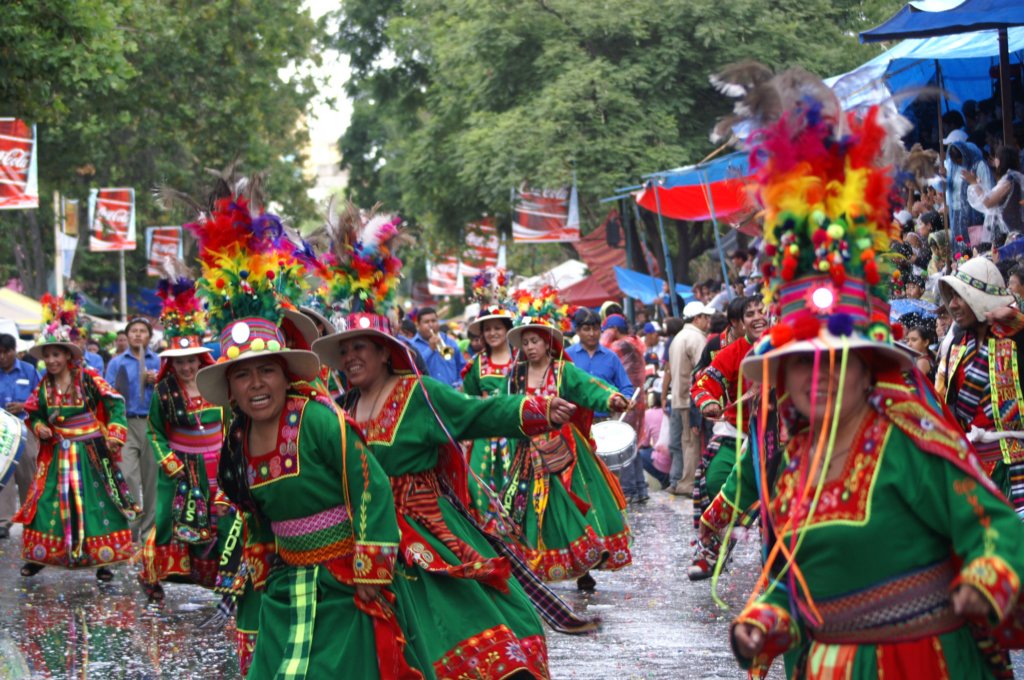 🇧🇴 Potosí, BoliviaTinku
A ritual combat and dance from northern Potosí, Bolivia, honoring Pachamama through ceremonial fighting and performance.Festival
🇧🇴 Potosí, BoliviaTinku
A ritual combat and dance from northern Potosí, Bolivia, honoring Pachamama through ceremonial fighting and performance.Festival
 🇧🇴 La Paz, Bolivia and 1 moreAlasitasFeria de la Alasita
A month-long Bolivian fair where people exchange miniatures to invite good fortuneFestival
🇧🇴 La Paz, Bolivia and 1 moreAlasitasFeria de la Alasita
A month-long Bolivian fair where people exchange miniatures to invite good fortuneFestival
 🇧🇴 San Ignacio de Moxos, BoliviaIchapekene Piesta
A four-day festival of dance, feathers and procession in San Ignacio de Moxos, BoliviaFestival
🇧🇴 San Ignacio de Moxos, BoliviaIchapekene Piesta
A four-day festival of dance, feathers and procession in San Ignacio de Moxos, BoliviaFestival
 🇵🇾 Ypacaraí, Paraguay and 5 moreFestival of the Lake YpacaraíFestival del Lago Ypacaraí
A Paraguayan folk festival celebrating national music, dance and poetry at the shores of Lake Ypacaraí.Festival
🇵🇾 Ypacaraí, Paraguay and 5 moreFestival of the Lake YpacaraíFestival del Lago Ypacaraí
A Paraguayan folk festival celebrating national music, dance and poetry at the shores of Lake Ypacaraí.Festival
The same idea elsewhere
Pilgrimage compared
🇵🇱 Poland and 5 moreChristmas Eve
The evening before Christmas, marked by church services, family meals, and gift preparations across Christian cultures.Festival · Dinner
 🇰🇷 Seoul, South KoreaTemplestay템플스테이
A program that invites visitors to live in South Korean Buddhist temples and join the daily routines of monastic life.Spiritual · Dinner
🇰🇷 Seoul, South KoreaTemplestay템플스테이
A program that invites visitors to live in South Korean Buddhist temples and join the daily routines of monastic life.Spiritual · Dinner
 🇵🇭 Marinduque, PhilippinesMoriones Festival
A Holy Week reenactment in Marinduque where masked participants search for the Roman centurion Longinus.Festival
🇵🇭 Marinduque, PhilippinesMoriones Festival
A Holy Week reenactment in Marinduque where masked participants search for the Roman centurion Longinus.Festival
 🇵🇭 Manila, Philippines and 5 moreNovena
A nine-day Christian prayer tradition for petitions, feasts, or mourning.Spiritual
🇵🇭 Manila, Philippines and 5 moreNovena
A nine-day Christian prayer tradition for petitions, feasts, or mourning.Spiritual