Festivals and celebrationsLatin America and the CaribbeanChristianIndigenous and traditional
Ichapekene Piesta
A four-day festival of dance, feathers and procession in San Ignacio de Moxos, Bolivia

Ichapekene Piesta is the biggest festival of San Ignacio de Moxos, a town in Bolivia's Beni Department, and it honours the town's patron saint, Ignatius of Loyola. Kept from 30 July to 2 August, with preparations starting in May, it blends the traditions of the Mojeño people with the Catholicism of the Jesuit missions, and UNESCO listed it in 2012.
When is Ichapekene Piesta kept?
Ichapekene Piesta is kept every year from 30 July to 2 August, with celebrations opening in May.
Every year the Bolivian town of San Ignacio de Moxos holds Ichapekene Piesta, its largest festival. It honours Ignatius of Loyola, the town's patron saint, and its official days fall between 30 July and 2 August. Preparations start much earlier, in May. What makes it distinctive is the meeting of two worlds: the Mojeño traditions of the region and the Catholicism brought by Jesuit missionaries.
What it is
Ichapekene Piesta is a yearly festival held in San Ignacio de Moxos, a town in Bolivia's Beni Department. It is the biggest celebration the town holds, and it centres on Ignatius of Loyola, its patron saint. The official programme lasts four days, from 30 July to 2 August. UNESCO placed it on the Representative List of the Intangible Cultural Heritage of Humanity in December 2012. The event is not only a church occasion. It belongs to the whole town, and it is a moment when Mojeño identity and Catholic devotion are expressed side by side, in the streets as much as in the church.
Origins and history
The festival grew out of the Jesuit missions of Moxos, where Catholic teaching met the culture of the Mojeño people. Missionaries worked in this part of the Bolivian lowlands, and the result was a religious life in which the two traditions fused rather than stayed apart. Ichapekene Piesta is often called syncretic for that reason: Mojeño practice and Jesuit evangelism both shape it. The town takes Ignatius of Loyola, founder of the Society of Jesus, as its patron. Recognition came from UNESCO in 2012, at the committee's seventh session, and it brought the festival attention far beyond Bolivia.
The Machateros dance
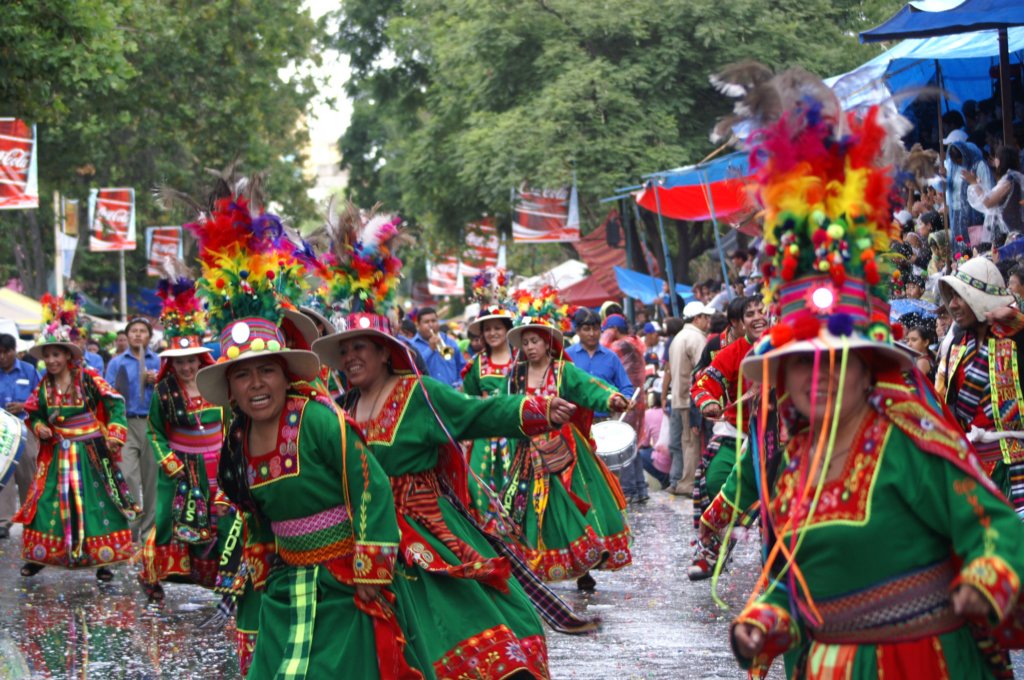
The best known part of the festival is a dance performed by men known as Machateros. In the indigenous language they are called Chipiperono. They wear broad headdresses trimmed with feathers and carry wooden machetes as they dance. Feathers are thought to call on the spirit of the bird, and through the bird on the sun, so these dancers are sometimes described as warriors of the sun. Others read the plumage and the solar imagery as a sign of Jesus rising from death and going up to the heavens. Either way the dance is an act of devotion, and it matters to the whole community.
Nature and procession
Respect for the natural world runs through the whole celebration. A procession is part of it, and many participants wear animal masks and costumes, so the birds and animals of the region are present in the streets beside the dancers. The festival is understood as a way of giving thanks and asking for protection. Between 30 July and 2 August the town fills with religious celebrations of several kinds, held by day and at night. Visitors see a town honouring both its faith and its place in the lowlands.
How Ichapekene Piesta is kept
Planning and celebration begin months ahead. Fireworks and worship songs start in May, and through July the town holds events by day and night. The official programme runs for four days, 30 July to 2 August. Dance groups, including the Machateros with their feather headdresses, move through the streets and into the church. A procession of people in animal masks and other costumes is part of the event. Religious observances of several kinds fill the days. Residents, visiting dancers and guests all take part, and the parish sits at the centre of it.
When and where
The festival is annual and its official days run from 30 July to 2 August. Earlier celebrations begin in May, and daily and nightly events follow through July. The four-day programme is the peak of a longer season of celebration rather than its whole length.
It is kept in San Ignacio de Moxos, a town in Bolivia's Beni Department, in the lowlands of the country. The festival is the largest celebration held in the town, and the parish church is at its centre. The tradition belongs to the Mojeño people of this mission town, and dance groups from the area take part.
What Ichapekene Piesta means
For those who keep it, the festival is a statement of identity as much as a religious duty. The feathers and the sun connect the dancer to the natural world, which is honoured throughout the celebration. Catholics in the town also see in the same images a sign of the resurrection and of Christ returning to the heavens. Because the Mojeño and Jesuit strands are woven together, taking part is a way of belonging to both at once, and of handing the tradition to the next generation.
Questions people ask about Ichapekene Piesta
When is Ichapekene Piesta kept?
Ichapekene Piesta is kept every year from 30 July to 2 August, with celebrations opening in May.
What is Ichapekene Piesta?
It is a yearly festival in San Ignacio de Moxos, Bolivia, and the largest celebration the town holds. It honours Ignatius of Loyola, the town's patron saint, and UNESCO has listed it as Intangible Cultural Heritage of Humanity since 2012.
Who are the Machateros?
They are the men who dance with wooden machetes while wearing wide headdresses decorated with feathers. The indigenous language calls them Chipiperono. Their feathers are believed to invoke the spirit of the bird, and through it the sun, so they are sometimes called sun warriors.
Where is it held?
In San Ignacio de Moxos, a town in the Beni Department of Bolivia. The parish church and the streets of the town are where the events take place, and the festival is the largest one held there.
Why is it called syncretic?
Because two traditions meet in it. The indigenous Mojeño culture of the region and the Catholicism taught in the Jesuit missions of Moxos both shape how the festival is kept, and they cannot be separated from one another.
See also
 TinkuA ritual combat and dance from northern Potosí, Bolivia, honoring Pachamama through ceremonial fighting and performance.
 Carnival of OruroA Bolivian festival of masked pilgrimage dances honoring the Virgin of the Mineshaft
 AlasitasA month-long Bolivian fair where people exchange miniatures to invite good fortune
 IntiThe Inca sun deity, honoured with temples, offerings and the June festival Inti Raymi
Good reading and sources
- Ichapekene Piesta, the biggest festival of San Ignacio de MoxosUNESCO, Heritage listing
- Ichapekene Piesta, the biggest festival of San Ignacio de MoxosUNESCO, Article
- Ichapekene Piesta on WikipediaEncyclopedia
- More photos on Wikimedia CommonsPhotos and video
- Wikidata recordOpen data
The facts on this page come from the Wikipedia article "Ichapekene Piesta", written by its contributors and used under the CC BY-SA 4.0 licence, and from its Wikidata record (CC0). EveryParampara rewrote the text in its own words, with AI assistance, and compares every page with the article to make sure no passage is copied. It may be reused under the same CC BY-SA 4.0 licence with a link back.
It may contain mistakes. Traditions differ from one family, village and community to the next, and the people who keep them know them best. If something is wrong, tell us. Last refreshed 2026-10-05.
More from Bolivia
All the traditions of Bolivia
🇧🇴 Potosí, BoliviaTinku
A ritual combat and dance from northern Potosí, Bolivia, honoring Pachamama through ceremonial fighting and performance.Festival
🇧🇴 Oruro, BoliviaCarnival of OruroEl carnaval de Oruro
A Bolivian festival of masked pilgrimage dances honoring the Virgin of the MineshaftFestival
🇧🇴 La Paz, Bolivia and 1 moreAlasitasFeria de la Alasita
A month-long Bolivian fair where people exchange miniatures to invite good fortuneFestival
 🇵🇾 Ypacaraí, Paraguay and 5 moreFestival of the Lake YpacaraíFestival del Lago Ypacaraí
A Paraguayan folk festival celebrating national music, dance and poetry at the shores of Lake Ypacaraí.Festival
🇵🇾 Ypacaraí, Paraguay and 5 moreFestival of the Lake YpacaraíFestival del Lago Ypacaraí
A Paraguayan folk festival celebrating national music, dance and poetry at the shores of Lake Ypacaraí.Festival
The same idea elsewhere
All of this kind 🇮🇹 Rome, Italy and 4 moreChristmas
A festival of Jesus's birth, kept on 25 December with gifts, lights and shared mealsFestival
🇮🇹 Rome, Italy and 4 moreChristmas
A festival of Jesus's birth, kept on 25 December with gifts, lights and shared mealsFestival
 🇮🇪 Ireland and 5 moreHalloween
An annual observance on 31 October marking the eve of All Saints' Day, rooted in Christian tradition and Celtic heritageFestival · Sweets given and shared
🇮🇪 Ireland and 5 moreHalloween
An annual observance on 31 October marking the eve of All Saints' Day, rooted in Christian tradition and Celtic heritageFestival · Sweets given and shared
 🇬🇧 United Kingdom and 4 moreValentine's Day
A Christian feast day and cultural celebration of love kept on February 14 in many countries.Festival
🇬🇧 United Kingdom and 4 moreValentine's Day
A Christian feast day and cultural celebration of love kept on February 14 in many countries.Festival
 🇹🇷 Turkey and 5 moreEid al-Fitrعيد الفطر
The feast that ends Ramadan, opened with morning prayers, sweets and visits homeFestival · Feasts and festival meals
🇹🇷 Turkey and 5 moreEid al-Fitrعيد الفطر
The feast that ends Ramadan, opened with morning prayers, sweets and visits homeFestival · Feasts and festival meals