Dress and adornmentSouth AsiaHinduBuddhist
Daura-Suruwal
In its own language: दौरा सुरुवाल
The traditional Nepali male attire of a wrap shirt, tapered trousers, and a coat.

Daura-Suruwal is the traditional national clothing worn by men in Nepal and Nepali communities in Darjeeling. The ensemble combines a side-tying high-collar tunic with tapered trousers, often layered under a western-style tailored jacket or a waistcoat.
Daura-Suruwal is the traditional national attire for Nepali men. Rooted in Himalayan regional dress and influenced by royal diplomacy, the outfit pairs an asymmetrical tied tunic with roomy, tapered trousers. Today, men wear it across Nepal and in diaspora communities such as Darjeeling for formal occasions, civic ceremonies, and daily life, reflecting both cultural identity and spiritual symbolism.
Structure of the garments
The upper piece, known as the daura, is a variant of the kurta that fastens across the chest with fabric cords rather than buttons. It features five pleats along with a high, closed collar. Underneath, the suruwal forms the lower half. These trousers remain loose and comfortable around the waist and hips before narrowing down the calf to fit snugly at the ankles, resembling styles from western India. To complete the modern look, wearers often layer a fitted waistcoat or a formal suit coat over the tunic.
Historical path and royal additions
Scholars trace the earliest forms of this attire along historic trade paths moving east from the Hindu Kush through Tajikistan, Afghanistan, and Kashmir. Over time, the style took firm root in Nepal. In the nineteenth century, political leader Janga Bahadur Rana introduced a tailored jacket to the ensemble after receiving a coat as a present from the British monarch. Later in the same century, Bir Shamsher Jang Bahadur Rana traveled unofficially to Britain in the complete outfit, helping secure its lasting status across Nepal.
Sacred symbolism and numbers
Every element of the tunic carries symbolic weight drawn from Hindu and Buddhist beliefs. The eight fastening cords represent the divine mother figures known as the Astamatrika, matching the auspicious nature of the number eight in Nepali folklore. These cords honor deities including Kumari, Mahalaxmi, and Brahmayani. Furthermore, the five fabric pleats represent the Pancha Buddha or the Pancha Ratna jewels, while the snug, high neckline pays tribute to the snake encircling Lord Shiva.
How Daura-Suruwal is kept
Men begin by putting on the suruwal trousers, adjusting them so they drape loosely at the thighs while gripping closely at the lower calves and ankles. Next, the daura shirt is slipped on, pulling the left and right panels across the chest. The wearer secures the garment using the eight dedicated fabric ties. Finally, a structured waistcoat or tailored coat is layered over the tunic. This combination is commonly donned by men across Nepal and nearby regions for official functions, cultural gatherings, and everyday affairs.
When and where
The outfit is worn throughout Nepal as the established national costume for men. It is also widely maintained by people of Nepali heritage residing across the border in Darjeeling, India.
What Daura-Suruwal means
The garment brings together spiritual iconography. Its eight fastening cords evoke the eight protective Astamatrika mother goddesses and the auspiciousness of the number eight. The five structural pleats invoke either the five Buddhas or the five sacred gems, while the band collar represents the divine serpent wrapped around Lord Shiva.
Questions people ask about Daura-Suruwal
What is Daura-Suruwal?
It is the traditional national outfit worn by men in Nepal. The ensemble combines a side-fastening wrap shirt, fitted ankle-tapered trousers, and a tailored coat or waistcoat.
Where is this traditional attire worn?
The outfit is worn throughout Nepal as a national dress. It is also popular in the Indian region of Darjeeling among people of Nepalese descent.
Why does the shirt have eight ties?
In Nepali belief, eight is an auspicious number. The eight ties denote the Astamatrika goddesses, including deities such as Mahalaxmi, Kumari, and Brahmayani.
How did the coat become part of the outfit?
In the nineteenth century, Prime Minister Jang Bahadur Rana received a coat as a gift from the Queen of the United Kingdom and began wearing it over the traditional shirt and trousers.
See also
 PaithaniA handwoven silk sari from Maharashtra, with a squared border and a peacock pallu
 JambiyaA short curved dagger worn at the waist by Yemeni men, its handle a sign of status
 SherwaniA long buttoned coat for men, worn at weddings and state occasions in South Asia
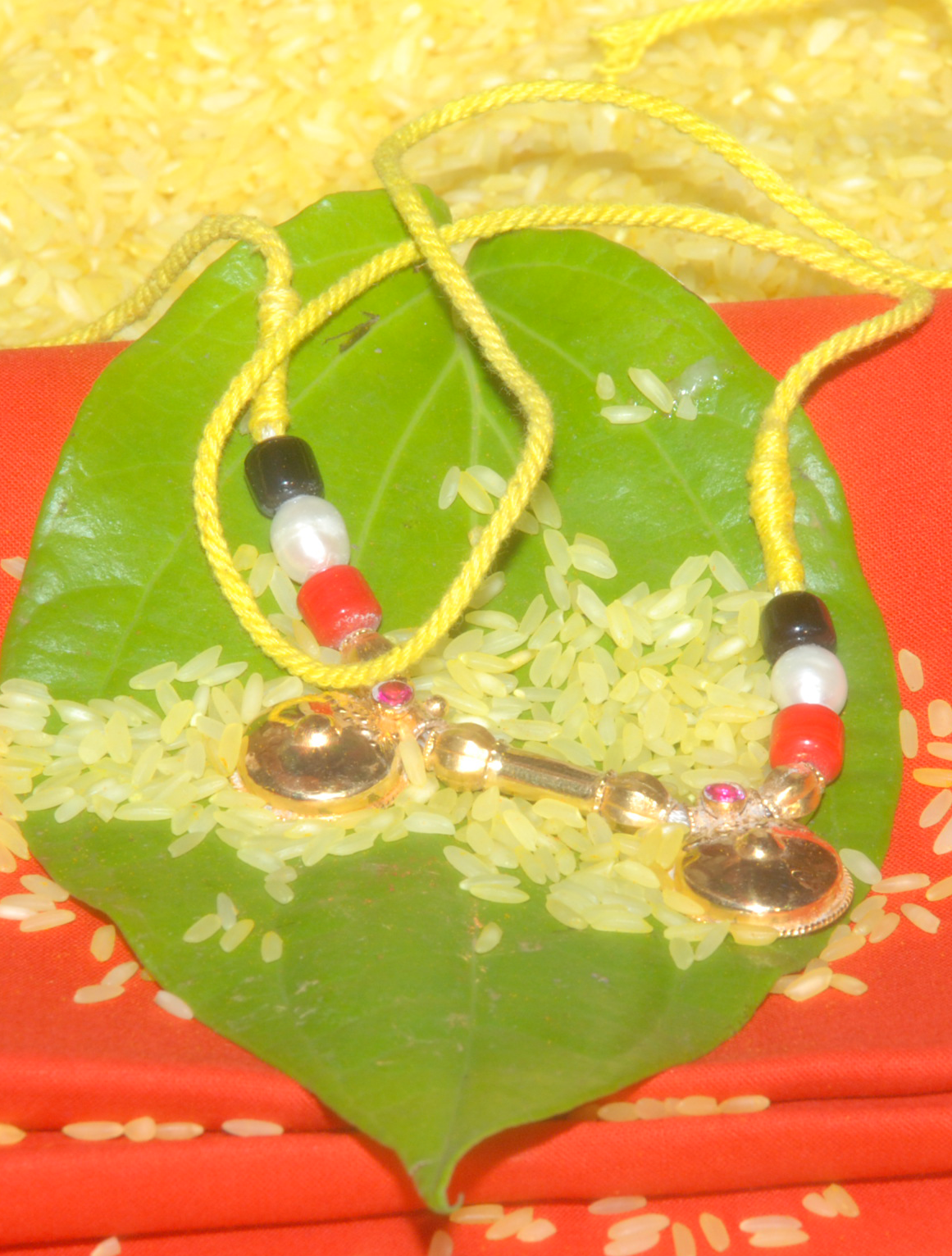 MangalasutraA necklace tied by the groom at a wedding, worn through married life
Good reading and sources
- Daura-Suruwal on WikipediaEncyclopedia
- More photos on Wikimedia CommonsPhotos and video
- Wikidata recordOpen data
The facts on this page come from the Wikipedia article "Daura-Suruwal", written by its contributors and used under the CC BY-SA 4.0 licence, and from its Wikidata record (CC0). EveryParampara rewrote the text in its own words, with AI assistance, and compares every page with the article to make sure no passage is copied. It may be reused under the same CC BY-SA 4.0 licence with a link back.
It may contain mistakes. Traditions differ from one family, village and community to the next, and the people who keep them know them best. If something is wrong, tell us. Last refreshed 2026-10-06.
More from Nepal
All the traditions of Nepal 🇮🇳 Srinagar, India and 3 morePashmina
Ultra-fine wool of Himalayan goats, hand-woven in Kashmir into shawls of rankDress
🇮🇳 India and 2 moreMangalasutraमङ्गलसूत्रम् (maṅgalasūtram)
A necklace tied by the groom at a wedding, worn through married lifeDress
🇮🇳 Srinagar, India and 3 morePashmina
Ultra-fine wool of Himalayan goats, hand-woven in Kashmir into shawls of rankDress
🇮🇳 India and 2 moreMangalasutraमङ्गलसूत्रम् (maṅgalasūtram)
A necklace tied by the groom at a wedding, worn through married lifeDress
 🇮🇳 Pune, India and 5 moreTurbanدولبند (dolband)
Cloth wound around the head, worn for faith, rank, shade and identityDress
🇮🇳 Pune, India and 5 moreTurbanدولبند (dolband)
Cloth wound around the head, worn for faith, rank, shade and identityDress
 🇮🇳 India and 4 moreSariसाड़ी
An unstitched length of cloth that women drape around the body, worn across South AsiaDress
🇮🇳 India and 4 moreSariसाड़ी
An unstitched length of cloth that women drape around the body, worn across South AsiaDress
The same idea elsewhere
All of this kind 🇳🇴 Norway and 3 moreGákti
A traditional coat worn by the Sámi people across northern Scandinavia and Russia, signaling origin and status through cDress
🇳🇴 Norway and 3 moreGákti
A traditional coat worn by the Sámi people across northern Scandinavia and Russia, signaling origin and status through cDress
 🇮🇱 Israel and 1 moreTzitzitצִיצִית
Knotted ritual fringes worn on a four-cornered garment, a reminder of the commandmentsDress
🇮🇱 Israel and 1 moreTzitzitצִיצִית
Knotted ritual fringes worn on a four-cornered garment, a reminder of the commandmentsDress
 🇼🇸 Samoa and 1 moreʻIe tōga
Precious woven mats exchanged in Samoan ceremonies to honor family ties and chiefly status.Dress
🇼🇸 Samoa and 1 moreʻIe tōga
Precious woven mats exchanged in Samoan ceremonies to honor family ties and chiefly status.Dress
 🇪🇬 Egypt and 5 moreTraditional tattooing
The ancient custom of marking the skin for protection, healing, status and sacred ritesDress
🇪🇬 Egypt and 5 moreTraditional tattooing
The ancient custom of marking the skin for protection, healing, status and sacred ritesDress