Seasons, harvest and the calendarEast AsiaSecular and civic
Fukubukuro
In its own language: 福袋
Surprise discount grab bags sold by Japanese retailers for the New Year

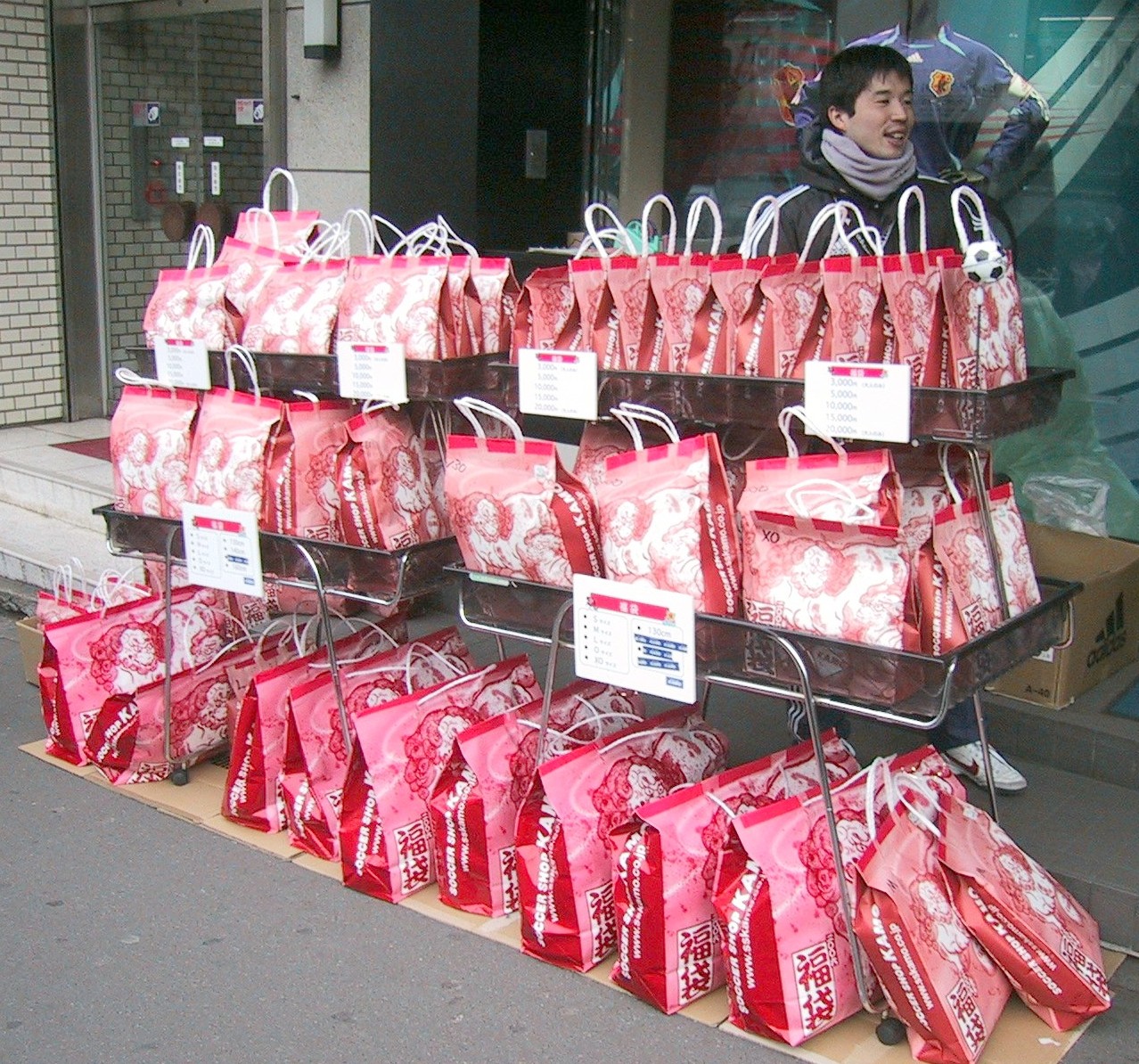
Fukubukuro is a Japanese New Year custom where shops sell sealed grab bags with surprise items at steep discounts. Shoppers line up early on New Year's Day to test their luck and bring home bargains.
When is Fukubukuro marked?
Fukubukuro is kept as part of Oshogatsu, which runs from 1 to 3 January 2027.
Fukubukuro, meaning lucky bag, is a shopping custom observed across Japan during the New Year. Retailers assemble sealed packages of mystery goods and offer them at steep discounts, often half price or less. Rooted in traditional folk beliefs about starting the calendar year afresh, the sales attract large crowds of shoppers who queue outside stores early in the morning to test their fortune.
Origins and meaning
The practice started during the late Meiji era, when the Ginza Matsuya department store began selling mystery parcels to customers. The term joins the word for good fortune, fuku, with the word for bag, fukuro. Its name draws on an old saying that fortune hides in leftover things. Shopkeepers historically used the bags to clear remaining stock from the preceding twelve months. This practice aligned with a folk belief that households should not carry unwanted possessions into the coming year, but instead start with a clean slate. Over time, the custom spread to retailers across Japan and eventually reached Japanese stores abroad.
Contents and variations
Merchants prepare the contents according to their trade. Department stores divide packages by section, packaging apparel or shoes to fit particular styles and price ranges. A tea shop might assemble an assortment of tea containers, cups, and a blanket. When items are too large to fit in a package, such as major home appliances, stores insert vouchers instead. Bags can also hold luxury surprises like expensive coats or travel tickets. When parcels hold genuinely poor merchandise, people jokingly refer to them as misfortune bags or depressing bags, which certain shops sell cheaply for humour.
Modern sales and pricing
Stores plan their sales months before the holiday. Standard bags cost between several hundred and ten thousand yen, but high-end jewellers and luxury department stores occasionally assemble packages priced in the millions of yen. In recent times, some merchants have begun revealing bag contents in advance. While this guarantees that buyers know what they receive, critics argue that displaying the goods beforehand turns the custom into an ordinary bundled sale and removes the element of chance and luck.
How Fukubukuro is kept
Merchants plan out their mystery packages and price tiers months before the holiday. On New Year's Day, eager buyers gather outside department stores and local shops, occasionally forming long queues that wrap around city blocks hours before opening. Shoppers choose bags based on store department or price point without seeing the specific goods inside. After purchasing, customers unwrap their bags to see what items they received and discover their luck for the new year.
When and where
Fukubukuro takes place during the Japanese New Year, starting on New Year's Day on the first of January, and continues while bag supplies last.
The custom is held throughout Japan at department stores, speciality shops, and retail districts. It is also observed by certain Japanese retailers in the United States, including shopping centres in Honolulu.
What Fukubukuro means
The custom links to the traditional idea that luck resides in surplus goods left over from the past year. Clearing away older inventory allows merchants and customers to begin the new calendar year clean, while the thrill of buying a mystery parcel serves as an auspicious test of personal fortune.

Days Fukubukuro is marked
Questions people ask about Fukubukuro
When is Fukubukuro marked?
Fukubukuro is kept as part of Oshogatsu, which runs from 1 to 3 January 2027.
What is a fukubukuro?
A fukubukuro is a sealed grab bag filled with surprise merchandise that Japanese retailers sell at a significant discount during the New Year.
Where did the custom originate?
The custom began in Japan during the late Meiji era, when it was introduced by the Ginza Matsuya department store before spreading nationwide.
What are misfortune bags?
Known as fukōbukuro or utsubukuro, these are humorous, low-priced bags intentionally filled with unwanted or odd items rather than valuable goods.
See also
 KadomatsuA Japanese New Year gateway decoration of pine and bamboo where a visiting deity can rest
 LosarThe Tibetan Buddhist New Year festival of renewal, offerings, and family feasts
 Yule logA log kept burning on the hearth through the twelve days of Christmas, for luck
 Twelve Days of ChristmasA festive Christian liturgical season linking Christmas Day to the eve of Epiphany
Good reading and sources
- Fukubukuro on WikipediaEncyclopedia
- More photos on Wikimedia CommonsPhotos and video
- Wikidata recordOpen data
The facts on this page come from the Wikipedia article "Fukubukuro", written by its contributors and used under the CC BY-SA 4.0 licence, and from its Wikidata record (CC0). EveryParampara rewrote the text in its own words, with AI assistance, and compares every page with the article to make sure no passage is copied. It may be reused under the same CC BY-SA 4.0 licence with a link back.
It may contain mistakes. Traditions differ from one family, village and community to the next, and the people who keep them know them best. If something is wrong, tell us. Last refreshed 2026-10-06.
More from Japan
All the traditions of Japan
🇯🇵 JapanKadomatsu門松
A Japanese New Year gateway decoration of pine and bamboo where a visiting deity can restSeasonal
 🇮🇷 Iran and 5 moreWinter solstice
The shortest day and longest night of the year, marked with fire, feasting and poetrySeasonal
🇮🇷 Iran and 5 moreWinter solstice
The shortest day and longest night of the year, marked with fire, feasting and poetrySeasonal
 🇯🇵 Tokyo, JapanJapanese New Year正月
An annual celebration of renewal, seasonal foods, and bell ringing across JapanSeasonal · Feasts and festival meals
🇯🇵 Tokyo, JapanJapanese New Year正月
An annual celebration of renewal, seasonal foods, and bell ringing across JapanSeasonal · Feasts and festival meals
 🇨🇳 China and 5 moreDouble Ninth Festival重陽節
An autumn festival of mountain walks, chrysanthemum wine and ancestor remembranceSeasonal · Tea-time and snacking customs
🇨🇳 China and 5 moreDouble Ninth Festival重陽節
An autumn festival of mountain walks, chrysanthemum wine and ancestor remembranceSeasonal · Tea-time and snacking customs
The same idea elsewhere
New Year compared 🇮🇳 Ayodhya, India and 7 moreDiwaliदीपावली (Dīpāvalī)
A five-day festival of lights celebrated across India and its diaspora to mark the victory of light over darkness.Festival · Feasts and festival meals
🇮🇳 Ayodhya, India and 7 moreDiwaliदीपावली (Dīpāvalī)
A five-day festival of lights celebrated across India and its diaspora to mark the victory of light over darkness.Festival · Feasts and festival meals
 🇮🇷 Iran and 7 moreNowruzنوروز
The Iranian new year at the March equinox, kept with fire, greenery and picnicsSeasonal
🇮🇷 Iran and 7 moreNowruzنوروز
The Iranian new year at the March equinox, kept with fire, greenery and picnicsSeasonal
 🇮🇱 Jerusalem, Israel and 1 moreHanukkahחֲנֻכָּה
An eight-day Jewish festival marking the rededication of the Second Temple in Jerusalem and the miracle of a single day'Festival
🇮🇱 Jerusalem, Israel and 1 moreHanukkahחֲנֻכָּה
An eight-day Jewish festival marking the rededication of the Second Temple in Jerusalem and the miracle of a single day'Festival
 🇪🇬 Egypt and 5 moreMawlidمولد (Mawlid)
An annual festival marking the birth of the Prophet Muhammad, marked by poetry, processions and feasts.Festival · Feasts and festival meals
🇪🇬 Egypt and 5 moreMawlidمولد (Mawlid)
An annual festival marking the birth of the Prophet Muhammad, marked by poetry, processions and feasts.Festival · Feasts and festival meals