Festivals and celebrationsEuropeSecular and civic
Hogmanay
The Scottish celebration of New Year's Eve and the first days of the new year.

Hogmanay is the Scottish celebration of New Year's Eve and the early days of January. It is kept by Scots people across the United Kingdom. The festivities begin on 31 December and often continue through 1 and 2 January. Traditions include first-footing, where guests bring gifts for luck, and local fire festivals in towns like Stonehaven and Burghead.
When is Hogmanay in 2026?
Hogmanay 2026 runs from 31 December 2026 to 1 January 2027. Other years: 2025, 31 December 2025 to 1 January 2026; 2027, 31 December 2027 to 1 January 2028.
Hogmanay marks the transition from the old year to the new one in Scotland. It is a time for families to gather, share meals, and welcome visitors into their homes. The celebration features distinctive local customs, including swinging burning fireballs and blessing houses with juniper smoke. It remains a vital part of Scottish cultural life.
Origins and etymology
Scholars debate the origin of the word Hogmanay. Some link it to French phrases for New Year gifts, while others suggest Norse or Gaelic roots. The term appears in records from 1443. Historically, it replaced Christmas as the main winter festival in Scotland following the Protestant Reformation. The celebration absorbed older Norse and Gaelic winter rituals.
First-footing and gifts
The most widespread custom is first-footing. After midnight, the first person to enter a home determines the luck for the coming year. Tall, dark-haired men are traditionally preferred. Visitors bring symbolic items such as shortbread, whisky, coal, or salt to bring prosperity to the household. Food and drink are then shared with the guests.
Fire festivals and local rites
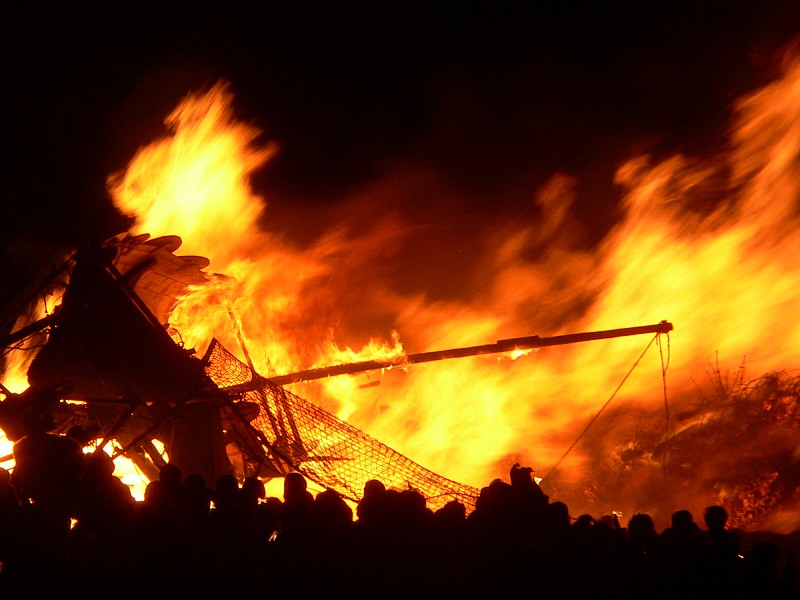
Towns across Scotland hold unique events. In Stonehaven, locals swing large balls of burning material into the harbour. In Burghead, a wooden club is burned. In the Highlands, households perform saining, a ritual involving sprinkling water and fumigating rooms with juniper smoke to protect the home and livestock. These rites aim to cleanse the space for the new year.
Songs and media
Singing Auld Lang Syne is common at midnight. This poem by Robert Burns is sung with linked arms. Television broadcasts like The White Heather Club helped popularize the celebration. Modern events in Edinburgh attract large crowds with fireworks and street performances. The festivities often extend into the middle of January in some communities.
How Hogmanay is kept
People visit friends and neighbours after midnight. The first person to enter a home determines the luck for the coming year. Tall, dark-haired men are traditionally preferred. Visitors bring symbolic items such as shortbread, whisky, coal, or salt to bring prosperity to the household. In some towns, residents swing burning fireballs into harbours or burn juniper to bless their homes. Families gather to eat and sing songs together.
When and where
It falls on 31 December and continues into 1 and 2 January. The date is fixed by the Gregorian calendar.
It is strongest in Scotland, particularly in Edinburgh, Stonehaven, and Burghead. It was also celebrated in northern England.
What Hogmanay means
The first-foot is believed to set the fortune for the entire year ahead. Traditional beliefs hold that tall, dark-haired men bring the best luck. The saining ritual uses juniper smoke and magic water to cleanse the home and protect livestock from harm. Gifts like coal and shortbread symbolize warmth and sustenance for the months to come.
On the table
- shortbread
- whisky
- black bun
- herring
- cakes


Days Hogmanay is marked
Hogmanay dates: 2025, 2026, 2027
| Year | Hogmanay date |
|---|---|
| 2025 | 31 December 2025 to 1 January 2026 |
| 2026 | 31 December 2026 to 1 January 2027 |
| 2027 | 31 December 2027 to 1 January 2028 |
Questions people ask about Hogmanay
When is Hogmanay in 2026?
Hogmanay 2026 runs from 31 December 2026 to 1 January 2027. Other years: 2025, 31 December 2025 to 1 January 2026; 2027, 31 December 2027 to 1 January 2028.
What is Hogmanay?
Hogmanay is the traditional Scottish celebration of New Year's Eve and the first days of the new year. It involves family gatherings, feasting, and unique customs like first-footing and fire festivals. It is a key event in the Scottish calendar.
What is first-footing?
First-footing is the custom of being the first person to cross a threshold after midnight. The visitor brings gifts like whisky, shortbread, or coal to ensure good luck for the household. Tall, dark-haired men are traditionally preferred.
Where is it celebrated?
It is celebrated throughout Scotland, with major public events in Edinburgh, Stonehaven, and Burghead. Historically, it was also observed in parts of northern England, such as Northumberland and Yorkshire.
See also
 Christmas marketA seasonal street market held during Advent in German-speaking regions and beyond, featuring stalls, food, and crafts.
 ImbolcA Gaelic festival heralding spring and honoring Saint Brigid with woven rush crosses
 ChristmasA festival of Jesus's birth, kept on 25 December with gifts, lights and shared meals
 HalloweenAn annual observance on 31 October marking the eve of All Saints' Day, rooted in Christian tradition and Celtic heritage
Good reading and sources
- Encyclopaedia BritannicaArticle
- Hogmanay events cancelled as Covid rules tightenedBBC, Article
- What is Hogmanay?BBC, Article
- Hogmanay events cancelled as Covid rules tightenedBBC, Article
- What is Hogmanay?BBC, Article
- Hogmanay on WikipediaEncyclopedia
- More photos on Wikimedia CommonsPhotos and video
- Wikidata recordOpen data
The facts on this page come from the Wikipedia article "Hogmanay", written by its contributors and used under the CC BY-SA 4.0 licence, and from its Wikidata record (CC0). EveryParampara rewrote the text in its own words, with AI assistance, and compares every page with the article to make sure no passage is copied. It may be reused under the same CC BY-SA 4.0 licence with a link back.
It may contain mistakes. Traditions differ from one family, village and community to the next, and the people who keep them know them best. If something is wrong, tell us. Last refreshed 2026-10-04.
More from the United Kingdom
All the traditions of the United Kingdom 🇬🇧 United Kingdom and 3 moreMumming
A medieval European custom of masked house-to-house visits, performances and seasonal revelry.Festival
🇬🇧 United Kingdom and 3 moreMumming
A medieval European custom of masked house-to-house visits, performances and seasonal revelry.Festival
 🇬🇧 United Kingdom and 5 moreApril Fools' Day
An annual day of lighthearted pranks, hoaxes and teasing kept on the first of AprilFestival
🇬🇧 Hinton St George, United KingdomPunkie Night
A Somerset Halloween custom where children carry mangelwurzel lanterns and sing for candles.Festival
🇩🇪 Nuremberg, Germany and 5 moreChristmas marketWeihnachtsmarkt
A seasonal street market held during Advent in German-speaking regions and beyond, featuring stalls, food, and crafts.Festival · Tea, coffee and drinking ceremonies
🇬🇧 United Kingdom and 5 moreApril Fools' Day
An annual day of lighthearted pranks, hoaxes and teasing kept on the first of AprilFestival
🇬🇧 Hinton St George, United KingdomPunkie Night
A Somerset Halloween custom where children carry mangelwurzel lanterns and sing for candles.Festival
🇩🇪 Nuremberg, Germany and 5 moreChristmas marketWeihnachtsmarkt
A seasonal street market held during Advent in German-speaking regions and beyond, featuring stalls, food, and crafts.Festival · Tea, coffee and drinking ceremonies
The same idea elsewhere
New Year compared 🇮🇳 Ayodhya, India and 7 moreDiwaliदीपावली (Dīpāvalī)
A five-day festival of lights celebrated across India and its diaspora to mark the victory of light over darkness.Festival · Feasts and festival meals
🇮🇳 Ayodhya, India and 7 moreDiwaliदीपावली (Dīpāvalī)
A five-day festival of lights celebrated across India and its diaspora to mark the victory of light over darkness.Festival · Feasts and festival meals
 🇮🇷 Iran and 7 moreNowruzنوروز
The Iranian new year at the March equinox, kept with fire, greenery and picnicsSeasonal
🇮🇷 Iran and 7 moreNowruzنوروز
The Iranian new year at the March equinox, kept with fire, greenery and picnicsSeasonal
 🇮🇱 Jerusalem, Israel and 1 moreHanukkahחֲנֻכָּה
An eight-day Jewish festival marking the rededication of the Second Temple in Jerusalem and the miracle of a single day'Festival
🇮🇱 Jerusalem, Israel and 1 moreHanukkahחֲנֻכָּה
An eight-day Jewish festival marking the rededication of the Second Temple in Jerusalem and the miracle of a single day'Festival
 🇪🇬 Egypt and 5 moreMawlidمولد (Mawlid)
An annual festival marking the birth of the Prophet Muhammad, marked by poetry, processions and feasts.Festival · Feasts and festival meals
🇪🇬 Egypt and 5 moreMawlidمولد (Mawlid)
An annual festival marking the birth of the Prophet Muhammad, marked by poetry, processions and feasts.Festival · Feasts and festival meals