Music, dance and storytellingEurope
Irish traditional music
A living folk practice of dance tunes, airs, songs and communal pub sessions

Rooted in the social gatherings and Gaelic heritage of Ireland, Irish traditional music is an instrumental and vocal tradition played solo or in group sessions. Musicians share airs, songs, and energetic dance tunes using instruments like fiddles, pipes, and flutes, shaped by distinctive modes and intricate ornamentation.
When is Irish traditional music kept?
Irish traditional music is kept on year-round in pub sessions, festivals, and community gatherings.
Irish traditional music is a shared cultural heritage of melody, song, and social playing that developed across Ireland. Centred on dance forms such as jigs, reels, hornpipes, and expressive slow airs, it is kept alive in informal pub sessions, concerts, and competitive festivals. Players pass down tunes through listening and communal gatherings, preserving an art form that serves as a vital symbol of Irish identity.
Musical structure and ornaments
Most dance tunes follow a regular two-part structure, moving through eight-bar phrases repeated in a set sequence. Musicians usually string several tunes together into medleys rather than playing single pieces. Harmony remains sparse, allowing unison melodies to lead while bouzouki or guitar accompanists use open tunings and drone notes. Melodies rely on ancient modal scales rather than standard major and minor keys. Instrumentalists add character through rapid ornaments such as rolls, slides, and cuts. On the uilleann pipes, players create branching decorations known as crans to enrich sustained notes.
Instruments and collectors
Early Gaelic records note instruments such as harps, fifes, hornpipes, clarions, bones, and early fiddles. By the eighteenth and nineteenth centuries, ballad sheets printed in Dublin helped popularise songs across the island. Dedicated antiquarians and collectors, including Edward Bunting and Francis O'Neill, transcribed thousands of melodies that might otherwise have disappeared. Although solo performance formed the core of the older custom, group playing emerged in the nineteenth century. The twentieth century saw the establishment of Comhaltas Ceoltóirí Éireann and the Fleadh Cheoil festival, which renewed public enthusiasm for folk tunes.
Singing and modern revival
Folk songs in Ireland evolved from older rural Irish-language roots into English-language verses during the nineteenth and twentieth centuries. While ancient songs carried country tales, later urban writers reflected tavern life and contemporary society. Post-war interest dipped until touring groups in the late 1950s and 1960s brought the sound to global audiences. Bands like the Dubliners and the Chieftains transformed traditional tunes into widely recognised arrangements. Through international migration, the sound spread across North America and Australia, eventually interacting with modern styles such as rock and punk.
Women and community voices
For decades following the 1920s, social barriers and laws such as the Marriage Bar kept many female instrumentalists out of public performance spaces. Women continued playing privately as tradition bearers, and emigrants carried the music abroad. Performers like fiddler Julia Clifford eventually gained wide acclaim for regional styles from Sliabh Luachra. From the 1980s onward, all-women groups and milestone concerts brought female artists to the forefront. In recent years, groups like Trad is Amach have also organised céilithe and sessions to increase the visibility of LGBTQ+ performers in festivals.
How Irish traditional music is kept
Musicians gather in pubs, concert halls, and festival grounds to play together in informal circles known as sessions. Lead instrumentalists start a tune, and other players join in unison on fiddles, flutes, whistles, or pipes. Dance tunes are grouped into flowing sets of two to four pieces, shifting seamlessly from one rhythm to the next. Accompanists follow the melody with steady rhythm chords. At music festivals like the Fleadh Cheoil, both amateur players and masters enter competitions, share repertoire, and join street céilithe.
When and where
The tradition is played year-round in local gatherings, with major peaks during annual summer festivals such as the Fleadh Cheoil and town cultural events.
The tradition is maintained across the island of Ireland, from Dublin to rural regional centres such as Sliabh Luachra in County Kerry. It is also actively sustained in Irish diaspora communities across the United States, Britain, Australia, and parts of Europe.
What Irish traditional music means
Following the foundation of the Irish Free State, traditional music became a powerful emblem of Gaelic heritage and national resilience. It links modern communities to Ireland's spoken, sung, and instrumental past, offering a shared cultural language that expresses local identity, hardship, and communal celebration.


Questions people ask about Irish traditional music
When is Irish traditional music kept?
Irish traditional music is kept on year-round in pub sessions, festivals, and community gatherings.
What is Irish traditional music?
It is a living folk tradition of instrumental dance tunes, slow airs, and songs from Ireland, played on instruments such as fiddles, pipes, and flutes.
Where is Irish traditional music played?
It is played across Ireland in pubs, homes, and community halls, as well as at international festivals and in diaspora hubs across the United States and Australia.
What instruments are used in Irish traditional music?
Historically, Gaelic instruments included harps, pipes, fifes, and bones. Today, musicians frequently play fiddles, uilleann pipes, wooden flutes, whistles, and bouzoukis in unison during sessions.
How are traditional Irish tunes structured?
Most dance tunes use a binary form with two repeating four- to eight-bar sections, known as the A and B parts, often combined into medleys.
See also
 PlenaPuerto Rican folk songs and dance sharing community news with rhythmic frame drums
 Sean-nós singingAn unaccompanied, highly ornamented style of traditional Irish folk singing
 Morris danceA rhythmic English folk dance performed in costume with bells, sticks and handkerchiefs
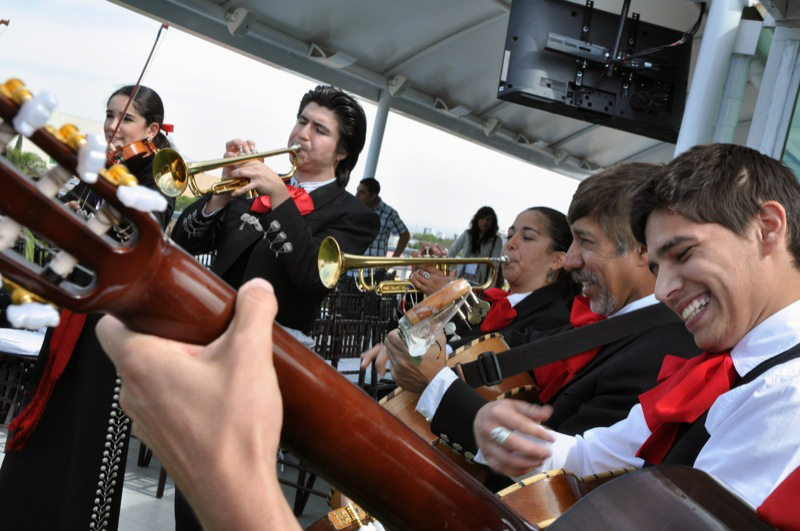 MariachiA Mexican string and trumpet music tradition featuring charro attire and communal singing.
Good reading and sources
- Irish traditional music on WikipediaEncyclopedia
- More photos on Wikimedia CommonsPhotos and video
- Wikidata recordOpen data
The facts on this page come from the Wikipedia article "Irish traditional music", written by its contributors and used under the CC BY-SA 4.0 licence, and from its Wikidata record (CC0). EveryParampara rewrote the text in its own words, with AI assistance, and compares every page with the article to make sure no passage is copied. It may be reused under the same CC BY-SA 4.0 licence with a link back.
It may contain mistakes. Traditions differ from one family, village and community to the next, and the people who keep them know them best. If something is wrong, tell us. Last refreshed 2026-10-04.
More from Ireland
All the traditions of Ireland 🇮🇪 Ireland and 5 moreFleadh CheoilFleadh Cheoil na hÉireann
An annual gathering of Irish traditional music and dance, featuring competitions, public sessions, and concerts across IPerformance
🇮🇪 Waterford, IrelandSean-nós singingSean-nós
An unaccompanied, highly ornamented style of traditional Irish folk singingPerformance
🇮🇪 Ireland and 5 moreFleadh CheoilFleadh Cheoil na hÉireann
An annual gathering of Irish traditional music and dance, featuring competitions, public sessions, and concerts across IPerformance
🇮🇪 Waterford, IrelandSean-nós singingSean-nós
An unaccompanied, highly ornamented style of traditional Irish folk singingPerformance
 🇮🇪 Dublin, Ireland and 2 moreIrish stepdance
A percussive dance form with swift, intricate footwork and an upright torsoPerformance
🇮🇪 Ros Muc, Ireland and 2 moreSean-nós dancedamhsa ar an sean nós
An improvised solo Irish dance: low footwork, free arms and a loud battering beatPerformance
🇮🇪 Dublin, Ireland and 2 moreIrish stepdance
A percussive dance form with swift, intricate footwork and an upright torsoPerformance
🇮🇪 Ros Muc, Ireland and 2 moreSean-nós dancedamhsa ar an sean nós
An improvised solo Irish dance: low footwork, free arms and a loud battering beatPerformance
The same idea elsewhere
All of this kind 🇹🇷 Kayseri, Turkey and 4 moreHalay
A traditional line and circle folk dance kept across Turkey, Azerbaijan, Armenia, Iran, and Syria.Performance
🇹🇷 Kayseri, Turkey and 4 moreHalay
A traditional line and circle folk dance kept across Turkey, Azerbaijan, Armenia, Iran, and Syria.Performance
 🇳🇿 Auckland, New ZealandPoi
A Māori performing art of swinging tethered weights in rhythmical patterns.Performance
🇳🇿 Auckland, New ZealandPoi
A Māori performing art of swinging tethered weights in rhythmical patterns.Performance
 🇵🇭 Philippines and 1 morePangalay
A traditional fingernail dance of the Tausūg and Bajau peoples in the Sulu Archipelago and Sabah.Performance
🇵🇭 Philippines and 1 morePangalay
A traditional fingernail dance of the Tausūg and Bajau peoples in the Sulu Archipelago and Sabah.Performance