Peshawari chappal
A leather sandal hand-stitched in Pakistan, worn with shalwar kameez and to weddings
The Peshawari chappal is a leather sandal from Pakistan, made by hand in workshops across Punjab and Khyber Pakhtunkhwa. Men wear it every day, with the shalwar kameez, and it also appears at weddings, cultural gatherings and religious festivals.
When is Peshawari chappal kept?
Peshawari chappal is kept on all year round, for everyday wear and for weddings, cultural events and religious festivals.
Pakistan's most widely worn traditional shoe goes by many names, but the Peshawari chappal is the one heard most. It is a sandal of stitched leather with two broad straps crossed over the foot and a strap at the heel. Men put it on with everyday clothes or with the shalwar kameez, and many in the country treat it as the national shoe.
What it is
Two wide leather straps cross each other and meet the sole. A third strap sits around the heel and fastens with a buckle, so the wearer can loosen or tighten the shoe to suit the foot. The upper is leather; the sole is often cut from an old lorry tyre, sometimes with softer leather stitched over the rubber. Because the materials cost little and wear well, the sandal lasts a long time. Makers offer many colours and patterns, and some pairs carry silver or gold embroidery. In Pakistan people reach for them instead of ordinary slippers or sandals, indoors and out.
Origins and history
The craft grew out of the artisan work of northern Punjab. In the hills the shoe had to survive rough ground, unlike the softer jutti of the plains. A limestone ridge near Rawalpindi earned the nickname The Sandal Breaker, because it ruined the soles of travellers who crossed it. British colonial gazetteers record the footwear in use across the Attock, Jhelum, Shahpur and Rawalpindi districts, and Raverty's 1860 Pashto dictionary lists chaplí and kheṛ as terms taken from Punjabi. Through the early twentieth century the design travelled along trade routes into the towns of the northwest. After independence in 1947, workers in Peshawar used softer leather and finer finishing, and the shoe took that city's name.
How it is made
In workshops the work is done by hand. A craftsman cuts the upper from leather and adds patterns to it while it lies flat, before the shoe is shaped. The decorated piece then goes into a mold that stretches it to size. The sole is prepared separately, often from a rubber tyre, and softer leather may be sewn onto it. The straps and the heel buckle are fixed to the sole and stitched. What leaves the workshops is a hand-stitched pair, and much of it is sent abroad.
Dress and occasions
The chappal fits into a way of dressing. Men pair it with the shalwar kameez, and since it is semi-closed rather than an open slip, it suits formal occasions as well as everyday ones. At weddings it is a familiar sight, and it also appears at cultural events and religious festivals around the country. Hand-stitched pairs are sent abroad as well, so the shoe is seen well beyond Pakistan.
Today and change
Since the 2010s the sandal has drawn notice far beyond Pakistan. In 2014 a British designer released a sandal that closely resembled it, which drew criticism in Pakistan; the label later acknowledged that the traditional footwear had been its inspiration. Five years after that, a French fashion house brought out a sandal it called the Imran Sandal, again credited to the Peshawari chappal and carrying the house's well-known red sole. Opinion online divided, some calling it cultural appropriation and others seeing new recognition for the sandal. A newer cut, the Kaptaan chappal, gained a following in 2015 after a pair was presented to the politician Imran Khan.
How Peshawari chappal is kept
Making a pair follows a fixed order. A craftsman selects leather and cuts the upper. Patterns are worked into it while flat. The upper goes into a mold and is stretched to size. Separately a sole is cut, often from a rubber tyre, and softer leather is sometimes stitched over it. Straps and the heel buckle are attached and sewn. The finished sandal is worn by men with the shalwar kameez, casually during the day or formally for weddings and festivals.
When and where
There is no fixed date connected to the chappal, and no season for it. Men wear it all year round, on ordinary days and on formal ones. It comes out for weddings, cultural events and religious festivals across Pakistan.
Stitching is concentrated in Punjab and Khyber Pakhtunkhwa, in northwestern Pakistan. Peshawar is one of the biggest centres, and Chakwal and Talagang are known for hand-stitched work that is sold abroad. Kohat, Sargodha, Hazro and Dera Ismail Khan also make the sandal.
What Peshawari chappal means
For the people who wear it, this sandal carries a sense of place. It is counted as part of Pashtun dress, and it is often called Pakistan's national shoe. Putting on a pair for a wedding or a festival ties the wearer to that shared identity. The arguments over foreign copies made the point plain: this is not just a cheap sandal but something people feel they own.
Questions people ask about Peshawari chappal
When is Peshawari chappal kept?
Peshawari chappal is kept on all year round, for everyday wear and for weddings, cultural events and religious festivals.
What is a Peshawari chappal?
A leather sandal made in Pakistan. Two broad straps cross the foot, another strap circles the heel and closes with a buckle, and the sole is usually a rubber tyre under soft leather. Men wear it with the shalwar kameez, both casually and for formal occasions.
Why does it have so many names?
Different places and workshops gave it different labels. The best known name comes from Peshawar, one of the largest production centres. Others in use include Zari chappal, Kohati chappal and Captaan chappal, and a newer cut is called the Kaptaan chappal.
Is it the same as a jutti?
No. The jutti is a soft leather shoe of the Punjab plains. The chappal came from hill country, where footwear had to cope with stony ground, so it is built with a hard sole and crossed straps.
Has the sandal been copied outside Pakistan?
It has. A British designer released a similar sandal in 2014, and a French fashion house brought out one in 2019, both described as inspired by the traditional shoe. Each time, debate followed in Pakistan about credit and cultural appropriation.
See also
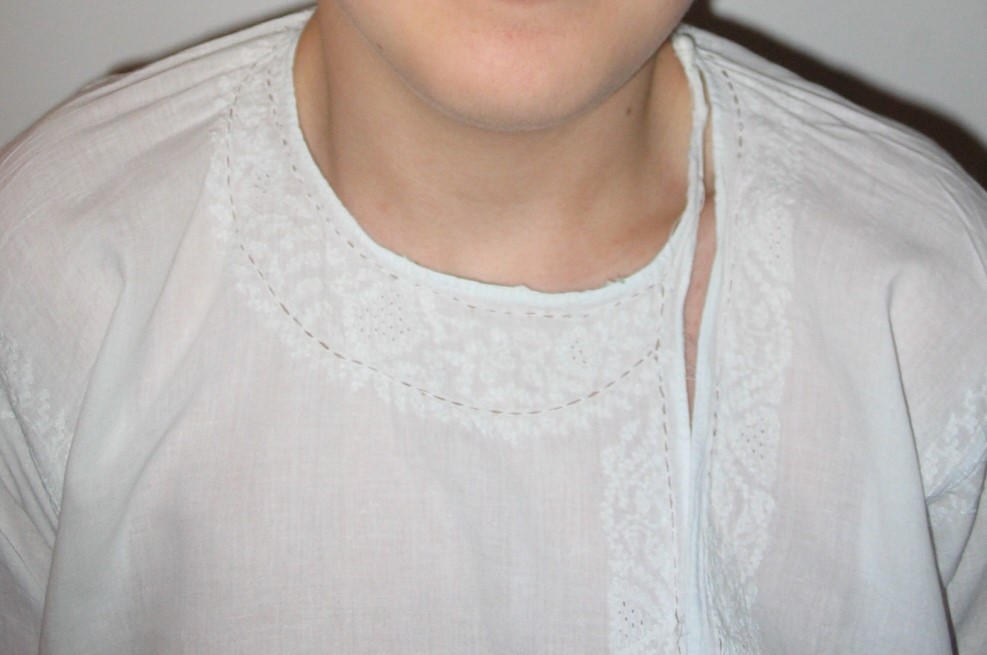 KurtaA loose collarless tunic from South Asia, worn plain or embroidered over pyjamas or jeans
 Shalwar kameezLoose trousers and a long tunic, worn as one outfit across South Asia
 SherwaniA long buttoned coat for men, worn at weddings and state occasions in South Asia
 PashminaUltra-fine wool of Himalayan goats, hand-woven in Kashmir into shawls of rank
Good reading and sources
- Kaptaan special chapal goes online as it gains popularityDawn, Article
- Kaptaan special chapal goes online as it gains popularityDawn, Article
The facts on this page come from the Wikipedia article "Kheri (footwear)", written by its contributors and used under the CC BY-SA 4.0 licence, and from its Wikidata record (CC0). EveryParampara rewrote the text in its own words, with AI assistance, and compares every page with the article to make sure no passage is copied. It may be reused under the same CC BY-SA 4.0 licence with a link back.
It may contain mistakes. Traditions differ from one family, village and community to the next, and the people who keep them know them best. If something is wrong, tell us. Last refreshed 2026-10-11.
More from Pakistan
All the traditions of Pakistan
🇵🇰 Multan, Pakistan and 3 moreShalwar kameez
Loose trousers and a long tunic, worn as one outfit across South AsiaDress
🇮🇳 Srinagar, India and 3 morePashmina
Ultra-fine wool of Himalayan goats, hand-woven in Kashmir into shawls of rankDress
🇮🇳 Lucknow, India and 5 moreKurtaکرته (Persian), कुरता (Hindi)
A loose collarless tunic from South Asia, worn plain or embroidered over pyjamas or jeansDress
🇮🇳 Lucknow, India and 3 moreSherwani
A long buttoned coat for men, worn at weddings and state occasions in South AsiaDress
The same idea elsewhere
All of this kind 🇳🇴 Norway and 3 moreGákti
A traditional coat worn by the Sámi people across northern Scandinavia and Russia, signaling origin and status through cDress
🇳🇴 Norway and 3 moreGákti
A traditional coat worn by the Sámi people across northern Scandinavia and Russia, signaling origin and status through cDress
 🇮🇱 Israel and 1 moreTzitzitצִיצִית
Knotted ritual fringes worn on a four-cornered garment, a reminder of the commandmentsDress
🇮🇱 Israel and 1 moreTzitzitצִיצִית
Knotted ritual fringes worn on a four-cornered garment, a reminder of the commandmentsDress
 🇼🇸 Samoa and 1 moreʻIe tōga
Precious woven mats exchanged in Samoan ceremonies to honor family ties and chiefly status.Dress
🇼🇸 Samoa and 1 moreʻIe tōga
Precious woven mats exchanged in Samoan ceremonies to honor family ties and chiefly status.Dress
 🇪🇬 Egypt and 5 moreTraditional tattooing
The ancient custom of marking the skin for protection, healing, status and sacred ritesDress
🇪🇬 Egypt and 5 moreTraditional tattooing
The ancient custom of marking the skin for protection, healing, status and sacred ritesDress