Lederhosen
Leather breeches that began as work wear and now belong to Alpine festivals

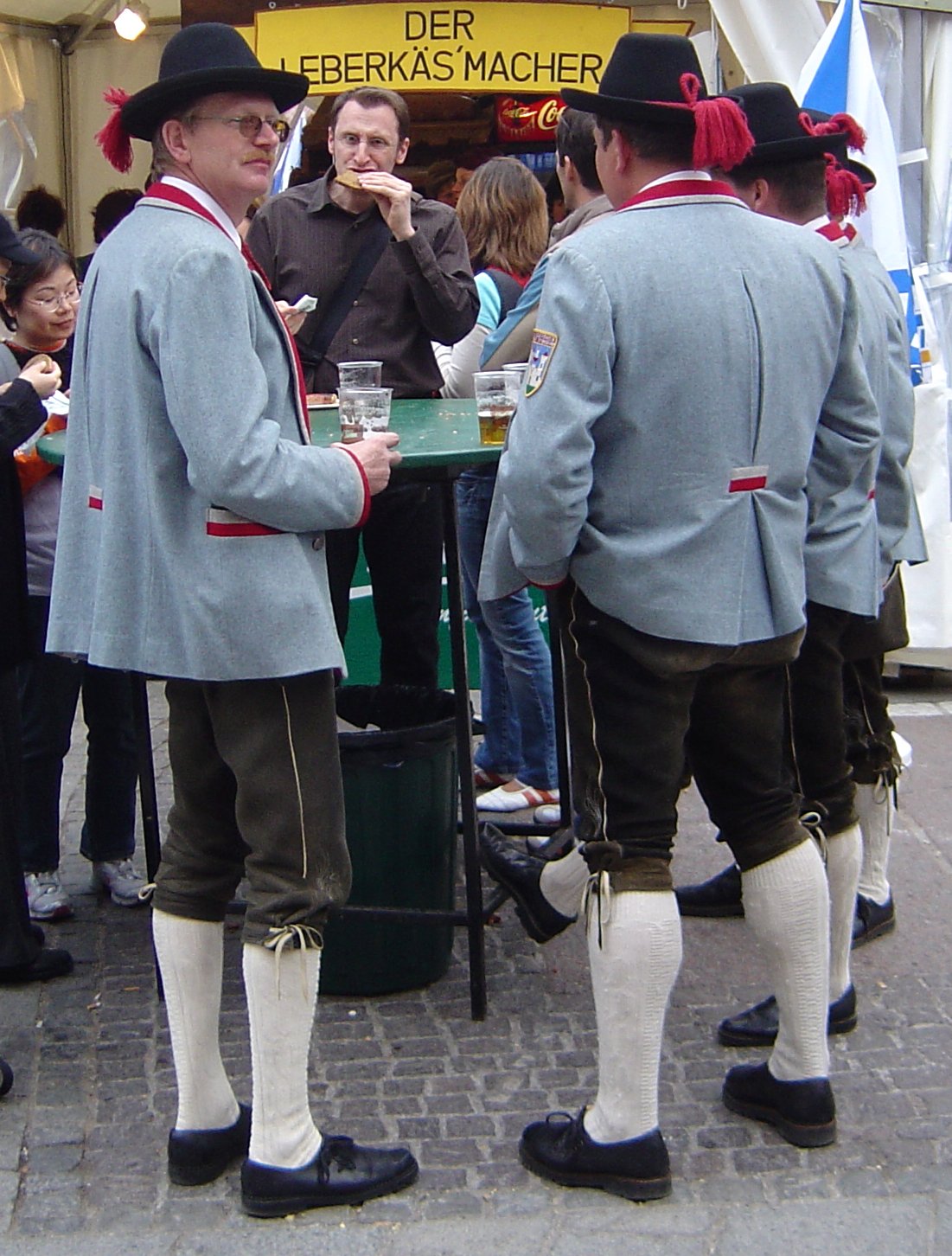
Lederhosen are leather knee breeches for men, kept in southern Germany, Austria, South Tyrol and Slovenia. They began as hard-wearing work clothes in the late Middle Ages and are mostly leisure wear today, worn for local festivals, club gatherings and Oktoberfest events.
When is Lederhosen marked?
Lederhosen is kept as part of Oktoberfest, which runs from 18 September to 3 October 2027.
Lederhosen are leather breeches, cut above or below the knee, that men wear across the eastern Alps and their northern foothills. They started as tough clothing for farm and forest work and lasted longest in the high valleys. Since the nineteenth century they have stood for local identity, and today they come out at festivals, club parades and Oktoberfest gatherings.
What it is
The name means leather trousers in German, and the garment is just that: breeches cut from hide. English speakers use the word for a pair worn by men in the south of Germany and in the Alpine lands nearby. Long versions pass the knee and are called Bundhosen; short ones stop above it. Stitching decorates the outer seam and the front of the bib, and a pair is counted by its stitched lines: three, five, seven or even nine. Ties or buttons close the side seams, and a vertical seam or a crosswise Tellernaht joins the legs. Black and brown are the usual colours.
Origins and history
These breeches are thought to have appeared in the late Middle Ages. Hide lasted longer than cloth, so they suited heavy outdoor labour. La Couturière Parisienne, a costume historian, argued that they were once worn in many parts of Europe by riders, hunters and others who worked in the open, not in Bavaria alone. The drop front may be a Bavarian idea. It grew so fashionable in the eighteenth century that France called the cut à la bavaroise, meaning in the Bavarian manner. In the Austrian and Bavarian Alps, everyday pairs were cut above the knee, giving workers and hunters freer movement on steep slopes. Where that short cut began is not known. August Lewald wrote the first account of it, from the Tuxertal in Tirol, in 1835.
Costume clubs
Everyday use fell away in the lower, outer parts of the mountains, while the garment held on in the inner valleys. In 1883 a schoolteacher, Joseph Vogl, started a society in the Upper Bavarian town of Bayrischzell, in the Leitzach valley, to keep local dress alive. Other clubs, the Trachtenvereine, took it as their model, and such groups appeared in Munich, Salzburg and Vienna. Bavarian rulers gave the movement their backing. King Ludwig II encouraged the new clubs, and King Ludwig III was known to travel into the Alps in lederhosen, which showed his support for keeping the old clothing in use.
The Swabian cut
Swabia keeps a version of its own, and so did the stretch of the Black Forest that now lies in Baden-Württemberg. There the legs were covered past the knee and finished with cuffs, not cut short as in Bavaria, and the bottom of each leg was turned back. Men wore a white linen shirt and a colourful waistcoat, most often red, with a plaid shirt appearing at times instead. Colour followed trade: farmers and most other Swabians chose black rather than brown, while winegrowers chose yellow. A pattern of decoration is found only in this region.
Today
Most pairs are now leisure wear. Dirndl dresses and lederhosen both appear at Oktoberfest events in many countries, and in the home regions people bring them out for local festivals. Some new pairs are shaped by current fashion rather than older patterns, and costume clubs continue to wear the full outfit at their own gatherings. Wearers in Bavaria, Austria, South Tyrol and Slovenia still treat them as part of local dress, and visitors usually meet them first at festival time. What began as clothing for farm and forest work has become clothing for occasions.
How Lederhosen is kept
Men wear the breeches with a shirt, usually white linen in Swabia and sometimes plaid, and with a colourful waistcoat, most often red. In Bavaria a shorter cut above the knee is usual; in Swabia the legs reach past the knee and end in cuffs. Pairs are picked by colour, length and the number of stitched seams. At club gatherings and local festivals, members turn out in the full costume. At Oktoberfest events the breeches appear beside dirndl dresses. On quiet days they serve as comfortable leisure clothing, and some wearers choose modern cuts.
When and where
No single date belongs to them. They come out for local festivals through the year and for Oktoberfest events, where dirndl dresses are worn alongside. Costume clubs put them on for their own meetings and parades. Otherwise they are everyday leisure clothing, worn whenever the owner wishes.
Their home is the eastern Alps and the country just north of the range. They are strongest in Bavaria and Swabia in southern Germany, in Austria, in South Tyrol and in Slovenia, where the local word is irharice. The costume clubs carried the fashion outward, and Munich, Salzburg and Vienna all feature in that history.
What Lederhosen means
For the people who wear them, these breeches mark a tie to a place and its older customs. They began as working clothes, and that plain toughness is still part of what they say. When Bavarian kings wore them, they showed favour towards ordinary Alpine dress, and the clubs that formed in the nineteenth century gave local costume a public stage. Putting on a pair at a festival signals that the wearer belongs to that occasion and keeps its customs.
Days Lederhosen is marked
Questions people ask about Lederhosen
When is Lederhosen marked?
Lederhosen is kept as part of Oktoberfest, which runs from 18 September to 3 October 2027.
What are lederhosen?
They are leather breeches for men, cut either above or below the knee and worn in southern Germany, Austria, South Tyrol and Slovenia. The German word means leather trousers. Long pairs are called Bundhosen. Most are black or brown, and the stitching along the side seams can be counted.
Where are they worn?
They belong to the eastern Alps and their northern edge, above all Bavaria and Swabia in Germany, Austria, South Tyrol and Slovenia. Costume clubs carried the fashion outward, and Munich, Salzburg and Vienna are part of that story. Oktoberfest events elsewhere also see them.
Are they still everyday clothing?
No. They are mostly leisure wear now, brought out for local festivals, club events and Oktoberfest gatherings. In Swabia length, colour and decoration once marked a man's trade and his district. Some new pairs follow current fashion trends instead of the older patterns.
How do Bavarian and Swabian pairs differ?
In Swabia the legs were covered past the knee and ended in cuffs, and black was usual, with yellow for winegrowers. Bavaria favoured a shorter cut above the knee, and wore brown beside black. Each region also has its own pattern of decorative stitching.
See also
 Damba festivalA Ghanaian celebration of royal authority, ancestral memory, music and dance
 Vyshyvanka DayAn annual day for wearing traditional Ukrainian embroidered shirts across the world
 DirndlA fitted dress with apron from the German-speaking Alps, worn for festivals and weddings.
 SherwaniA long buttoned coat for men, worn at weddings and state occasions in South Asia
Good reading and sources
- Lederhosen on WikipediaEncyclopedia
- More photos on Wikimedia CommonsPhotos and video
- Wikidata recordOpen data
The facts on this page come from the Wikipedia article "Lederhosen", written by its contributors and used under the CC BY-SA 4.0 licence, and from its Wikidata record (CC0). EveryParampara rewrote the text in its own words, with AI assistance, and compares every page with the article to make sure no passage is copied. It may be reused under the same CC BY-SA 4.0 licence with a link back.
It may contain mistakes. Traditions differ from one family, village and community to the next, and the people who keep them know them best. If something is wrong, tell us. Last refreshed 2026-10-05.
More from Germany
All the traditions of Germany
🇺🇦 Chernivtsi, Ukraine and 5 moreVyshyvanka DayДень вишиванки
An annual day for wearing traditional Ukrainian embroidered shirts across the worldDress
🇦🇹 Austria and 4 moreDirndl
A fitted dress with apron from the German-speaking Alps, worn for festivals and weddings.Dress
 🇩🇪 Germany and 1 moreTracht
Traditional dress of the German-speaking regions, from lederhosen to the dirndlDress
🇬🇭 Ghana and 3 moreDamba festivalDamba chuɣu
A Ghanaian celebration of royal authority, ancestral memory, music and danceFestival
🇩🇪 Germany and 1 moreTracht
Traditional dress of the German-speaking regions, from lederhosen to the dirndlDress
🇬🇭 Ghana and 3 moreDamba festivalDamba chuɣu
A Ghanaian celebration of royal authority, ancestral memory, music and danceFestival
The same idea elsewhere
Royalty and coronation compared 🇮🇱 IsraelRosh Hashanahרֹאשׁ הַשָּׁנָה
The Jewish New Year marked by shofar horn blasts, prayer and sweet foodsSpiritual
🇮🇱 IsraelRosh Hashanahרֹאשׁ הַשָּׁנָה
The Jewish New Year marked by shofar horn blasts, prayer and sweet foodsSpiritual
 🇵🇪 Cusco, Peru and 4 moreIntiinti (Quechua)
The Inca sun deity, honoured with temples, offerings and the June festival Inti RaymiSpiritual
🇹🇭 ThailandThai solar calendarปฏิทินสุริยคติไทย
The official solar calendar of Thailand, numbered in the Buddhist EraSeasonal
🇵🇪 Cusco, Peru and 4 moreIntiinti (Quechua)
The Inca sun deity, honoured with temples, offerings and the June festival Inti RaymiSpiritual
🇹🇭 ThailandThai solar calendarปฏิทินสุริยคติไทย
The official solar calendar of Thailand, numbered in the Buddhist EraSeasonal
 🇺🇸 United StatesTalking stick
A carved staff that shows who may speak at a Northwest Coast gatheringCeremony
🇺🇸 United StatesTalking stick
A carved staff that shows who may speak at a Northwest Coast gatheringCeremony