Spiritual and religiousNorth AfricaPagan and ancient
Min Festival
An ancient Egyptian royal rite for the god Min, staged by the king to renew his rule

The Min Festival belonged to ancient Egypt, where it served the god Min and the king's right to rule. The king led it in person, and his wife, household and court followed. It went back to Predynastic Egypt and was still widely kept in the 19th Dynasty under Ramesses II. It took place in summer's closing month.
When is Min Festival kept?
Min Festival is kept in the closing month of summer.
The Min Festival was a ceremony of ancient Egypt. It affirmed the king's right to go on ruling, and it belonged to the cult of the god Min. Kings performed it themselves, with their wives, their families and their courts beside them. Records place it in Predynastic times, and it remained well attended in the 19th Dynasty, under Ramesses II. It fell in summer's final month.
What it was
The Min Festival was a state ceremony of ancient Egypt. It belonged to the honour paid to Min, a god, and it also served the king. By taking part, the ruler showed that his reign should carry on. It was not a private act. The king performed it, and his wife, the rest of the royal family and the court took their places behind him. It had a long history: people trace it to Predynastic Egypt, long before the dynasties that most readers know. It stayed popular into the 19th Dynasty, during the reign of Ramesses II.
Origins and history
The festival reaches back to Predynastic Egypt, which makes it older than the dynasties most people learn about. The sources do not say when it first appeared. They do show how long it lasted: it was still popular in the 19th Dynasty, in the time of Ramesses II. Two strands ran through it, the cult of the god Min and the standing of the king. Since the king led the rites in person, the ceremony worked as an act of rule as well as an act of devotion.
How it unfolded
The king went into Min's sanctuary first, carrying offerings and incense. Then priests brought the standing image of the god out of the temple, resting it on a shield. Twenty-two of them carried it. Small seated figures of the pharaoh stood in front of the god's statue. A long procession formed ahead of Min, with dancers and priests in it. A white bull walked at the front, a sun disc set between its horns, and the king led the way. When the god reached the procession's end, the king presented sacrificial offerings.
Grain and fertility
The closing act gave the king a sheaf of grain. Grain stood for fertility, so the gift carried a promise of growth and plenty for the land he ruled. This is the part that ties the ceremony to the soil and to the year's produce, not only to the court. Every element pointed the same way: incense and offerings honoured Min, the procession showed the god to the people, and the grain returned the blessing to the king and to Egypt. The sources describe the rite but do not explain every symbol in it.
How Min Festival is kept
Officiating fell to the king. He went first into the sanctuary of Min, bringing offerings and incense. Priests then lifted the standing image of the god onto a shield, and twenty-two of them carried it. Small seated statues of the pharaoh were placed before the god. A procession walked ahead, made up of dancers and priests. A white bull with a sun disc between its horns went in front, with the king. Once the god arrived at the procession's end, the king made sacrificial offerings to it. At the close, the king received a sheaf of grain.
When and where
It fell in the last month of summer, and the sources do not name a fixed modern date. The rite was repeated while the custom lasted, from Predynastic times into the 19th Dynasty. It belonged to the reign of a given king rather than to a fixed feast day.
It was kept in ancient Egypt, and it belonged to the court and to the temple of Min rather than to any one town. The sources do not name a city or a sanctuary site. Its strongest setting was the royal household, since the king, his wife, his family and his court all took part.
What Min Festival means
To those who kept it, the Min Festival joined the king's rule to the god's favour. The incense and the offerings asked Min to look kindly on the ruler. The procession carried the god out to be seen, and the white bull with its sun disc linked the ceremony to the sun. The sheaf of grain placed in the king's hands at the close spoke of fertility, of crops and of a land that would keep producing. Taking part affirmed that the king should go on ruling.
Questions people ask about Min Festival
When is Min Festival kept?
Min Festival is kept in the closing month of summer.
What was the Min Festival?
A royal ceremony of ancient Egypt. It honoured the god Min and served the king's rule. The king performed it himself, with the queen, the royal family and the court. It went back to Predynastic Egypt and was still popular in the 19th Dynasty, under Ramesses II.
Who took part?
The king led it. His wife, the royal family and the court followed him. Twenty-two priests carried the standing image of Min out of the temple on a shield. Dancers and more priests walked in the procession, and a white bull went at its head with the king.
What was the king handed at the close?
A sheaf of grain, given to him when the festival ended. Grain carried the idea of fertility, so the gift pointed to crops, growth and the fruitfulness of the land. The sources describe the moment but say nothing more about how the gift was used.
Was this a religious or a political event?
Both, in the way the sources describe it. It belonged to the cult of the god Min, and it also set out the king's right to rule. Since the king carried out the rites himself, the religious act and the royal claim were one and the same ceremony.
See also
 Opet FestivalAn ancient Egyptian festival in Thebes celebrating divine kingship and the Nile flood
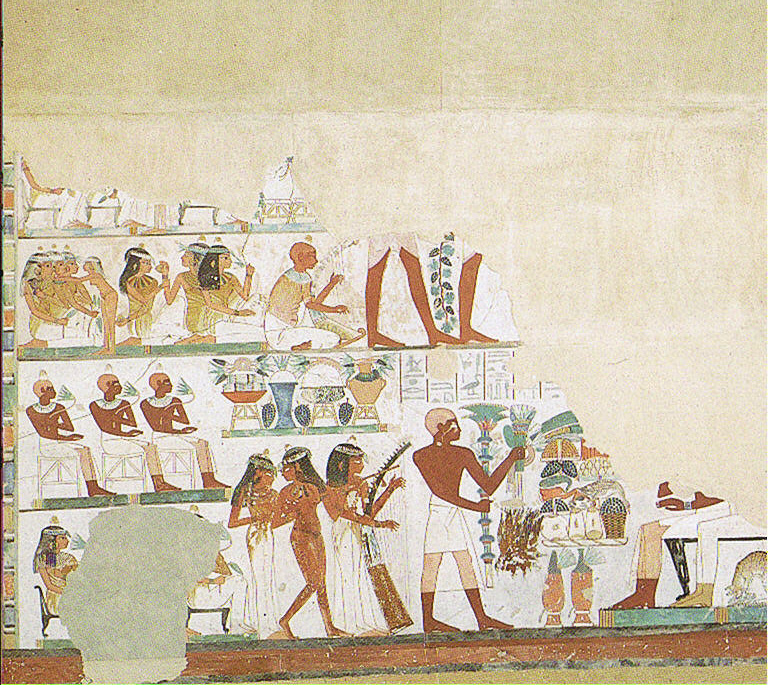 Beautiful Festival of the ValleyAn ancient Egyptian festival honouring the dead with river processions across Thebes
 Sed festivalAn ancient Egyptian royal jubilee marking thirty years of a pharaoh's rule
 Ancient Egyptian funerary practicesRites for the dead in ancient Egypt: preserving the body, spells and grave goods
Good reading and sources
The facts on this page come from the Wikipedia article "Min Festival", written by its contributors and used under the CC BY-SA 4.0 licence, and from its Wikidata record (CC0). EveryParampara rewrote the text in its own words, with AI assistance, and compares every page with the article to make sure no passage is copied. It may be reused under the same CC BY-SA 4.0 licence with a link back.
It may contain mistakes. Traditions differ from one family, village and community to the next, and the people who keep them know them best. If something is wrong, tell us. Last refreshed 2026-10-05.
More from Egypt
All the traditions of Egypt
🇪🇬 Luxor, EgyptOpet Festivalḥb nfr n jpt
An ancient Egyptian festival in Thebes celebrating divine kingship and the Nile floodSpiritual
🇪🇬 Thebes, EgyptBeautiful Festival of the Valleyhb nfr n jnt
An ancient Egyptian festival honouring the dead with river processions across ThebesSpiritual
🇲🇦 Morocco and 1 moreHamadsha
A Moroccan possession rite kept by Muslim fraternities to cure affliction and restore social balance through music and dSpiritual
 🇹🇷 Konya, Turkey and 4 moreMevlevi OrderMevlevilik
A Sufi tradition from Konya known for its whirling ceremony and devotion to Rumi's teachings.Spiritual
🇹🇷 Konya, Turkey and 4 moreMevlevi OrderMevlevilik
A Sufi tradition from Konya known for its whirling ceremony and devotion to Rumi's teachings.Spiritual
The same idea elsewhere
Royalty and coronation compared 🇮🇱 IsraelRosh Hashanahרֹאשׁ הַשָּׁנָה
The Jewish New Year marked by shofar horn blasts, prayer and sweet foodsSpiritual
🇮🇱 IsraelRosh Hashanahרֹאשׁ הַשָּׁנָה
The Jewish New Year marked by shofar horn blasts, prayer and sweet foodsSpiritual
 🇸🇪 Mora, SwedenVasaloppet
A 90 km cross-country ski race from Sälen to Mora, run every March since 1922Game
🇸🇪 Mora, SwedenVasaloppet
A 90 km cross-country ski race from Sälen to Mora, run every March since 1922Game
 🇵🇪 Cusco, Peru and 4 moreIntiinti (Quechua)
The Inca sun deity, honoured with temples, offerings and the June festival Inti RaymiSpiritual
🇹🇭 ThailandThai solar calendarปฏิทินสุริยคติไทย
The official solar calendar of Thailand, numbered in the Buddhist EraSeasonal
🇵🇪 Cusco, Peru and 4 moreIntiinti (Quechua)
The Inca sun deity, honoured with temples, offerings and the June festival Inti RaymiSpiritual
🇹🇭 ThailandThai solar calendarปฏิทินสุริยคติไทย
The official solar calendar of Thailand, numbered in the Buddhist EraSeasonal