Music, dance and storytellingCentral Asia and the CaucasusChristian
Georgian polyphonic singing
Several voices at once, sung without instruments at Georgian feasts and weddings

Georgian polyphonic singing is a village tradition in which several voices sound at once, often with no instrument at all. It grew in the regions of Georgia well before Christianity reached the country in the 4th century, and it is still sung at feasts, weddings, funerals and on concert stages.
When is Georgian polyphonic singing kept?
Georgian polyphonic singing is kept at village feasts, weddings and funerals, and on concert stages today.
In Georgia, singing often happens with several voices at once and no instruments at all. This polyphonic style is older than the country's Christianity, and it belongs to villages, families and whole communities. A guest at a large feast may hear dozens of singers holding the low part while one or two voices carry the melody above them.
What it is
Georgian folk music is mostly sung, not played. Its best known feature is polyphony: two, three or four separate vocal lines sounding at the same time. Some of it is sung with no instruments at all. Singers and scholars count at least fifteen regional styles, which they call musical dialects. Edisher Garaqanidze put the number at sixteen. In everyday life the music belongs to the whole community: at a large feast or a wedding, everybody joins in. The top parts are usually taken by one voice each, while the bass can grow to dozens or even hundreds of singers.
East and west
The regional styles fall into an eastern group and a western one. The two largest areas, Kartli and Kakheti, sit in the east, together with the mountain districts of Khevsureti, Pshavi, Tusheti, Khevi, Mtiuleti and Gudamakari, and the southern district of Meskheti. Feasting songs from Kakheti often carry a long held bass note under two solo voices, and Chakrulo, a patriotic song, is the best known of them. In the west are Imereti, the highlands of Svaneti, Racha and Lechkhumi, and the coastal areas of Samegrelo, Guria and Achara. Singing from Guria is admired for its independent melodic lines, and singers there add krimanchuli, a local kind of yodel.
Sound and tuning
The old tuning is not the western European one. Georgian intervals are measured differently, and scholars describe the scale as slightly compressed in places, so the third often sits between major and minor. One chord, made of a fourth with a second stacked above it, is so common that Dimitri Arakishvili, who founded the study of Georgian ethnomusicology, named it the Georgian triad. Harmony leans on seconds, fourths, sevenths and ninths, which sound sharp to outside ears. From 1886, when the first professional choir was formed, singers began to drift towards equal temperament. Mtiebi, Anchiskhati and the American group Kavkasia later went back to the older tuning, and in Svaneti some singers never left it.
At the table
Much of this singing happens at the supra, a banquet with food, wine and toasts. Songs and speeches follow one another, honouring God, peace, the homeland, long life, love and friendship. Zamtari, a winter song about how quickly life passes, is sung to remember the dead, and the many versions of Mravalzhamier close a gathering. Work songs survive too: orovela is a solo song from the east, while naduri, a hard three or four part piece, comes from the west. There are songs for healing, funerals, weddings, love and dancing, along with lullabies and travelling songs. Many old songs are tied to round dances.
Singers today
Under Soviet rule, from 1921 to 1991, folk music was officially praised and its leading musicians were given prizes. Church songs were banned, large choirs took the place of small groups, dance was separated from singing on stage, and smaller ensembles and improvisation returned in the 1950s and 1960s. From the 1970s the Rustavi Choir and Georgian Voices carried this music to audiences abroad, and the pop group Orera blended polyphony with jazz. Since the 1980s ensembles of non-Georgian singers have formed outside Georgia, first in the United States and Canada, later in Europe. UNESCO recognised the singing in 2001 and again in 2008; Georgia added it to its own heritage register in 2011.
How Georgian polyphonic singing is kept
Singing here is a shared act, not a show put on by a few. At celebrations, and above all at weddings, everyone present is expected to join in. One or two strong voices take the decorated upper lines, while the bass gathers as many singers as there are, sometimes dozens. Smaller groups also exist, and in western Georgia a trio of three singers is a favourite form. At a supra, songs and toasts alternate. Village singers, most of them farmers, carried this music for centuries, and today's ensembles learn much from the gramophone recordings made of them from the late 19th century onwards.
When and where
The singing is not tied to one date. It belongs to the moments when people gather: feasts, weddings, funerals, working days and evenings of dancing. Since the late 20th century it also has a place on concert programmes and in workshops, which are held through the year in Georgia and abroad.
It is kept across Georgia, in villages and in the cities. The eastern areas of Kartli and Kakheti and the western areas of Imereti, Guria, Samegrelo, Achara, Svaneti, Racha and Lechkhumi each sing in their own way. Two districts outside the present borders, Saingilo in Azerbaijan and Lazeti in Turkey, are sometimes counted with them. Ensembles outside Georgia, in the United States, Canada and Europe, keep it going as well.
What Georgian polyphonic singing means
For the people who sing it, these songs carry memory. Many are addressed to God, to peace, to the homeland or to a long life, and to sing together is to hold a community together. Zamtari is sung to remember those who have died, so grief and belonging share the same tune. The style is also a mark of identity: Georgians point to polyphony as something their villages made long before the country became Christian, and UNESCO's recognition gave that claim a wider audience.


Questions people ask about Georgian polyphonic singing
When is Georgian polyphonic singing kept?
Georgian polyphonic singing is kept at village feasts, weddings and funerals, and on concert stages today.
What is Georgian polyphonic singing?
It is the traditional singing of Georgia, in which two, three or four melodic lines sound together. Most of it is unaccompanied. Singers learn it in villages and in ensembles, and it exists in at least fifteen regional styles that scholars call musical dialects.
Where is it sung?
Across Georgia, in villages and cities alike, with strong traditions in Kartli, Kakheti, Imereti, Guria, Samegrelo, Svaneti and other regions. Communities of Georgian singers abroad, in the United States, Canada and Europe, also perform it. Two areas now inside Azerbaijan and Turkey are sometimes included.
Does everyone sing the same part?
No. One or two singers take the decorated upper lines, and the bass is open to many voices at once, sometimes dozens or hundreds at a feast. In western Georgia a trio of three singers is a well-loved form, and mixed groups are more common in villages than on stage.
Is the tradition officially recognised?
Yes. UNESCO named it among the Masterpieces of the Oral and Intangible Heritage in 2001 and recognised it again in 2008, and in 2011 Georgia placed it on its own register of intangible cultural heritage.
See also
 RaraA Haitian street music of bamboo trumpets and drums, played in the Easter season
 HoronLine dances of Turkey's eastern Black Sea coast, danced with shaking shoulders
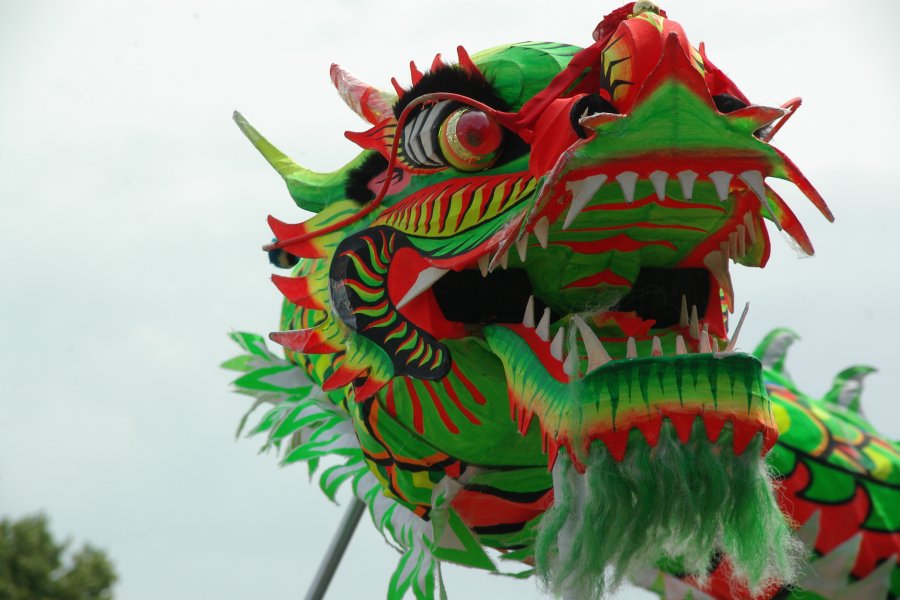 Dragon danceA long dragon puppet on poles, danced by a team at Chinese New Year and other festivals
 PuntaA lively dance and music style of the Garifuna people, celebrated in Central America and the Caribbean.
Good reading and sources
- BBC Radio 3 - World Routes, World Routes in Georgia, Polyphonic drinking songs and choral musicBBC, Article
- BBC Radio 3 - World Routes, World Routes in Georgia, Polyphonic drinking songs and choral musicBBC, Article
- Music of Georgia (country) on WikipediaEncyclopedia
- More photos on Wikimedia CommonsPhotos and video
- Wikidata recordOpen data
The facts on this page come from the Wikipedia article "Music of Georgia (country)", written by its contributors and used under the CC BY-SA 4.0 licence, and from its Wikidata record (CC0). EveryParampara rewrote the text in its own words, with AI assistance, and compares every page with the article to make sure no passage is copied. It may be reused under the same CC BY-SA 4.0 licence with a link back.
It may contain mistakes. Traditions differ from one family, village and community to the next, and the people who keep them know them best. If something is wrong, tell us. Last refreshed 2026-10-05.
More from Georgia
All the traditions of Georgia 🇬🇪 Tbilisi, GeorgiaGeorgian danceქართული ცეკვა
Martial, courtship, and celebratory regional dances from across GeorgiaPerformance
🇬🇪 GeorgiaBerikaobaბერიკაობა
An improvised Georgian folk theatre and masquerade of fertility, satire and dramaPerformance · Feasts and festival meals
🇬🇪 Tbilisi, GeorgiaGeorgian danceქართული ცეკვა
Martial, courtship, and celebratory regional dances from across GeorgiaPerformance
🇬🇪 GeorgiaBerikaobaბერიკაობა
An improvised Georgian folk theatre and masquerade of fertility, satire and dramaPerformance · Feasts and festival meals
 🇹🇷 Bursa, Turkey and 5 moreKaragöz and Hacivat
A Turkish shadow play of two quarrelling friends, acted on a lit screen behind a curtainPerformance
🇹🇷 Bursa, Turkey and 5 moreKaragöz and Hacivat
A Turkish shadow play of two quarrelling friends, acted on a lit screen behind a curtainPerformance
 🇩🇪 Germany and 5 moreDelphic Games of the modern era
Global competitions and exhibitions across the arts, modelled on ancient Greek gamesPerformance
🇩🇪 Germany and 5 moreDelphic Games of the modern era
Global competitions and exhibitions across the arts, modelled on ancient Greek gamesPerformance
The same idea elsewhere
Weddings compared 🇨🇳 ChinaChinese paper cutting剪紙 / 剪纸 (jiǎnzhǐ)
Chinese cut paper pictures, pasted on windows and doors for luck at New YearCraft
🇨🇳 ChinaChinese paper cutting剪紙 / 剪纸 (jiǎnzhǐ)
Chinese cut paper pictures, pasted on windows and doors for luck at New YearCraft
 🇮🇳 India and 2 morePujaपूजा (pūjā)
Hindu worship: light, flowers and food offered to a deity or a guestSpiritual
🇮🇳 India and 2 morePujaपूजा (pūjā)
Hindu worship: light, flowers and food offered to a deity or a guestSpiritual
 🇷🇺 RussiaBlack wedding
A traditional Jewish crisis wedding held in a cemetery to ward off diseaseSpiritual
🇷🇺 RussiaBlack wedding
A traditional Jewish crisis wedding held in a cemetery to ward off diseaseSpiritual
 🇹🇱 Timor-LesteUma Lulik
Sacred ancestral clan houses and ritual shrines in East TimorSpiritual
🇹🇱 Timor-LesteUma Lulik
Sacred ancestral clan houses and ritual shrines in East TimorSpiritual