Osariya
In its own language: ඔසරිය (Sinhala)
Sri Lanka's national dress: a sari with a waist frill and a full blouse

The Osariya is Sri Lanka's national dress and the dress Sinhalese people, especially the Kandyan Sinhalese, count as their own. It took shape in the Kandyan kingdom, was worn there by women of the upper class, and is still kept for work, weddings and state occasions.
When is Osariya kept?
Osariya is kept on worn for work, weddings and other occasions, and as the national dress.
The Osariya is a sari style that Sinhalese women in Sri Lanka wear as the country's national dress. It is linked to the Kandyan kingdom, where women of the upper class wore it, and it takes its name from the Sinhala word for the garment. People keep it for working days, weddings and formal events, and its look changes with the occasion.
What it is
The Osariya is a form of sari. It has a frill at the waist, and it is worn with a full blouse that hides the midriff rather than leaving it bare. The sleeves are puffed, and the cloth is partly tucked in at the front. Cotton is the material named for it. The word Osariya is Sinhala. People describe it as the Kandyan dress, because it belongs to the Kandyan Sinhalese and to the kingdom of Kandy. It is also called the national dress of Sri Lanka, and it is worn by women rather than men.
Origins and history
The dress comes from the Kandyan Sinhalese of the Kandyan kingdom, and upper class women of that period wore it. How it began is not settled. One view holds that the Nayake dynasty of the Kandyan kingdom gave it its final form. Another holds that the Kandyan dress of the time met influences from mainland Southeast Asia and from South India, and that the Osariya grew out of that meeting. The infobox dates its introduction to the early 20th century. Anagarika Dharmapala, who argued for Sinhalese authenticity in clothing, said an ideal woman's blouse should cover her chest, stomach and back fully, and that a cloth of ten riyans, or cubits, should be worn as an Osariya or sari. He also turned down Western dress for men.
How it is worn
The Osariya is worn by women. The sources give cotton as its material. The cloth is wrapped so that it forms a frill at the waist, with the front partly tucked in, and a full blouse with puffed sleeves goes over it, covering the midriff. That is the shape the sources describe. The details are not fixed. A plainer version serves for work and a grander one for a wedding, the occasion the sources name. Kandyan Sinhalese women wear it, and it also stands as Sri Lanka's national dress on public occasions.
Meaning and identity
For those who wear it, the Osariya carries the idea of being Sinhalese and of being Sri Lankan. It is the national dress, and its name and shape point back to the Kandyan kingdom, so wearing it links a person to that past. In the early 20th century it also became part of a wider argument about modesty and authenticity, when Anagarika Dharmapala argued that a blouse should cover the body fully and that Sinhalese people should not dress in Western clothes. The sources tie the Osariya to no religion.
How Osariya is kept
The Osariya is worn by women, and the sources name cotton as its material. A frill is formed at the waist, the front of the cloth is partly tucked in, and a full blouse with puffed sleeves covers the midriff. That is the shape described. The finish is not fixed: a plain version suits a working day and a grander one a wedding, the occasion the sources name. Kandyan Sinhalese women wear it, and it also represents Sri Lanka as national dress at public events.
When and where
The Osariya has no fixed date. It belongs to the occasion rather than the calendar, and the sources name work and weddings, with the look of the dress changing to match. It is also worn as national dress when the country marks formal and public events.
The Osariya belongs to Sri Lanka, where it is the national dress. It is strongest among the Kandyan Sinhalese, whose kingdom was centred on Kandy, and it came from that court and its upper class. The sources also mention South India and mainland Southeast Asia as possible influences on how it developed, but not as places where it is kept.
What Osariya means
For those who wear it, the Osariya carries the idea of being Sinhalese and of being Sri Lankan. It is the national dress, and its name and shape point back to the Kandyan kingdom, so wearing it links a person to that past. In the early 20th century it also became a way of talking about modesty and authenticity, when Anagarika Dharmapala argued that a blouse should cover the body fully and that Sinhalese people should not dress in Western clothes.
Questions people ask about Osariya
When is Osariya kept?
Osariya is kept on worn for work, weddings and other occasions, and as the national dress.
What is an Osariya?
It is a form of sari and the national dress of Sri Lanka, worn by Sinhalese women. It has a frill at the waist and a full blouse with puffed sleeves that covers the midriff, and the front of the cloth is partly tucked in.
Where is it worn?
It belongs to Sri Lanka, and it is tied most closely to the Kandyan Sinhalese and the old kingdom of Kandy. The article also names South India and mainland Southeast Asia as possible influences on how it developed.
Where does it come from?
It comes from the Kandyan Sinhalese of the Kandyan kingdom, where women of the upper class wore it. Scholars disagree about its beginnings: one view points to the Nayake dynasty, another to contact with mainland Southeast Asia and South India.
Is it connected to a religion?
The sources do not tie the Osariya to any religion. It is a national and cultural dress, worn by Sinhalese women, and the discussion around it in the early 20th century was about Sinhalese identity and modesty rather than religious practice.
See also
 SariAn unstitched length of cloth that women drape around the body, worn across South Asia
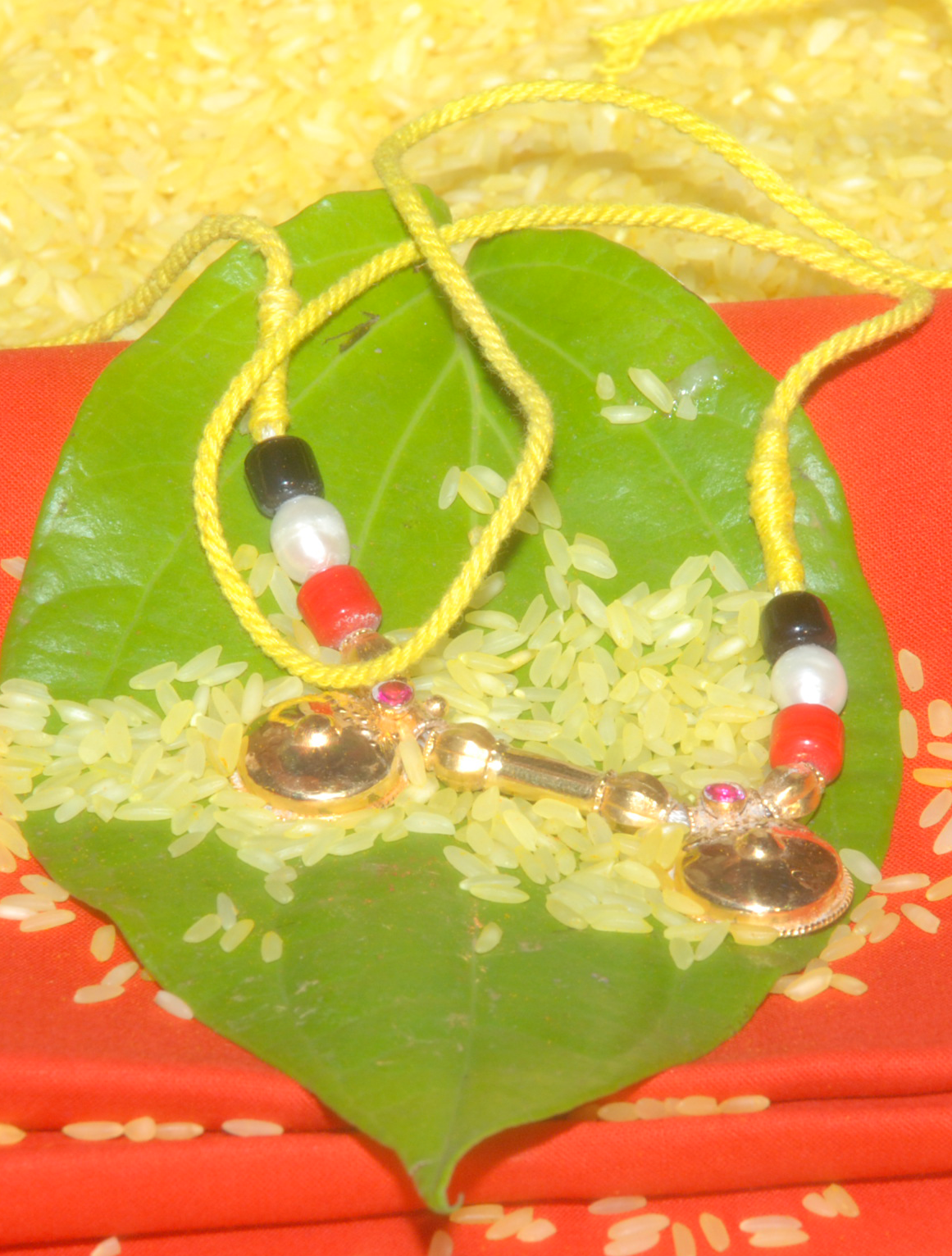 MangalasutraA necklace tied by the groom at a wedding, worn through married life
 SherwaniA long buttoned coat for men, worn at weddings and state occasions in South Asia
 BindiA dot worn between the eyebrows, red for marriage and devotion, worn daily by many women
Good reading and sources
The facts on this page come from the Wikipedia article "Osariya", written by its contributors and used under the CC BY-SA 4.0 licence, and from its Wikidata record (CC0). EveryParampara rewrote the text in its own words, with AI assistance, and compares every page with the article to make sure no passage is copied. It may be reused under the same CC BY-SA 4.0 licence with a link back.
It may contain mistakes. Traditions differ from one family, village and community to the next, and the people who keep them know them best. If something is wrong, tell us. Last refreshed 2026-10-10.
More from Sri Lanka
All the traditions of Sri Lanka
🇮🇳 Lucknow, India and 3 moreSherwani
A long buttoned coat for men, worn at weddings and state occasions in South AsiaDress
🇮🇳 India and 4 moreSariसाड़ी
An unstitched length of cloth that women drape around the body, worn across South AsiaDress
🇮🇳 India and 2 moreMangalasutraमङ्गलसूत्रम् (maṅgalasūtram)
A necklace tied by the groom at a wedding, worn through married lifeDress
🇮🇳 India and 5 moreBindi
A dot worn between the eyebrows, red for marriage and devotion, worn daily by many womenDress
The same idea elsewhere
Weddings compared 🇼🇸 Samoa and 1 moreʻIe tōga
Precious woven mats exchanged in Samoan ceremonies to honor family ties and chiefly status.Dress
🇼🇸 Samoa and 1 moreʻIe tōga
Precious woven mats exchanged in Samoan ceremonies to honor family ties and chiefly status.Dress
 🇹🇱 Timor-LesteUma Lulik
Sacred ancestral clan houses and ritual shrines in East TimorSpiritual
🇹🇱 Timor-LesteUma Lulik
Sacred ancestral clan houses and ritual shrines in East TimorSpiritual
 🇮🇩 Indonesia and 2 moreKenduri
A communal prayer meal and gathering shared across Indonesia, Malaysia and BruneiSpiritual · Feasts and festival meals
🇺🇬 UgandaKwanjula
A formal marriage introduction ritual of the Baganda people in Uganda, where families meet to exchange gifts and seek blRite of passage
🇮🇩 Indonesia and 2 moreKenduri
A communal prayer meal and gathering shared across Indonesia, Malaysia and BruneiSpiritual · Feasts and festival meals
🇺🇬 UgandaKwanjula
A formal marriage introduction ritual of the Baganda people in Uganda, where families meet to exchange gifts and seek blRite of passage