Music, dance and storytellingEast Asia
Peking opera
In its own language: 京剧 / 京劇 (Jīngjù)
China's main opera form: song, dance and acrobatics tell the story on a bare stage
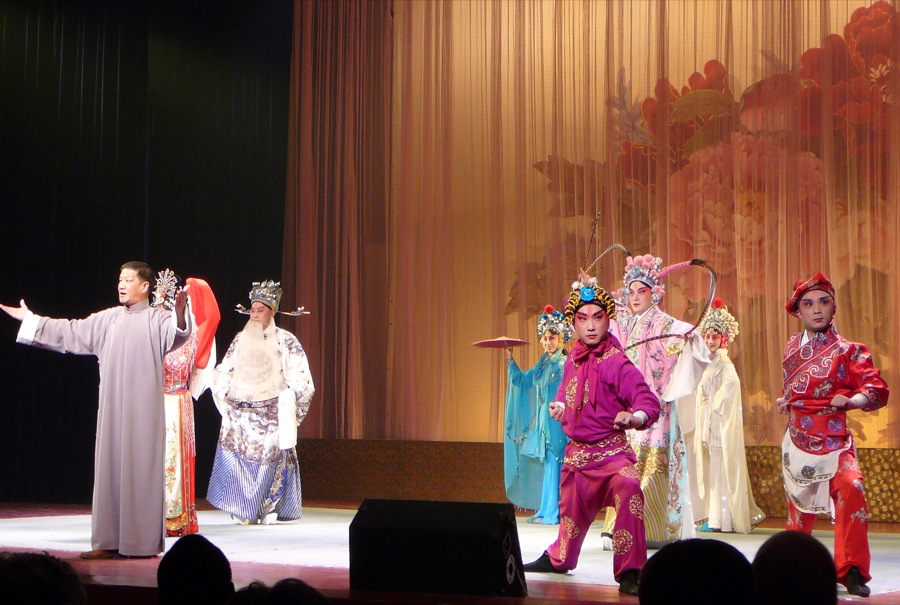
Peking opera, also called Beijing opera or Jingju, is the leading form of Chinese opera. It grew out of Hui and Hubei troupes who came to Beijing in 1790 and 1828, took full shape by about 1845, and has been performed since in mainland China, Taiwan and beyond.
When is Peking opera kept?
Peking opera is kept on performed through the year, with no fixed season. Its beginning is dated to 25 September 1790, when Anhui troupes reached Beijing..
Peking opera is the best-known form of Chinese opera, a theatre of song, speech, dance, mime, acrobatics and martial arts. It began in Beijing in the middle of the Qing dynasty and was fully formed by the 1840s. Performers in bright costumes carry the whole story on a stage that holds almost nothing else.
The four role types
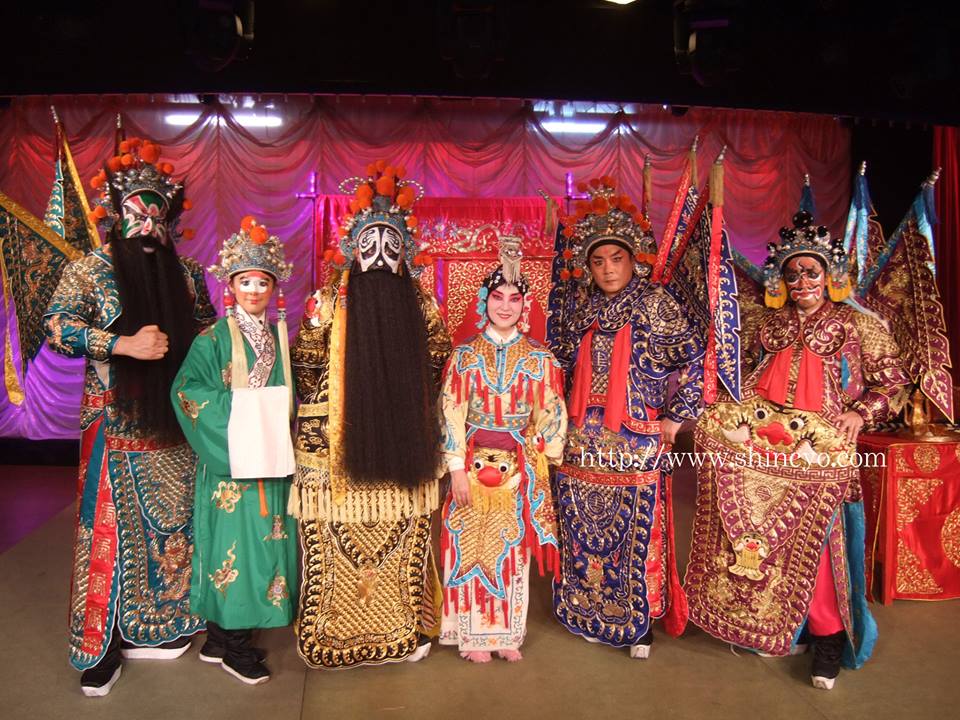
Every Peking opera cast is built from four kinds of role. The shēng are male characters, the dàn are women, the jìng are forceful painted men and the chǒu are clowns. A troupe usually has several of each kind, plus supporting and minor players. Costumes are elaborate and colourful, and the performer is the only focus on a stage that is deliberately bare. Movements are symbolic and suggestive rather than realistic, so a gesture can stand for something far larger. Audiences learn these conventions and use them to follow the plot.
Origins in Beijing
The form took shape when troupes from Anhui came to Beijing in 1790 to mark the Qianlong Emperor's eightieth birthday. They played at court at first, and only later for the public. More troupes arrived from Hubei in 1828, and the two styles blended. By about 1845, most people treated Peking opera as a finished art. Its roots lie in the dialect regions of Anqing and eastern Hubei. Older traditions fed into it: staging and style came partly from Kunqu, and some scholars link one of its melodies, xipi, to the older Qinqiang.
Song, speech and movement
Music carries the whole performance. Its two main melodic styles are xipi and erhuang, and the earliest Chinese name for the art, Píhuáng, joined the two names together. Arias, fixed tunes and percussion patterns make up a score, and every movement has to land with the music. Dialogue uses an old form of Mandarin. The best-known measure of a performer is not realism but the beauty of the movement. A large repertoire supports all this: more than 1,400 works draw on Chinese history and folklore, and increasingly on present-day life.
Court, bans and revolution
Peking opera began as a male world. Qing emperors banned women from the stage, from the Kangxi reign in 1671 to a last ban in Beijing in 1772. Women appeared unofficially in the 1870s, some taking male roles. Li Maoer, a former performer, set up the first women's troupe in Shanghai, and by 1894 there was a commercial venue for such troupes. The ban ended in 1912. Later, politics pressed hard again. During the Cultural Revolution the form was attacked and largely replaced by model revolutionary operas, five of them Peking operas. Traditional plays returned after the late 1970s.
Today and reform
Audiences shrank steadily in the second half of the twentieth century. Performers and scholars blame falling standards on one side, and on the other the difficulty of telling modern stories in an old form. Its archaic language often needs electronic subtitles, and younger viewers can find the pace slow. From the 1980s, troupes tried reforms: training in performance theory, modern staging, shorter works and new plays. Funding has been short and the political climate has not always helped. Taiwan keeps its own strong tradition, where the art is called Guójù, meaning national opera.
How Peking opera is kept
A performance brings together singing, spoken lines, dance, mime, acrobatics and martial arts. Music from the orchestra drives it, in the xipi and erhuang styles, with arias, fixed tunes and percussion. Casts are drawn from the four role types, shēng, dàn, jìng and chǒu, with supporting players behind them. Actors wear heavy, bright costumes and painted faces, and they carry the story alone on a stage with almost no scenery. Every movement is symbolic and timed to the music, and audiences follow the plot through conventions they already know. Troupes in Beijing, Tianjin and Shanghai keep the form today.
When and where
Peking opera has no single season. It is performed through the year by resident troupes. Its beginning is dated to 25 September 1790, the Qianlong Emperor's eightieth birthday, when Anhui troupes first performed in Beijing. Full development is usually placed around 1845.
It belongs to China, where Beijing is its home and troupes also work from Tianjin and Shanghai. It is preserved in Taiwan, where it is known as Guójù. It has spread to other places too, including the United States and Japan. Its roots reach back to Anhui and Hubei, the regions whose troupes created it.
What Peking opera means
For those who keep it, Peking opera is more than entertainment. It was long tied to the Qing court, and today it is treated as one of China's cultural treasures. In Taiwan it once stood for a claim to represent Chinese culture, and its name there, national opera, carries that history. Its sparse stage and exact gestures ask the audience to read meaning into every movement, so watching is a skill passed on between generations.


Questions people ask about Peking opera
When is Peking opera kept?
Peking opera is kept on performed through the year, with no fixed season. Its beginning is dated to 25 September 1790, when Anhui troupes reached Beijing..
What is Peking opera?
A form of Chinese opera that tells stories through singing, speech, dance, mime, acrobatics and martial arts. Performers wear elaborate costumes and painted faces and work on a nearly empty stage, where movements are symbolic rather than realistic. It is the best-known branch of Chinese opera, with more than 1,400 works in its repertoire.
Where is it kept?
Mainly in mainland China, with Beijing as its home and major troupes also in Tianjin and Shanghai. It is also preserved in Taiwan, where it is called Guójù. Outside these places it has spread to countries such as the United States and Japan.
What are the four role types?
Peking opera divides its characters into four kinds: shēng for male roles, dàn for female roles, jìng for forceful painted men and chǒu for clowns. A troupe normally keeps several performers of each kind, together with secondary and minor players, so it can stage a range of works.
Is it recognised as heritage?
Yes. UNESCO added Peking Opera to its Representative List of the Intangible Cultural Heritage of Humanity in 2010, put forward by China. Inside China it is often described as a cultural treasure.
See also
 Chinese operaA sung, danced and acrobatic theatre from China, in over a hundred regional styles
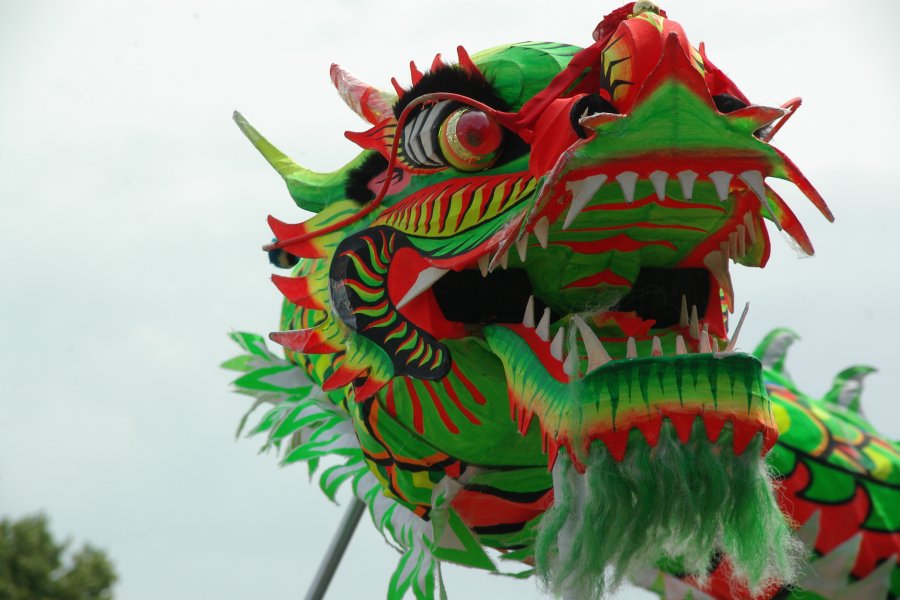 Dragon danceA long dragon puppet on poles, danced by a team at Chinese New Year and other festivals
 KizombaA close, slow couple dance from Angola, named after a Kimbundu word for party
 Glove puppetryA traditional theatre of cloth-bodied puppets with carved wooden heads and live music
Good reading and sources
- Peking opera on WikipediaEncyclopedia
- More photos on Wikimedia CommonsPhotos and video
- Wikidata recordOpen data
The facts on this page come from the Wikipedia article "Peking opera", written by its contributors and used under the CC BY-SA 4.0 licence, and from its Wikidata record (CC0). EveryParampara rewrote the text in its own words, with AI assistance, and compares every page with the article to make sure no passage is copied. It may be reused under the same CC BY-SA 4.0 licence with a link back.
It may contain mistakes. Traditions differ from one family, village and community to the next, and the people who keep them know them best. If something is wrong, tell us. Last refreshed 2026-10-05.
More from China
All the traditions of China 🇹🇼 Yilan, Taiwan and 4 moreTaiwanese opera歌仔戲
A Taiwanese theatrical art of Hokkien balladry, stylized staging, and expressive song.Performance
🇹🇼 Yilan, Taiwan and 4 moreTaiwanese opera歌仔戲
A Taiwanese theatrical art of Hokkien balladry, stylized staging, and expressive song.Performance
 🇨🇳 China and 5 moreLion dance舞獅
A dynamic ritual dance featuring costumed lions, drums and martial acrobaticsPerformance
🇨🇳 Quanzhou, China and 3 moreGlove puppetry布袋戲
A traditional theatre of cloth-bodied puppets with carved wooden heads and live musicPerformance
🇨🇳 China and 5 moreLion dance舞獅
A dynamic ritual dance featuring costumed lions, drums and martial acrobaticsPerformance
🇨🇳 Quanzhou, China and 3 moreGlove puppetry布袋戲
A traditional theatre of cloth-bodied puppets with carved wooden heads and live musicPerformance
 🇨🇳 China and 5 moreShadow play
A storytelling art using flat puppets and light to cast moving silhouettes on a screen.Performance
🇨🇳 China and 5 moreShadow play
A storytelling art using flat puppets and light to cast moving silhouettes on a screen.Performance
The same idea elsewhere
All of this kind 🇹🇷 Kayseri, Turkey and 4 moreHalay
A traditional line and circle folk dance kept across Turkey, Azerbaijan, Armenia, Iran, and Syria.Performance
🇧🇷 BrazilBaião
A syncopated folk rhythm and partnered dance from northeastern BrazilPerformance
🇹🇷 Kayseri, Turkey and 4 moreHalay
A traditional line and circle folk dance kept across Turkey, Azerbaijan, Armenia, Iran, and Syria.Performance
🇧🇷 BrazilBaião
A syncopated folk rhythm and partnered dance from northeastern BrazilPerformance
 🇺🇦 Kyiv, UkraineBanduraБандура
A Ukrainian plucked string instrument played to accompany epic songs and folk balladsPerformance
🇺🇦 Kyiv, UkraineBanduraБандура
A Ukrainian plucked string instrument played to accompany epic songs and folk balladsPerformance
 🇳🇿 Auckland, New ZealandPoi
A Māori performing art of swinging tethered weights in rhythmical patterns.Performance
🇳🇿 Auckland, New ZealandPoi
A Māori performing art of swinging tethered weights in rhythmical patterns.Performance