Life-cycle ritesSouth AsiaHinduMuslim
Political marriages in India
Royal marriages arranged to seal treaties, peace and power in Indian history

Across Indian history, ruling houses married their sons and daughters into other dynasties to make peace, gain land or hold power. Court records, inscriptions and chronicles from the Mauryan period onward describe brides, dowries and envoys exchanged between royal families, a practice that continued under Deccan kingdoms, Rajput clans and sultanates.
When is Political marriages in India kept?
Political marriages in India is kept on no fixed time; arrangements were made as politics required, from the fourth century BCE into the medieval period.
Political marriage in India means a union arranged between ruling families for reasons of state. A king gave a daughter, or took a bride, to end a war, win an ally or lift his family's standing. Records from the Mauryan age onward describe such matches among Guptas, Deccan dynasties, Rajput clans and sultanates, with land, elephants and promises travelling with the bride.
What it was
These were marriages made for a purpose beyond the couple: an alliance between two ruling houses. A king might give a daughter to a rival to end a war, or take a princess to secure a border. Land, treasure, elephants or the promise of troops could travel with the bride. The sources call these unions matrimonial or marital alliances, and note that they bound dynasties together for generations. A marriage also carried a message about status: a family that married into a grander house rose in rank. In some accounts the arrangement ran the other way, with a princess coming to the Indian court. Not every alliance held, and wars sometimes resumed between in-laws.
Early alliances
The earliest detailed case involves the Mauryas. Seleucus I Nicator, once a general under Alexander of Macedon, held Babylon as his seat and by 312 BCE ruled a kingdom of his own. He and Chandragupta fought until they came to terms, and a marriage sealed the agreement. Territory west of the Indus passed to the Mauryas, and five hundred war elephants went the other way, helping Seleucus win at Ipsus. Some scholars argue the bride came from the other side, since Greek writers never mention an Indian queen. A Puranic text and the Mahavamsa both name a Greek princess who married Chandragupta, and envoys followed the treaty: Megasthenes attended Chandragupta's court, and Deimakos was sent later to Bindusara at Patna.
Gupta and southern houses
Chandragupta I married Kumaradevi of the Lichchhavi clan, whose homeland may have lain near Vaishali in Bihar or in present-day Nepal. Samudragupta's inscription says subordinate kings pleased him by attending on him and offering their daughters. Chandragupta II took a Naga princess, Kuberanaga, and the match is thought to have helped him against the Western Kshatrapas. Kumaragupta I's wife Anantadevi is called a Kadamba princess by R. N. Dandekar, and a pillar inscription at Talagunda records a Kadamba alliance with the Guptas. Further south, Simuka's son Satakarni married Nayanika, and Vashishtiputra Satakarni took the daughter of Rudradaman I, receiving Aparanta as dowry. Fighting between the two houses went on regardless.
Vakatakas and Chalukyas
Rudrasena II of the Vakatakas married Prabhavatigupta, whose father was the Gupta emperor Chandragupta II. Narendrasena's wife came from Kuntala. Amoghavarsha I of the Rashtrakutas gave his daughter Chandrabbalabbe to the Ganga prince Butuga I, sealing an alliance between the two houses. Kirtivarman II married into the Sendraka family after he defeated the Kadambas, and Pulakeshin's Ganga wife was mother to Vikramaditya I. Ayyana I took a Rashtrakuta bride, which raised his family's standing, and Vikramaditya VI married a Chola princess for a truce while marrying his own daughter Maila Devi to a Kadamba king to quiet a revolt.
Sultans and Rajputs
From the thirteenth century, sultans and Rajput houses also intermarried. Ramachandra of the Yadavas gave his daughter Jhatyapali to Alauddin Khalji; her son Shihab-ud-din Omar later followed Alauddin on the throne. Ghiyas-ud-din Tughlaq married a Hindu Jat woman, and Firuz Shah Tughlaq is said to have built a palace at Hisar for a Gurjar wife. In 1406 Firuz Shah Bahmani, a Muslim ruler, took a princess from Vijayanagara; her father, Deva Raya II, was a Hindu king. The Guhilas married into many clans, and one Guhila princess wed a Songira chief, a match the records note went against the clan rules.
How Political marriages in India is kept
A marriage of this kind began as a bargain between courts rather than a private matter. Envoys were exchanged, terms agreed, and the bride or groom sent to the other house, sometimes with land, treasure or elephants as dowry. The match was concluded between the houses and treated as a treaty. In many cases the new relatives owed military support. Sources record mixed results: an alliance might end a feud or raise a family's standing, or fail, with the two houses going to war again, as happened between the Satavahanas and the Western Satraps.
When and where
There was no set season for these matches. They were made when a ruler wanted peace, a safer border or an ally against a stronger neighbour. Some can be dated, such as the Bahmani marriage of 1406 and the eleventh-century unions that followed Deccan rebellions.
The practice belongs to the Indian subcontinent, and the sources describe it mainly in royal courts: Magadha and Patna under the Mauryas, Gupta lands in the north, the Deccan under the Satavahanas, Vakatakas, Chalukyas and Rashtrakutas, Rajasthan and Gujarat among Rajput clans, and the sultanates of Delhi, Jaunpur, Bidar and Bijapur.
What Political marriages in India means
To those who arranged them, these marriages meant more than a wedding. A bride carried a promise between two houses, and the giving or taking of a wife showed which family stood higher. A marriage could end a feud, mark a defeat, or turn a rival into a relative who would send troops. Dowry and territory sealed the meaning. Sources even record objections: one Guhila princess married below her clan's rank, which the records treat as a break with accepted custom.
Questions people ask about Political marriages in India
When is Political marriages in India kept?
Political marriages in India is kept on no fixed time; arrangements were made as politics required, from the fourth century BCE into the medieval period.
What is meant by a political marriage in India?
It means a union arranged between ruling families for reasons of state, such as peace, territory or rank, rather than by the couple's own choice. Sources from the Mauryan period onward record such marriages among Indian dynasties, and the practice continued through Deccan kingdoms, Rajput clans and medieval sultanates.
Where were they most common?
Records come from many parts of the subcontinent: Mauryan Magadha, Gupta territory in the north, the Deccan under the Satavahanas, Vakatakas, Chalukyas and Rashtrakutas, Rajput clans in Rajasthan and Gujarat, and the Delhi, Jaunpur, Bahmani and Bijapur sultanates.
Did the marriages always bring peace?
No. The Satavahanas and the Western Satraps fought again after a marriage, and Rudradaman spared his son-in-law's life mainly because of the family tie. Other unions did hold: one linked the Gangas and Rashtrakutas, and another ended a long feud between two Rajput houses.
Who decided whom a prince or princess married?
Rulers and their advisers decided. Fathers gave daughters away, and sometimes a son was married to a rival's daughter, as Simuka did with Satakarni. Inscriptions record kings offering their daughters to a stronger overlord. The sources hardly ever say what the bride or groom thought.
See also
 SaptapadiThe seven-step ritual that finalizes a Hindu marriage, observed across India.
 MatchmakingThe custom of using a trusted intermediary to introduce partners for marriage
 SvayamvaraAn ancient Indian noble assembly where a bride chose her husband among suitors
 Hindu weddingA traditional Hindu marriage ceremony involving sacred rituals and vows witnessed by fire.
Good reading and sources
- Library of Congress CatalogLibrary of Congress, Article
- Library of Congress CatalogLibrary of Congress, Article
The facts on this page come from the Wikipedia article "Political marriages in India", written by its contributors and used under the CC BY-SA 4.0 licence, and from its Wikidata record (CC0). EveryParampara rewrote the text in its own words, with AI assistance, and compares every page with the article to make sure no passage is copied. It may be reused under the same CC BY-SA 4.0 licence with a link back.
It may contain mistakes. Traditions differ from one family, village and community to the next, and the people who keep them know them best. If something is wrong, tell us. Last refreshed 2026-10-10.
More from India
All the traditions of India
🇮🇳 IndiaSaptapadiसप्तपदी (Sanskrit), सात फेरे (Marathi)
The seven-step ritual that finalizes a Hindu marriage, observed across India.Rite of passage
🇮🇳 India and 2 moreHindu weddingVivaha (विवाह)
A traditional Hindu marriage ceremony involving sacred rituals and vows witnessed by fire.Rite of passage
 🇮🇳 IndiaGaye holudগায়ে হলুদ
A Bengali pre-wedding ceremony where turmeric paste is applied to the bride and groomRite of passage
🇮🇳 IndiaZoroastrian wedding
A multi-day Zoroastrian ceremony uniting two people through prayers, rituals and a shared meal.Rite of passage · Dinner
🇮🇳 IndiaGaye holudগায়ে হলুদ
A Bengali pre-wedding ceremony where turmeric paste is applied to the bride and groomRite of passage
🇮🇳 IndiaZoroastrian wedding
A multi-day Zoroastrian ceremony uniting two people through prayers, rituals and a shared meal.Rite of passage · Dinner
The same idea elsewhere
Weddings compared 🇮🇩 Bali, Indonesia and 5 moreIkat
A resist-dyeing craft from Southeast Asia, where yarns are tied and dyed before weavingCraft
🇮🇩 Bali, Indonesia and 5 moreIkat
A resist-dyeing craft from Southeast Asia, where yarns are tied and dyed before weavingCraft
 🇮🇷 Isfahan, Iran and 3 morePersian gardenباغ ایرانی
An ancient tradition of creating walled, geometric sanctuaries of shade and flowing waterCraft
🇮🇷 Isfahan, Iran and 3 morePersian gardenباغ ایرانی
An ancient tradition of creating walled, geometric sanctuaries of shade and flowing waterCraft
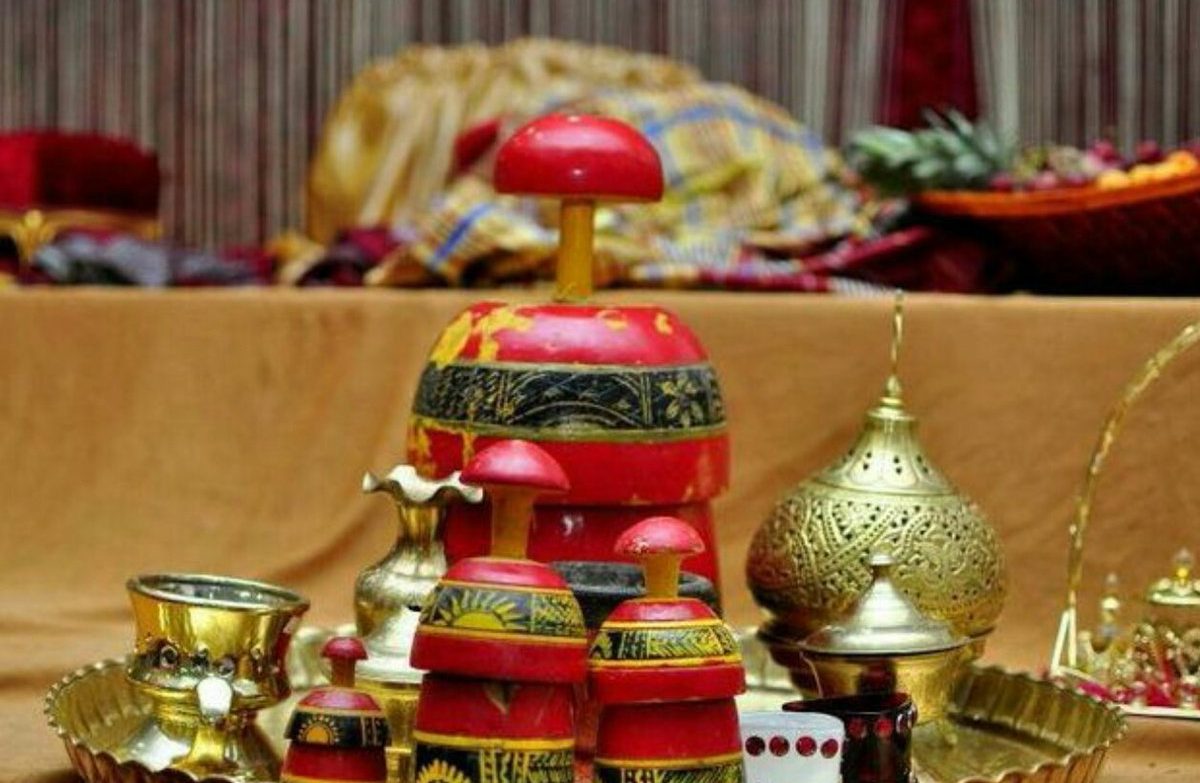 🇸🇩 SudanJirtigالجَرْتِقْ
A Sudanese wedding ritual of regal adornment, protection, and blessings of fertilityRite of passage
🇸🇩 SudanJirtigالجَرْتِقْ
A Sudanese wedding ritual of regal adornment, protection, and blessings of fertilityRite of passage
 🇮🇷 Iran and 4 moreZardoziزردوزی (zarduzi)
Heavy gold and silver embroidery on silk or velvet, worked in Iran, India and beyondCraft
🇮🇷 Iran and 4 moreZardoziزردوزی (zarduzi)
Heavy gold and silver embroidery on silk or velvet, worked in Iran, India and beyondCraft