Music, dance and storytellingEast Asia
Sichuan opera
In its own language: 川劇
A Chinese opera from Sichuan, known for split-second mask changes and a central clown

Sichuan opera is a Chinese opera form from Sichuan province, dated to about 1700 and built from five older melodic styles. It is kept by troupes across Sichuan, Chongqing, Guizhou, Yunnan, Hubei and Taiwan, and is known for instant mask changes and for its comic fool.
Sichuan opera is a form of Chinese opera that grew up in Sichuan province and is usually dated to about 1700. It brings together five older melodic styles with the speech, music and dance of the region. Chengdu is its main home. Audiences know it for performers who change masks in an instant and for the clown, a comic figure given rare importance.
What it is
Sichuan opera is a genre of Chinese opera that took shape in Sichuan province and is generally dated to about 1700. What audiences see today is a blend of five older melodic traditions, each with its own history, brought together with Sichuan speech, local music and dance. Chengdu is its main home, and it is also strong in Chongqing, Guizhou, Yunnan, Hubei and Taiwan. Two features stand out: performers switch masks or personae in an instant, a trick called bian lian, or face changing, and the fool, a comic character, carries unusual weight in the stories. It is the most influential of the regional operas in southwestern China.
Origins and history
Its roots reach back far before the genre itself existed. A play about bullfighting is recorded from the time Li Bing governed Shu County in the 3rd century BC. The Jiaodian opera of the later Han dynasty is described as laying groundwork for early Sichuan opera, and a Warring States poem speaks of 'Xialiba people', a term for local songs and dances and the performers who gave them. In the Three Kingdoms period a satirical piece appears in the records, later treated as the start of the comic strand. Performances flourished under the Tang and the Five Dynasties that followed. Southern opera and Sichuan Zaju were popular in Song and Yuan times.
Modern history
At the close of the Ming dynasty and the start of the Qing, Sichuan lost much of its population, and settlers came in from other provinces, a movement called Huguang filling Sichuan. They carried their own opera with them, so styles sung in northern and southern dialects spread across the province. Over time a settled Sichuan opera took shape, built on Lantern opera and mixing Gaoqiang, Kunqu, huqin and Tanqiang with local speech, customs, music and dance. After the 1911 Revolution a group of singers formed the Sanqing Hui and merged five vocal traditions, moving the art from open squares into theatres. In 1952 a large delegation performed in Beijing. The Cultural Revolution disbanded over a hundred troupes and harmed many performers, and the 1980s brought a revival.
Schools and styles
Different schools grew up over time, shaped by local taste in vocal styles and by how teachers and pupils worked together. Four carry the names of artists: Huanxian, also written Huaxian; Chouxing Fu, or Sangan; Cao, from Junchen and Wusheng; and Wuzhou, or Wuchou. The Cao line is sometimes praised as 'King Cao'. Four others are geographical and known as the four rivers. The western Sichuan Ba school, centred on Chengdu and Wenjiang, sings in the Chengdu dialect and leans on Gaoqiang and Lantern opera. The Ziyang River school, centred on Zigong, is held to have the most careful style. The North Sichuan River school covers Nanchong, Santai, Mianyang and Guangyuan and shows the pull of Qin opera. The Xiachuandong, or Eastern Sichuan, school is centred on Chongqing.
Masks, makeup and music
Face changing is the trick most associated with the genre: a performer swaps mask or persona in the blink of an eye. Makeup carries meaning. Clowns wear a white square on the bridge of the nose, and a painted face can be read like a label: black for strength and honesty, white for deceit and cruelty, red for loyalty and courage, green for the chivalrous, blue for resolve, yellow for tyranny, and gold or silver for the sacred. Music is led by wind and percussion, with suona tunes and loud gong and drum sets. The most distinctive style, Gaoqiang, has a free melodic line, is sung without accompaniment, and keeps time with a clapper and drum while a chorus answers the soloist.
How Sichuan opera is kept
A performance is carried by a troupe of actors, singers and musicians. The percussion players set the pace with gongs and drums, and in the Gaoqiang style a clapper and drum keep time while a chorus answers the lead voice. Actors sing in the dialect of their school, and their painted faces tell the audience what kind of person they are playing. In a face-changing sequence a performer swaps mask or persona in an instant. The fool holds a central place in the stories, and clowns wear a white patch at the bridge of the nose. Some troupes once employed full-time women as backing singers, an innovation of the 1950s.
When and where
Chengdu is the main home of the genre. It is also influential in Chongqing, Guizhou, Yunnan, Hubei and Taiwan. Inside Sichuan the four river schools give it different centres: the west around Chengdu and Wenjiang, the Ziyang River around Zigong and Neijiang, the north around Nanchong, Santai, Mianyang and Guangyuan, and the east around Chongqing.
What Sichuan opera means
For its audiences the opera is a local art that belongs to the people who watch it. Zhou Enlai made this point in 1961, recalling a reply that whether Sichuan opera was backward was for the seventy million people of Sichuan to decide, and saying that art earns its value from those who like it. The fool holds an unusually important place in the plays, and the heritage listing of 2006 marked the genre as public heritage.


Questions people ask about Sichuan opera
What is Sichuan opera?
It is a form of Chinese opera from Sichuan province, usually dated to about 1700, when five older melodic styles were brought together. It mixes those styles with local speech, music and dance, and it is known for fast mask changes and for the weight it gives the comic fool.
Where can it be seen?
Chengdu is its main home. It also has a strong following in Chongqing, Guizhou, Yunnan, Hubei and Taiwan. Within Sichuan, the western Ba school is based around Chengdu and Wenjiang, the Ziyang River school around Zigong and Neijiang, and the North Sichuan River school around Nanchong and Santai.
What is bian lian, or face changing?
It is the quick change of mask or persona that audiences most often single out. The switch is so fast that it is hard to follow. Along with the prominent role given to the fool, it is one of the two features most often named as typical of the genre.
When did the modern form appear?
The opera as it is performed now is usually dated to around 1700, but its roots run much earlier, to songs and dances recorded in the pre-Qin period and to a bullfighting play from the 3rd century BC. Settlers moving into Sichuan at the end of the Ming dynasty brought the styles that were later combined.
What happened to it in modern times?
Troupes were disbanded during the Cultural Revolution and many performers were harmed. Afterwards the art came back quickly: the Sichuan Opera School reopened, a research institute was set up, and a quarterly magazine, The Art of Sichuan Opera, appeared in 1980. In 2006 the Ministry of Culture listed it as intangible heritage.
See also
 Chinese operaA sung, danced and acrobatic theatre from China, in over a hundred regional styles
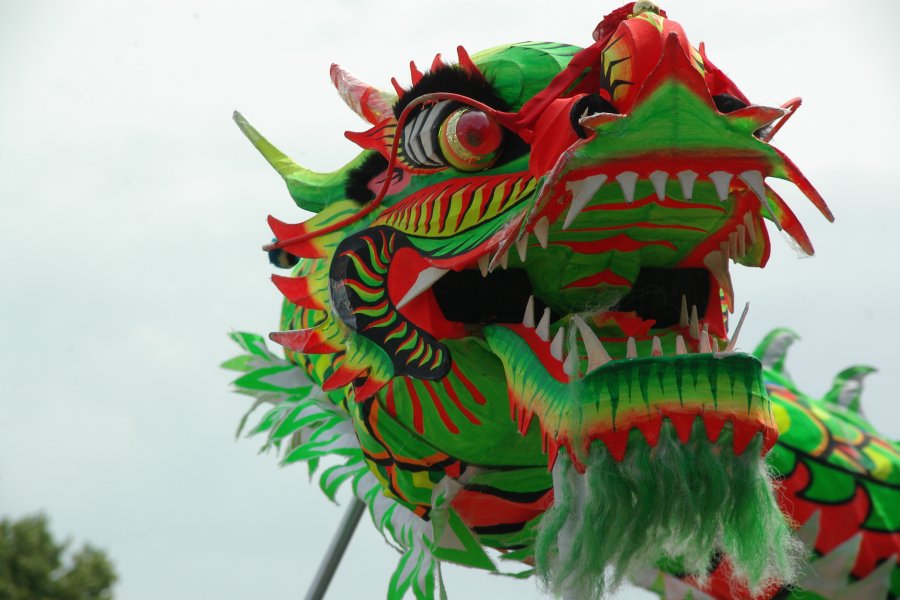 Dragon danceA long dragon puppet on poles, danced by a team at Chinese New Year and other festivals
 KizombaA close, slow couple dance from Angola, named after a Kimbundu word for party
 Glove puppetryA traditional theatre of cloth-bodied puppets with carved wooden heads and live music
Good reading and sources
- Sichuan opera on WikipediaEncyclopedia
- More photos on Wikimedia CommonsPhotos and video
- Wikidata recordOpen data
The facts on this page come from the Wikipedia article "Sichuan opera", written by its contributors and used under the CC BY-SA 4.0 licence, and from its Wikidata record (CC0). EveryParampara rewrote the text in its own words, with AI assistance, and compares every page with the article to make sure no passage is copied. It may be reused under the same CC BY-SA 4.0 licence with a link back.
It may contain mistakes. Traditions differ from one family, village and community to the next, and the people who keep them know them best. If something is wrong, tell us. Last refreshed 2026-10-05.
More from China
All the traditions of China 🇹🇼 Yilan, Taiwan and 4 moreTaiwanese opera歌仔戲
A Taiwanese theatrical art of Hokkien balladry, stylized staging, and expressive song.Performance
🇹🇼 Yilan, Taiwan and 4 moreTaiwanese opera歌仔戲
A Taiwanese theatrical art of Hokkien balladry, stylized staging, and expressive song.Performance
 🇨🇳 China and 5 moreLion dance舞獅
A dynamic ritual dance featuring costumed lions, drums and martial acrobaticsPerformance
🇨🇳 Quanzhou, China and 3 moreGlove puppetry布袋戲
A traditional theatre of cloth-bodied puppets with carved wooden heads and live musicPerformance
🇨🇳 China and 5 moreLion dance舞獅
A dynamic ritual dance featuring costumed lions, drums and martial acrobaticsPerformance
🇨🇳 Quanzhou, China and 3 moreGlove puppetry布袋戲
A traditional theatre of cloth-bodied puppets with carved wooden heads and live musicPerformance
 🇨🇳 China and 5 moreShadow play
A storytelling art using flat puppets and light to cast moving silhouettes on a screen.Performance
🇨🇳 China and 5 moreShadow play
A storytelling art using flat puppets and light to cast moving silhouettes on a screen.Performance
The same idea elsewhere
All of this kind 🇹🇷 Kayseri, Turkey and 4 moreHalay
A traditional line and circle folk dance kept across Turkey, Azerbaijan, Armenia, Iran, and Syria.Performance
🇧🇷 BrazilBaião
A syncopated folk rhythm and partnered dance from northeastern BrazilPerformance
🇹🇷 Kayseri, Turkey and 4 moreHalay
A traditional line and circle folk dance kept across Turkey, Azerbaijan, Armenia, Iran, and Syria.Performance
🇧🇷 BrazilBaião
A syncopated folk rhythm and partnered dance from northeastern BrazilPerformance
 🇺🇦 Kyiv, UkraineBanduraБандура
A Ukrainian plucked string instrument played to accompany epic songs and folk balladsPerformance
🇺🇦 Kyiv, UkraineBanduraБандура
A Ukrainian plucked string instrument played to accompany epic songs and folk balladsPerformance
 🇳🇿 Auckland, New ZealandPoi
A Māori performing art of swinging tethered weights in rhythmical patterns.Performance
🇳🇿 Auckland, New ZealandPoi
A Māori performing art of swinging tethered weights in rhythmical patterns.Performance