Spiritual and religiousSoutheast AsiaMuslimIndigenous and traditional
Slametan
A short communal meal on Java where neighbours share food, prayer and a wish for peace

A slametan is a communal meal kept in Java, usually in the evening. It marks births, marriages, deaths, house moves and days of the Islamic calendar, and the men who come are neighbours chosen by how close they live, not by kinship.
When is Slametan kept?
Slametan is kept in the evening, on the day of the event it marks or on a favourable day of the Javanese calendar.
Slametan is a communal meal from Java that gathers neighbours for a short, formal dinner. A host calls it for a birth, a wedding, a death, a move, a day of the Islamic calendar or a village cleaning. Guests eat a little, pray, and go home to finish their meal with their families. The aim is slamet, a state of peace in which nothing happens.
What it is
A slametan is a shared meal that stands at the centre of Javanese religious life. Clifford Geertz, writing in 1960 about his fieldwork, called it the core ritual of Javanese religion, and especially of the abangan strand within it. The feast is kept by the Javanese and by the closely related Sundanese and Madurese. Its name comes from slamet, a Javanese word drawn from the Arabic salam, which describes a state of calm in which nothing will befall a person. A host holds the meal so that this peace rests on everyone present, himself, his household and the men who eat with him.
How a meal runs
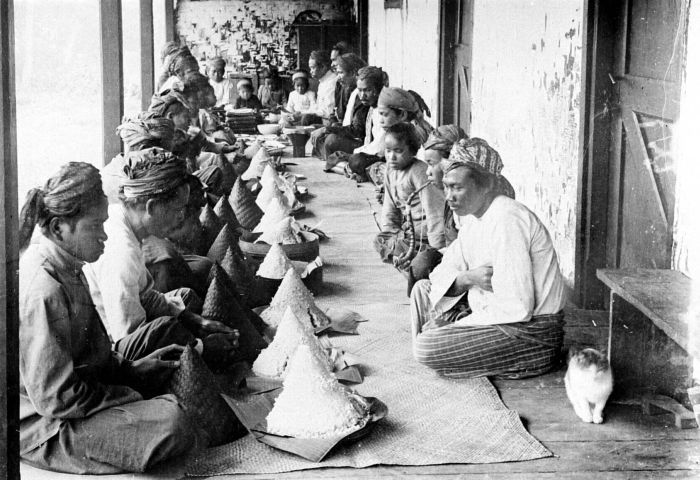
Slametans are held in the evening, after the evening prayer. The day is fixed either by the event itself, as with a birth or a death, or by favourable days in the Javanese calendar. Those who come are men, and they are near neighbours, chosen for how close they live rather than for kinship. A child of the host used to call on them minutes before the start; today invitations arrive by email and social media. Guests sit on mats around the food in the middle of the room while incense burns. The host speaks in high Javanese, thanking them and naming the reason for the meal. A chant-prayer in Arabic follows, led by a kyai, and the men answer aamiin.
Food on the mat
Women of the household do the cooking, and for a large slametan they may bring in female relatives to help. The fare is finer than an ordinary day's, and the host neither touches it nor hands it round. One or two of the guests serve instead. Each kind of food laid out in the middle of the room is understood to carry a meaning, and the host may explain those meanings during his speech. The men eat quickly and without talking, then excuse themselves after a few minutes, leaving most of the food. They take it home and finish it there with their wives and children. The whole affair, from speech to farewell, usually lasts ten or fifteen minutes.
Life-cycle rites
Birth brings four main slametans and several smaller ones. Tingkeban falls at about seven months of pregnancy and is held only for a first child. Babaran, also called brokokan, comes at the birth. Pasaran follows five days later and includes the naming of the baby. Pitonan is kept seven Javanese months after the birth, a month here being thirty-five days. A boy's circumcision and a girl's wedding each have their own feast, and both are treated as marks of growing up. Funerals are held as soon as possible and always involve the village's religious specialist. A slametan is given on the day of death, then again at three, seven, forty and a hundred days, at the first and second anniversaries, and finally at a thousand days.
Days and gatherings
The most important calendrical slametans are Muludan, for the Prophet's birthday on 12 Rabi' al-awwal, and Maleman, near the end of Ramadan. Satu Suro, the first of Muharram, is kept by those who see themselves as consciously Muslim. Since these days come to everyone at once, a man may attend several neighbours' meals, so such gatherings stay small. The bersih désa belongs to the eleventh month, Dhu al-Qi'dah, and each village keeps it on its own days, at the burial place of the village's guardian spirit. Every family sends food and its adult head must attend; in santri villages it may be held at a mosque and be prayer alone. Smaller meals answer private needs: a move, a new name, a journey, a bad dream, sorcery or illness.
How Slametan is kept
A host decides to hold a slametan, and the men of the neighbourhood are the guests. A messenger, often the host's child, calls them shortly before it begins; nowadays an email or a social media message may do the same work. They arrive in the evening after prayer and sit on mats around the food, with incense burning. The host gives a speech in high Javanese, naming his reason and asking for peace on all present, and the men answer inggih. Someone with religious training then chants a prayer in Arabic. Food is served by a guest or two. The men eat briefly, excuse themselves, and complete the meal at home. The whole thing takes ten or fifteen minutes.
When and where
A slametan is usually held in the evening, once the evening prayer has finished. Its date depends on what is being marked. Births and deaths fix it directly, while other occasions are placed on days the Javanese calendar treats as favourable. Calendrical slametans follow the Islamic lunar dates, such as 12 Rabi' al-awwal or the last nights of Ramadan.
The slametan belongs to Java, in Indonesia. It is kept by Javanese people and by two groups close to them, the Sundanese and the Madurese. Clifford Geertz's account came from his fieldwork in a town he called Mojokuto during the 1950s.
What Slametan means
Those who hold a slametan are asking for slamet: a settled, even state in which nothing bad will happen. The host seeks it for himself, for his household and for the men who share the meal. Prayers in Arabic and petitions to spirits both belong to the occasion. Eating the same food in the same place, with no rank among those present, is meant to bind neighbours into one body. The food carries its own meanings too, and each sort may be explained aloud so that everyone understands the wish behind it.

Questions people ask about Slametan
When is Slametan kept?
Slametan is kept in the evening, on the day of the event it marks or on a favourable day of the Javanese calendar.
What is a slametan?
A communal meal held in Java. A host gathers the men of the neighbourhood, speaks, has a prayer chanted, and serves food. It is given for births, marriages, deaths, house moves, days of the Islamic calendar and many other reasons.
Who comes to it?
Men who live nearby. The host chooses them by how close they are, not by friendship or family. Traditionally one of the host's children knocked on their doors minutes before the start, and they had to come at once. Invitations now often go out online.
What is eaten?
A meal finer than everyday food, laid out in the middle of the room and served by one or two of the guests, never by the host, who does not eat. Each kind of dish has a meaning. Tea is served with it. The men eat briefly, then finish the food at home.
How long does it last?
Ten or fifteen minutes, in most accounts. The speech, the prayer and a short spell of eating fill the time. The men then leave and complete the meal with their own families, which is why so little is eaten on the spot.
See also
 KenduriA communal prayer meal and gathering shared across Indonesia, Malaysia and Brunei
 Spirit houseA small roofed shrine on a pillar, kept in homes and villages across Southeast Asia to honour protective spirits.
 ThaipusamA Tamil Hindu festival honoring Murugan through devotional burdens and pilgrimage
 NyepiA Balinese Hindu day of silence, fasting and stillness marking the Saka new year
Good reading and sources
- Slametan on WikipediaEncyclopedia
- More photos on Wikimedia CommonsPhotos and video
- Wikidata recordOpen data
The facts on this page come from the Wikipedia article "Slametan", written by its contributors and used under the CC BY-SA 4.0 licence, and from its Wikidata record (CC0). EveryParampara rewrote the text in its own words, with AI assistance, and compares every page with the article to make sure no passage is copied. It may be reused under the same CC BY-SA 4.0 licence with a link back.
It may contain mistakes. Traditions differ from one family, village and community to the next, and the people who keep them know them best. If something is wrong, tell us. Last refreshed 2026-10-05.
More from Indonesia
All the traditions of Indonesia
🇮🇩 Indonesia and 2 moreKenduri
A communal prayer meal and gathering shared across Indonesia, Malaysia and BruneiSpiritual · Feasts and festival meals
🇹🇭 Thailand and 7 moreSpirit house
A small roofed shrine on a pillar, kept in homes and villages across Southeast Asia to honour protective spirits.Spiritual
🇮🇳 India and 5 moreThaipusam
A Tamil Hindu festival honoring Murugan through devotional burdens and pilgrimageSpiritual
🇮🇩 Bali, IndonesiaNyepiᬜᬾᬧᬶ
A Balinese Hindu day of silence, fasting and stillness marking the Saka new yearSpiritual · Fasting and breaking the fast
The same idea elsewhere
Birth and new babies compared 🇮🇳 India and 2 morePujaपूजा (pūjā)
Hindu worship: light, flowers and food offered to a deity or a guestSpiritual
🇮🇳 India and 2 morePujaपूजा (pūjā)
Hindu worship: light, flowers and food offered to a deity or a guestSpiritual
 🇦🇺 AustraliaSmoking ceremonyNumbuk Yabbun
An Aboriginal Australian ritual of burning native plants to cleanse, heal and welcomeSpiritual
🇦🇺 AustraliaSmoking ceremonyNumbuk Yabbun
An Aboriginal Australian ritual of burning native plants to cleanse, heal and welcomeSpiritual
 🇺🇸 United States and 5 moreRite of passage
A ceremony that marks leaving one group and entering another, with a new statusRite of passage
🇺🇸 United States and 5 moreRite of passage
A ceremony that marks leaving one group and entering another, with a new statusRite of passage
 🇨🇦 Canada and 1 morePotlatch
A ceremonial feast of gift-giving and wealth distribution among First Nations on the Northwest Coast.Festival · Feasts and festival meals
🇨🇦 Canada and 1 morePotlatch
A ceremonial feast of gift-giving and wealth distribution among First Nations on the Northwest Coast.Festival · Feasts and festival meals