Life-cycle ritesEuropeChristian
Traditional Ukrainian wedding
A wedding spread over many days, with matchmaking, bread, wreaths and song

A Ukrainian wedding was not one day but three runs of ceremony: the agreements before it, the wedding itself, and the days that followed. Old ancestral elements and Greek and Byzantine church influence sit side by side, and it was kept across Ukraine as a joyful rite of marriage.
When is Traditional Ukrainian wedding kept?
Traditional Ukrainian wedding is kept on over a run of days, with the church ceremony on a Sunday before lunch and more celebrating afterwards.
A Ukrainian wedding was never a single day. It came in three parts, the agreements before, the wedding itself, and the days after, and each part held its own small ceremonies. Matchmakers, bread, wreaths and songs carried the couple from the first visit to the last dance. Families kept it as a joyful rite of marriage, and its older layers sit alongside the church service.
An agreement first
Before a wedding there was zmovyny, a meeting where a marriage contract was drawn up. Posah, the dowry the girl's parents provided, was set out there, together with the vino, a payment made to the bride, and the pryvinok, gifts. Wealthy families recorded the terms in government books with witnesses; ordinary people simply agreed in front of witnesses. The date of the wedding and a sum owed by any side that broke the terms were also written down. Matchmaking came next: the boy and the starosty, respected married men who acted as go-betweens, arrived with bread. A towel meant yes, a pumpkin meant no. An engagement feast followed, and a day later the girl's parents went to look over the groom's household.
Bread, wreaths and songs
On the Saturday evening before the wedding, a small tree or branch called hiltse was decorated. Sources also give it as vyltse, viltse, tree or rishchka, and it was trimmed with candles, viburnum, gilded nuts, apples and rue, then set in the corner opposite the icons. Women baked the korovai at the same time, shaping birds and flowers from dough. Girls made wreaths of periwinkle, sometimes rue or mint, and gilded them. Wreath-making is described as an ancient part of sun cult and of marriage. Once the tree and wreaths were ready, bride and groom each set out with their friends to invite guests, and the bride left the house walking towards the sun. She bowed to everyone present, even the children, and offered them cone-shaped bread.
The wedding day
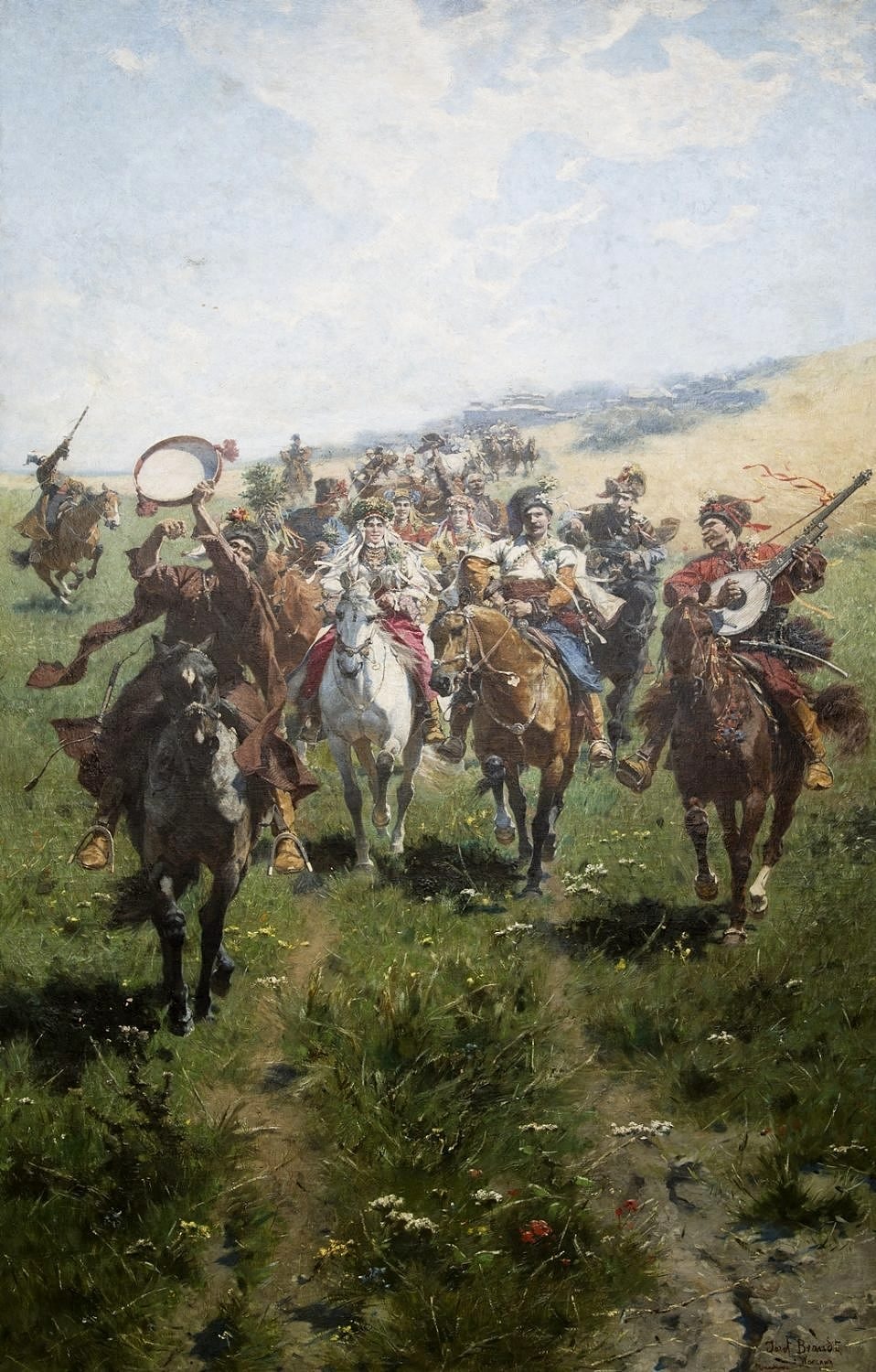
The church service was held on a Sunday before lunch, and before it the groom's party had to get past the bride's gate. At the door there was a ransom. The groom rode out with his boyary, the groomsmen, their hats marked with red ribbons or periwinkle, the youngest of them called a kniaz'. Girls in the party, the svitylka, wore the same marks. Wedding flags went in front, and along the road others stopped the train and were paid. At the yard, two groomsmen from each side met at a table to negotiate. Then the bride's mother came out in a coat worn inside out, carrying water and oats. After gifts of embroidered towels, the bride's braid was undone and her head covered.
Days after the wedding
The feast was not the end. A second day of celebration fell on the Monday, a third on the Tuesday, and in Galicia a fourth day was known as kolachyny, though B. Hrinchenko notes that in some regions it came later. Moving the bride to the groom's house began with a supper. In the Lemko region the pattern had its own form: the couple's families visited each other first, a groomsmen's dance opened the Saturday, and the svashka, usually the groom's married sister, dressed the bride. On the Monday the svashky took the vinets from the bride's head and put on the chepets, or ochipok. Then came dancing and prydany, when the bride's guests walked with her to her new home.
Cloth and meanings
Cloth carried much of the meaning. The rushnyk, a long embroidered cloth, was a central object of the ceremony and often formed part of the bride's dowry; pairs of birds stitched on it stood for the couple. Gifts of towels passed between the two families. The svashky were a women's choir that sang through the ceremony. The korovai, the ceremonial wedding bread, was a large round braided wheat loaf, shaped with suns, moons, birds, animals and pine cones, and it was cut and shared out according to kinship and age. In some areas an unmarried woman who died was buried in a wedding dress, linking marriage and mourning.
How Traditional Ukrainian wedding is kept
Matchmaking opened the process, then the zmovyny contract, an engagement and a visit to the groom's home. On the Saturday, a decorated tree and wreaths were made and guests were invited. Married women baked the korovai. The church service came on Sunday before lunch, and before it the groom's party paid a ransom at the gate. Then came the covering of the bride's head and the sharing of the bread. The bride moved to the groom's house after a supper. Celebrations ran on to Monday and Tuesday, and in some places to a fourth day.
When and where
The old wedding had no fixed date in the year, but its own sequence of days. The zmovyny letter named the day of the wedding. Ceremonies spread over a week or more: preparations and invitations on the Saturday, the church service on the Sunday before lunch, then Monday, Tuesday and in some regions a fourth day.
Ukraine is where the rite belongs, and the sources describe it in village life across the country's regions, including Galicia and the Lemko region. Variations appear from place to place, so the details of each day, and even the names of the objects, differ between areas.
What Traditional Ukrainian wedding means
The rite marked a change of status, from girl to married woman and from young man to householder. The undone braid and the new head covering showed that change plainly to everyone watching. Bread stood for plenty and for the couple, and the birds and suns worked into the korovai echoed the old sun cult the sources name. The rushnyk, with its two birds facing each other, held the marriage in cloth, and the whole run of days was a joyful rite of marriage kept by a wide circle of family and neighbours.



Questions people ask about Traditional Ukrainian wedding
When is Traditional Ukrainian wedding kept?
Traditional Ukrainian wedding is kept on over a run of days, with the church ceremony on a Sunday before lunch and more celebrating afterwards.
What is a traditional Ukrainian wedding?
It is a set of wedding rites from Ukrainian village life, built from three parts: the agreements made before the marriage, the wedding itself, and the days that followed. Older ancestral customs sit beside Greek and Byzantine church influence, and each stage had its own ceremonies.
Where is it kept?
The sources place it in Ukraine, in village life across different regions, including Galicia and the Lemko region. Details varied from place to place, and the names of objects and days were not the same everywhere.
What is the korovai?
It is the ceremonial bread of the wedding, a large round braided loaf of wheat flour. Married women baked it, decorating the dough with suns, moons, birds and pine cones. It was cut and handed out to guests in order of kinship and age.
Who takes part?
Family, neighbours and a wide circle of helpers. The starosty acted as go-betweens, the boyary were the groom's groomsmen, the svitylka were girls in the groom's party, and the svashky formed a women's choir. Married women baked the bread, and guests were invited from house to house.
See also
 RushnykA sacred embroidered cloth used in East Slavic rituals, weddings and daily life.
 KorovaiA round wedding bread of Eastern Europe, baked with songs and shared by all the guests
 KlezmerAn Ashkenazi Jewish instrumental tradition of lively dance tunes and ritual melodies
 Islamic marriageThe sacred contract, agreement and wedding celebration forming an Islamic marriage
Good reading and sources
- Traditional Ukrainian wedding on WikipediaEncyclopedia
- More photos on Wikimedia CommonsPhotos and video
- Wikidata recordOpen data
The facts on this page come from the Wikipedia article "Traditional Ukrainian wedding", written by its contributors and used under the CC BY-SA 4.0 licence, and from its Wikidata record (CC0). EveryParampara rewrote the text in its own words, with AI assistance, and compares every page with the article to make sure no passage is copied. It may be reused under the same CC BY-SA 4.0 licence with a link back.
It may contain mistakes. Traditions differ from one family, village and community to the next, and the people who keep them know them best. If something is wrong, tell us. Last refreshed 2026-10-05.
More from Ukraine
All the traditions of Ukraine
🇺🇦 Ukraine and 2 moreRushnykрушник
A sacred embroidered cloth used in East Slavic rituals, weddings and daily life.Dress
🇺🇸 New York, United States and 5 moreKlezmerקלעזמער
An Ashkenazi Jewish instrumental tradition of lively dance tunes and ritual melodiesPerformance
🇺🇦 Ukraine and 4 moreKorovaiкоровай (Ukrainian), каравай (Russian)
A round wedding bread of Eastern Europe, baked with songs and shared by all the guestsTable custom · Feasts and festival meals
🇺🇦 Kyiv, Ukraine and 1 moreUkrainian embroideryвишивка (vyshyvka)
A stitched folk art of Ukraine, worked into shirts, cloths and church furnishingsCraft
The same idea elsewhere
Weddings compared 🇼🇸 Samoa and 1 moreʻIe tōga
Precious woven mats exchanged in Samoan ceremonies to honor family ties and chiefly status.Dress
🇼🇸 Samoa and 1 moreʻIe tōga
Precious woven mats exchanged in Samoan ceremonies to honor family ties and chiefly status.Dress
 🇹🇱 Timor-LesteUma Lulik
Sacred ancestral clan houses and ritual shrines in East TimorSpiritual
🇹🇱 Timor-LesteUma Lulik
Sacred ancestral clan houses and ritual shrines in East TimorSpiritual
 🇮🇩 Indonesia and 2 moreKenduri
A communal prayer meal and gathering shared across Indonesia, Malaysia and BruneiSpiritual · Feasts and festival meals
🇺🇬 UgandaKwanjula
A formal marriage introduction ritual of the Baganda people in Uganda, where families meet to exchange gifts and seek blRite of passage
🇮🇩 Indonesia and 2 moreKenduri
A communal prayer meal and gathering shared across Indonesia, Malaysia and BruneiSpiritual · Feasts and festival meals
🇺🇬 UgandaKwanjula
A formal marriage introduction ritual of the Baganda people in Uganda, where families meet to exchange gifts and seek blRite of passage