Spiritual and religiousSoutheast AsiaBuddhistHindu
Wai khru
In its own language: พิธีไหว้ครู
A Thai ceremony of thanks to teachers, held in schools and in the arts
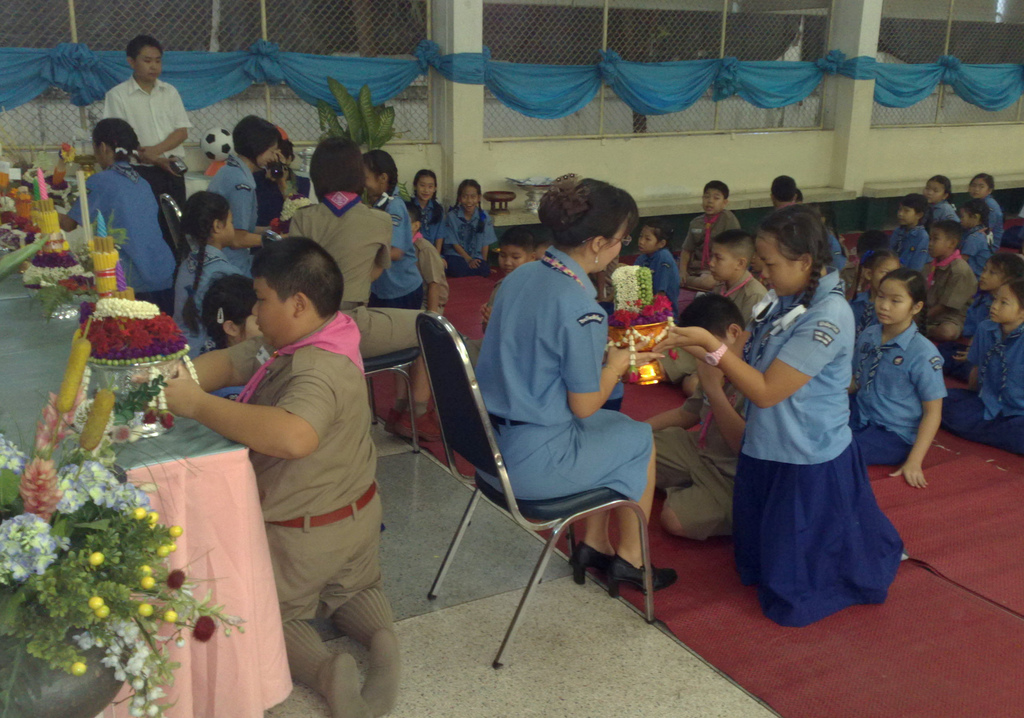
A Thai ritual of respect for teachers, kept in most schools near the start of the school year, usually on a Thursday. It is also a long-standing rite of Thai classical music and dance, Muay Thai, astrology and traditional massage, performed at initiation and before performances.
When is Wai khru kept?
Wai khru is kept each year soon after the school year opens, usually on a Thursday.
Wai khru is a Thai ceremony in which students bow to their teachers and thank them, making the bond between them formal and clear. Schools across Thailand hold it soon after the school year opens. Dancers, musicians, Muay Thai fighters, astrologers and traditional healers also keep it, honouring both the people who taught them and the gods who watch over their craft.
What it is
Wai khru is a Thai way of honouring teachers. Students take part in a formal ceremony where they thank the person who instructs them and openly accept the bond of teacher and pupil. Most schools in Thailand hold one near the beginning of the school year. The same name covers the older rites kept by performers and healers. Those who study Thai dance, classical music, Muay Thai, astrology or traditional massage hold a wai khru when they begin, and again before they perform.
Origins and history
People trace the rite to old spirit beliefs, shaped later by Brahmin ideas arriving from India. That mixture shows in what is honoured during the ceremonies: dance and music name Ishvara, while massage names Shivaga Komarpaj and Narayana alongside other Hindu deities. For centuries it stayed a folk practice handed down between generations rather than a fixed institution. The version now common in schools took shape at Triam Udom Suksa School in 1941, when the sarabhañña chant used there was composed by Thanpuying Dussadee Malakul Na Ayutthaya. Her husband, ML Pin Malakul, led the school at the time.
How schools keep it
Where Theravada Buddhism is the official religion, the day opens with a Buddhist devotion. Students then say a chant that thanks their teachers and asks a blessing on their studies. Representatives chosen from each class carry up trays, called phan, holding flowers, candles and joss sticks. The head of the school usually speaks afterwards, offering guidance for the year ahead, and many schools hand out awards and honours at the same gathering. It is normally held soon after the first term begins, on a Thursday, because Thursday belongs to Brihaspati, the Vedic god of wisdom and of teachers.
Music, dance and fighting
Thai classical ensembles hold their own wai khru once a year, and again when a new player starts. The evening before or the morning of, Buddhist rites may come first: monks are invited to make merit and are given alms. An altar stands on one side, the instruments on the other, and the taphon drum sits highest as the seat of Phra Prakhonthap, grand-teacher of music. Masks of Bharata Muni, Pragondharba, Vishvakarman, Pancasikha and Biraba are shown, sometimes with images of Shiva, Vishnu, Brahma and Ganesha. A teacher dressed in white leads, the ensemble plays the na phat, and lustral water and white paste are shared. Muay Thai fighters perform wai khru ram muay before a bout.
Healing and change
Traditional massage and medicine keep wai khru as a central practice. Healers thank each generation of teachers in their line, working back from those still living to Jīvaka Komārabhacca, the doctor remembered in the Pāli Canon. Chants are said in Pāli, Sanskrit and Thai, often with passages that honour the Buddha, and deities, rishi and spirits are acknowledged too. A healer may hold the rite privately, or a training school may host it as a large community event. Some historians, among them Nidhi Eoseewong and Sujit Wongthes, argue that today's yearly school version has drifted from its spirit-worship past and now stresses the rank of teachers over students.
How Wai khru is kept
Participants gather, usually on a Thursday. Where Theravada Buddhism is the religion of the institution, a Buddhist devotion opens the ceremony. Students then recite a chant of thanks and ask for a blessing on their studies. Class representatives carry in pedestalled trays with flowers, candles and joss sticks and present them to the teachers. The head teacher gives a short address, and some schools add awards. In music and dance the sequence runs longer: monks may be invited first, a presiding teacher in white leads the invocations, the na phat is played, food is offered, and lustral water and white paste are applied before the khrop khru initiation.
When and where
In schools it falls shortly after the first term of the year begins, and almost always on a Thursday, the day linked to Brihaspati, the Vedic god of wisdom and teachers. Ensembles hold theirs once a year on the same weekday, and again at the moment a newcomer begins to learn. Healers stage it as their own schedule allows.
It is kept throughout Thailand, above all in the country's schools, where most pupils meet it each year. The older forms live where Thai classical music and dance are taught, in Muay Thai gyms and rings, and among teachers of traditional massage and medicine. Professional pi phat ensembles and amateur groups attached to schools and universities also hold their own.
What Wai khru means
Each item on the offering tray carries a meaning. Ixora flowers, closed into pointed buds, stand for a sharp mind. Bermuda grass, called ya phraek, spreads quickly, and stands for persistence and a wish to keep learning. Rice puffed by heat, khao tok, stands for self-discipline. Eggplant flowers bend towards the ground as fruit forms, and stand for respect and humility. Underneath all of it lies gratitude: the ceremony joins a learner to a line of teachers, and, in the older arts, to the gods who guard the craft.
Questions people ask about Wai khru
When is Wai khru kept?
Wai khru is kept each year soon after the school year opens, usually on a Thursday.
What is wai khru?
It is a Thai ceremony in which students pay respect to their teachers, give thanks and make the teacher-pupil relationship a formal one. Schools across Thailand hold it near the beginning of the school year, and performers and healers keep their own versions.
What do students offer?
Class representatives present pedestalled trays, called phan, carrying flowers, candles and joss sticks. The traditional flowers are ixora, Bermuda grass, puffed rice and eggplant flowers, each chosen for what it stands for.
Who else performs it?
Dancers, classical musicians, Muay Thai fighters, astrologers and traditional healers. Muay Thai practitioners perform wai khru ram muay before a bout. Massage and medicine practitioners use it to thank their line of teachers, reaching back to Jīvaka Komārabhacca.
Is it only religious?
No. Buddhist devotion opens the school ceremony where Theravada Buddhism is the official religion, and Hindu deities are honoured in the arts and in healing. It is also a mark of respect and a way of keeping a teaching lineage alive.
See also
 Spirit houseA small roofed shrine on a pillar, kept in homes and villages across Southeast Asia to honour protective spirits.
 Yi PengA northern Thai Buddhist festival of sky lanterns, clay lamps and temple sermons
 Double Ninth FestivalAn autumn festival of mountain walks, chrysanthemum wine and ancestor remembranceMak yongA dance-drama of Kelantan and Patani, told in song, music and improvised speech
Good reading and sources
- Wai khru on WikipediaEncyclopedia
- More photos on Wikimedia CommonsPhotos and video
- Wikidata recordOpen data
The facts on this page come from the Wikipedia article "Wai khru", written by its contributors and used under the CC BY-SA 4.0 licence, and from its Wikidata record (CC0). EveryParampara rewrote the text in its own words, with AI assistance, and compares every page with the article to make sure no passage is copied. It may be reused under the same CC BY-SA 4.0 licence with a link back.
It may contain mistakes. Traditions differ from one family, village and community to the next, and the people who keep them know them best. If something is wrong, tell us. Last refreshed 2026-10-05.
More from Thailand
All the traditions of Thailand
🇹🇭 Thailand and 7 moreSpirit house
A small roofed shrine on a pillar, kept in homes and villages across Southeast Asia to honour protective spirits.Spiritual
🇹🇭 Chiang Mai, Thailand and 1 moreYi Pengยี่เป็ง
A northern Thai Buddhist festival of sky lanterns, clay lamps and temple sermonsSpiritual
 🇨🇳 China and 5 moreLife release放生
A Buddhist practice of freeing captive animals to spare their lives and gain meritSpiritual
🇨🇳 China and 5 moreLife release放生
A Buddhist practice of freeing captive animals to spare their lives and gain meritSpiritual
 🇱🇦 Laos and 1 moreBaciບາສີ (Lao)
A Lao rite that calls the soul home and ties a thread on the wrist for good luckSpiritual
🇱🇦 Laos and 1 moreBaciບາສີ (Lao)
A Lao rite that calls the soul home and ties a thread on the wrist for good luckSpiritual
The same idea elsewhere
Healing, luck and protection compared 🇩🇪 Germany and 5 moreChristmas tree
A decorated evergreen or artificial tree placed indoors to mark the Christmas season.Festival
🇩🇪 Germany and 5 moreChristmas tree
A decorated evergreen or artificial tree placed indoors to mark the Christmas season.Festival
 🇫🇷 France and 5 moreCandlemas
A Christian feast of candle blessings marking the end of the Christmas seasonSpiritual
🇫🇷 France and 5 moreCandlemas
A Christian feast of candle blessings marking the end of the Christmas seasonSpiritual
 🇺🇸 United States and 4 moreFriday the 13th
A Western folk superstition regarding the unluckiness of a Friday falling on the 13th.Folklore
🇺🇸 United States and 4 moreFriday the 13th
A Western folk superstition regarding the unluckiness of a Friday falling on the 13th.Folklore
 🇮🇪 Ireland and 2 moreJack-o'-lantern
A carved pumpkin lantern lit with a candle to brighten and protect Halloween nightsFolklore
🇮🇪 Ireland and 2 moreJack-o'-lantern
A carved pumpkin lantern lit with a candle to brighten and protect Halloween nightsFolklore