Spiritual and religiousSoutheast AsiaBuddhist
Yi Peng
In its own language: ยี่เป็ง
A northern Thai Buddhist festival of sky lanterns, clay lamps and temple sermons

Yi Peng is a northern Thai festival of lights observed by Lanna Buddhist communities across three days in November. Devotees release floating paper lanterns into the night sky, illuminate temples with earthen lamps, and gather for marathon scriptural readings to earn spiritual merit.
When is Yi Peng marked?
Yi Peng is kept as part of Loy Krathong, which is on Tuesday, 24 November 2026.
Yi Peng is a northern Thai festival of illumination kept each autumn by Lanna Buddhists. For three days, communities decorate homes, hang colourful paper lanterns, and send glowing paper balloons into the evening sky. Worshippers believe the ascending flames honour a heavenly Buddhist relic, carry away past misfortunes, and generate spiritual merit to ensure good fortune in future lives.
Origins and meaning
The observance dates back to the historical Lan Na realm and holds ties to earlier traditions in Haripuñjaya. Although early roots may connect to ancient Indian rites, modern practice focuses on Theravada Buddhist devotion. According to lore, birds once flew around the Buddha with lit torches in their beaks, prompting him to promise them auspicious rebirths. Worshippers today make offerings of fire to venerate the five Buddhas of this cosmic age. Sky lanterns carry prayers toward Phra That Kaew Chulamanee, a stupa in the heavens said to house the Buddha's hair. Releasing these lights symbolizes casting away previous bad luck.
Lanterns and lights
Illumination appears in many forms during the holiday. The best-known objects are khom loi, buoyant lanterns crafted by stretching rice paper over bamboo or metal frames and lighting a fuel cake beneath. Temples and domestic gardens are brightened with hanging lanterns in five sacred colours, signifying the six rays of the Buddha's aura. Small earthenware lamps known as phang pratheep sit along walls and courtyards. Some sanctuaries display revolving lanterns spun by candle heat, while artisans present large, decorated creations in civic craft competitions at the city gates of Chiang Mai.
Temple recitations and rituals
Monasteries serve as the spiritual core of the observance through the Tang Tham Luang ritual. Monks chant the Vessantara Jataka across multiple chapters, retelling the penultimate life of the Buddha. To prepare the sacred space, villagers build forest gateways from banana plants, sugar cane, and palm fronds, evoking the woodland exile of Prince Vessantara. Inside the assembly hall, worshippers place paper animal cutouts, lotus blooms, and water lilies in sets of one hundred. Devotees also construct decorative mazes on monastery grounds to guide pilgrims toward central Buddha images.
The festival schedule
Festivities span three successive lunar dates, opening on Wan Da when families purchase supplies and prepare temple offerings. The second day features sermons, evening chanting, meditation, and the assembly of large communal rafts packed with food for the needy. On the full moon night, celebrations reach their peak. Cities hold illuminated street parades, temple grounds launch traditional fireworks, and thousands of paper lanterns rise into the night. At the riverbanks, worshippers join the broader Thai custom of setting decorated rafts upon the water.
How Yi Peng is kept
Preparations start on Wan Da with market shopping and temple decorating. On the second day, devotees gather at monasteries for chanting, listen to monks recite traditional Buddhist sermons, and craft large food-filled baskets for the destitute. In the evenings, worshippers light small clay lamps, suspend multi-coloured paper lanterns, and launch glowing sky lanterns from courtyards. The event culminates on the full moon with civic float parades, displays of traditional fireworks at shrines, and the dual launching of aerial lanterns and floating water baskets.
When and where
The festival occurs over three days, peaking on the full moon of the second month in the Lanna lunar calendar. This date usually corresponds to the twelfth month of the central Thai calendar and falls in November.
Yi Peng is celebrated across northern Thailand, especially in Chiang Mai, Lamphun, Lampang, and Chiang Rai. Chiang Mai serves as the main centre, hosting massive lantern launches, parades, and craft contests.
What Yi Peng means
Light honours the five Buddhas of the present era and pays homage to the heavenly relic of the Buddha's hair. Releasing a lantern into the sky represents shedding bad fortune, paying debts to ancestors, and asking for clarity and prosperity in coming lives. The five original lantern colours symbolise the six rays of the Buddha's aura, which traditional folklore held would deter harmful spirits.


Days Yi Peng is marked
Questions people ask about Yi Peng
When is Yi Peng marked?
Yi Peng is kept as part of Loy Krathong, which is on Tuesday, 24 November 2026.
What is Yi Peng?
It is a three-day northern Thai Buddhist festival of lights, famous for the mass launch of glowing paper sky lanterns, temple sermons, and decorative illumination.
How does Yi Peng differ from Loy Krathong?
While Loy Krathong sends floating baskets onto rivers to thank the water goddess, Yi Peng sends lanterns upward into the sky to venerate the Buddha and heavenly relics.
What is the Tang Tham Luang sermon?
It is an extensive temple recitation of the Vessantara Jataka, where monks narrate the Buddha's past life inside prayer halls decorated like forest sanctuaries.
See also
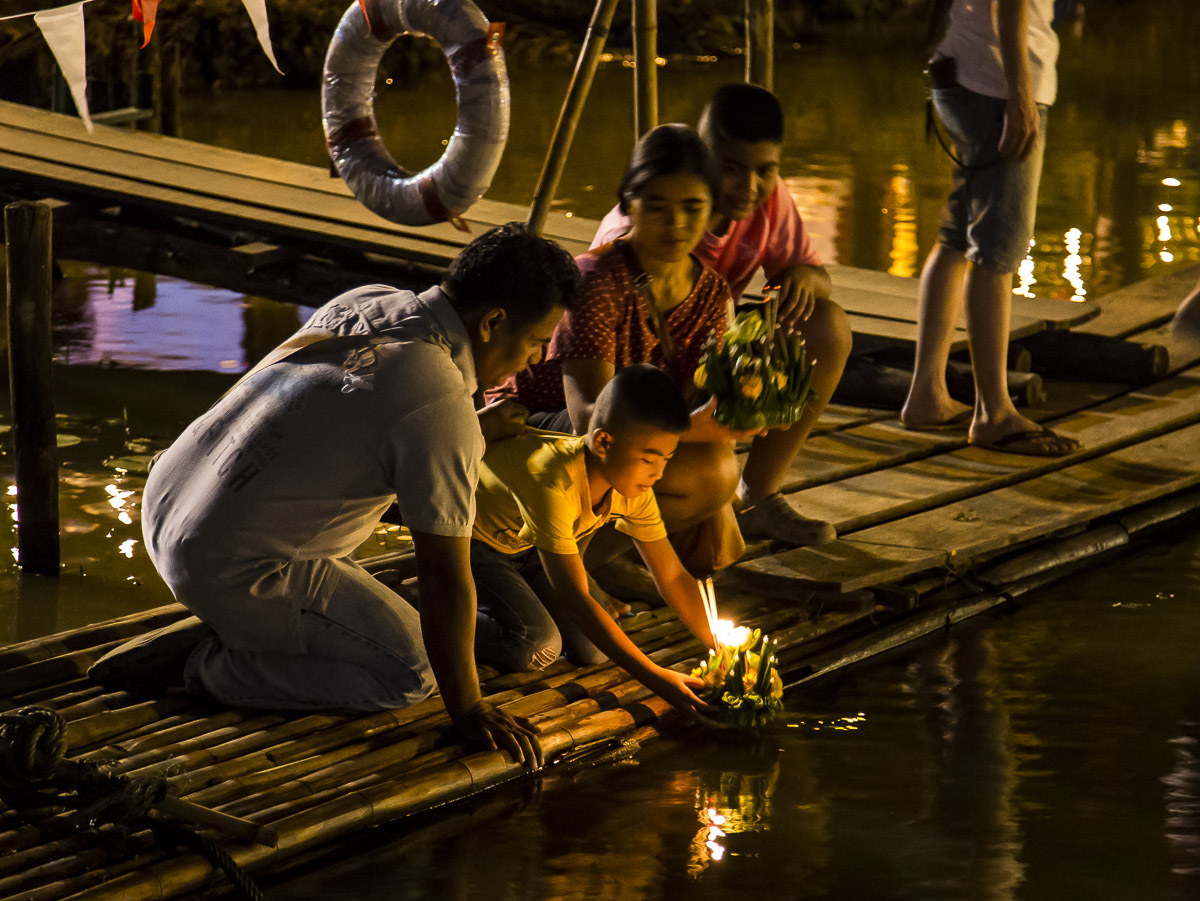 Loy KrathongA Thai festival of floating leaf baskets on rivers to honor water and release negativity.
 Double Ninth FestivalAn autumn festival of mountain walks, chrysanthemum wine and ancestor remembrance
 Thai funeralBuddhist rites in Thailand featuring water blessings, temple chanting and cremation.
 Eid al-FitrThe feast that ends Ramadan, opened with morning prayers, sweets and visits home
Good reading and sources
The facts on this page come from the Wikipedia article "Yi Peng festival", written by its contributors and used under the CC BY-SA 4.0 licence, and from its Wikidata record (CC0). EveryParampara rewrote the text in its own words, with AI assistance, and compares every page with the article to make sure no passage is copied. It may be reused under the same CC BY-SA 4.0 licence with a link back.
It may contain mistakes. Traditions differ from one family, village and community to the next, and the people who keep them know them best. If something is wrong, tell us. Last refreshed 2026-10-04.
More from Thailand
All the traditions of Thailand 🇹🇭 Thailand and 7 moreSpirit house
A small roofed shrine on a pillar, kept in homes and villages across Southeast Asia to honour protective spirits.Spiritual
🇹🇭 Thailand and 7 moreSpirit house
A small roofed shrine on a pillar, kept in homes and villages across Southeast Asia to honour protective spirits.Spiritual
 🇮🇳 India and 5 morePretaप्रेत
Offerings and rites for spirits enduring deep hunger across Asian traditions.Spiritual
🇮🇳 India and 5 morePretaप्रेत
Offerings and rites for spirits enduring deep hunger across Asian traditions.Spiritual
 🇹🇭 ThailandWai khruพิธีไหว้ครู
A Thai ceremony of thanks to teachers, held in schools and in the artsSpiritual
🇹🇭 ThailandWai khruพิธีไหว้ครู
A Thai ceremony of thanks to teachers, held in schools and in the artsSpiritual
 🇨🇳 China and 5 moreLife release放生
A Buddhist practice of freeing captive animals to spare their lives and gain meritSpiritual
🇨🇳 China and 5 moreLife release放生
A Buddhist practice of freeing captive animals to spare their lives and gain meritSpiritual
The same idea elsewhere
Remembering the ancestors compared 🇬🇪 Tbilisi, Georgia and 4 moreGeorgian polyphonic singing
Several voices at once, sung without instruments at Georgian feasts and weddingsPerformance
🇬🇪 Tbilisi, Georgia and 4 moreGeorgian polyphonic singing
Several voices at once, sung without instruments at Georgian feasts and weddingsPerformance
 🇮🇳 India and 4 moreWater lantern
Small lamps floated on water to honour the dead and ask for good fortuneFestival
🇮🇳 India and 4 moreWater lantern
Small lamps floated on water to honour the dead and ask for good fortuneFestival
 🇮🇪 Ireland and 2 moreJack-o'-lantern
A carved pumpkin lantern lit with a candle to brighten and protect Halloween nightsFolklore
🇮🇪 Ireland and 2 moreJack-o'-lantern
A carved pumpkin lantern lit with a candle to brighten and protect Halloween nightsFolklore
 🇨🇬 Republic of the CongoNkisi
Spiritual vessels and figures crafted to channel ancestral power, healing and justiceSpiritual
🇨🇬 Republic of the CongoNkisi
Spiritual vessels and figures crafted to channel ancestral power, healing and justiceSpiritual