Royal, civic and national ceremonyEuropeSecular and civic
Water Tribunal of the plain of Valencia
In its own language: Tribunal de les Aigües de la Vega de València
A weekly outdoor gathering of Valencian farmers settling irrigation disputes by word of mouth

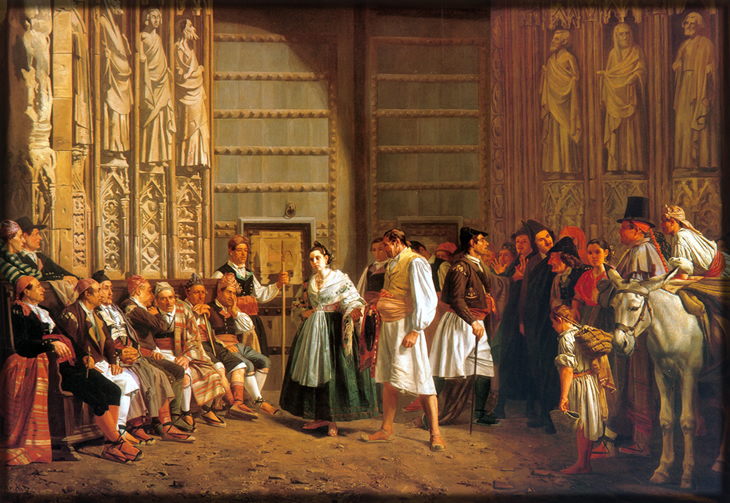
The Water Tribunal of the plain of Valencia is a customary court where elected farming representatives settle water disputes across local canals. Meeting on Thursdays in the heart of Valencia, the court conducts all business aloud in the Valencian language without written records.
When is Water Tribunal of the plain of Valencia kept?
Water Tribunal of the plain of Valencia is kept every Thursday morning, or Wednesday if Thursday is a public holiday.
Every Thursday, elected representatives from the farming communities of the Valencian plain gather in public to resolve water conflicts. As Europe's oldest surviving democratic body, the court manages water drawn from the Turia River for local irrigation canals. The judges listen to grievances, deliberate in the open, and deliver swift oral verdicts in the Valencian language, upholding a centuries-old community tradition of shared governance.
Origins and history
The institution originated during the tenth century under Islamic rule in Spain to allocate canal water from the Turia River fairly. According to Francisco Borrull, the court was established around 960 CE during a time of general peace across the peninsula. King James I of Aragon officially confirmed the court in the thirteenth century, protecting its traditional role for local growers. In 1960, legal scholar Vicente Giner Boira organised a millennial commemoration celebrating ten centuries of uninterrupted water justice. Spain formally incorporated the customary assembly into its national legal structure in 1978, and UNESCO recognized it as intangible cultural heritage in 2009 alongside Murcia's Council of Wise Men.
The court in session
The assembly convenes at Casa Vestidor on Plaça de la Mare de Déu in Valencia. Nine syndics, each chosen to represent an irrigation community from canals like Mestalla, Favara, and Tormos, sit together in public view. The group elects a president every two years. When the session opens, a bailiff calls out claimants canal by canal using the phrase 'denunciants de la séquia de...'. Complainants present their accusations directly, and the accused farmers offer their defense on the spot. Proceedings move swiftly and are conducted entirely in the Valencian tongue.
Customs and oral justice
Simplicity and total openness define the hearings. The court operates completely by word of mouth, keeping no written minutes, logs, or paper files. To guarantee neutrality, the syndic representing the canal involved in a grievance must step aside while the remaining judges assess guilt. If the defendant is found responsible, that canal's own trustee returns to pronounce the penalty prescribed by their community bylaws. Because trials happen out in the open before fellow farmers and spectators, rulings carry immediate moral and practical authority throughout the agricultural plain.
How Water Tribunal of the plain of Valencia is kept
Nine elected syndics take their seats outside the Casa Vestidor. The bailiff summons complainants from each irrigation channel in sequence. Each farmer states their grievance aloud before the assembled panel, followed immediately by the response and explanation of the accused. The syndic from the canal under review stands down so the rest of the tribunal can determine guilt impartially. If convicted, the defendant receives a fine or sanction set by their canal trustee according to community ordinances, concluding the matter entirely by spoken word.
When and where
The court convenes weekly on Thursdays. Whenever an official public holiday falls on a Thursday, the syndics shift their session to the preceding Wednesday instead.
Hearings take place publicly at the Casa Vestidor on the Plaça de la Mare de Déu in the city of Valencia, serving the agricultural district known as the Horta de València.
What Water Tribunal of the plain of Valencia means
To the farming communities of the Valencian plain, the tribunal represents self-governance and direct justice. By keeping proceedings completely verbal and visible to all, it preserves mutual trust among neighbours sharing scarce water resources from the Turia River. The ritual maintains centuries of collective responsibility without relying on bureaucratic paperwork.
Questions people ask about Water Tribunal of the plain of Valencia
When is Water Tribunal of the plain of Valencia kept?
Water Tribunal of the plain of Valencia is kept every Thursday morning, or Wednesday if Thursday is a public holiday.
What is the Water Tribunal of the plain of Valencia?
It is an ancient customary court in Valencia, Spain, where elected agricultural representatives settle water disputes among local farmers through swift, open-air hearings conducted entirely by spoken word.
How are decisions made without written records?
Complainants and defendants speak directly to the syndics in Valencian. The panel deliberates openly, while the canal's own trustee steps aside during the verdict before enforcing penalties according to community bylaws.
Who makes up the court panel?
The bench consists of nine syndics elected from the different irrigation canal communities of the plain, with one member chosen to serve as president for two years.
See also
 HalloweenAn annual observance on 31 October marking the eve of All Saints' Day, rooted in Christian tradition and Celtic heritage
 Holy WeekThe solemn seven days leading to Easter, recalling the final week and Passion of Jesus
 Our Lady of GuadalupeA Mexican devotion to Mary, with a feast on 12 December and an image kept on a cloak
Good reading and sources
- Encyclopaedia BritannicaArticle
- Drink in History at the World's Oldest CourtSmithsonian Magazine, Article
- Drink in History at the World's Oldest CourtSmithsonian Magazine, Article
- Water Tribunal of the plain of Valencia on WikipediaEncyclopedia
- More photos on Wikimedia CommonsPhotos and video
- Wikidata recordOpen data
The facts on this page come from the Wikipedia article "Water Tribunal of the plain of Valencia", written by its contributors and used under the CC BY-SA 4.0 licence, and from its Wikidata record (CC0). EveryParampara rewrote the text in its own words, with AI assistance, and compares every page with the article to make sure no passage is copied. It may be reused under the same CC BY-SA 4.0 licence with a link back.
It may contain mistakes. Traditions differ from one family, village and community to the next, and the people who keep them know them best. If something is wrong, tell us. Last refreshed 2026-10-04.
More from Spain
All the traditions of Spain 🇪🇸 Spain and 5 moreArbor Day
An annual secular observance dedicated to planting and caring for trees around the worldCeremony
🇪🇸 Spain and 5 moreArbor Day
An annual secular observance dedicated to planting and caring for trees around the worldCeremony
 🇺🇸 United States and 5 moreColumbus Day
An annual autumn holiday marking the 1492 arrival of Christopher Columbus in the AmericasCeremony
🇺🇸 United States and 5 moreColumbus Day
An annual autumn holiday marking the 1492 arrival of Christopher Columbus in the AmericasCeremony
 🇨🇦 Canada and 5 moreWorkers' Memorial Day
An annual day remembering people killed, injured, or made ill by their workCeremony
🇪🇸 Spain and 5 moreInternet DayDía de Internet
An annual May observance dedicated to digital access, education and online community.Ceremony
🇨🇦 Canada and 5 moreWorkers' Memorial Day
An annual day remembering people killed, injured, or made ill by their workCeremony
🇪🇸 Spain and 5 moreInternet DayDía de Internet
An annual May observance dedicated to digital access, education and online community.Ceremony
The same idea elsewhere
All of this kind 🇺🇸 Philadelphia, United States and 1 moreIndependence Day
The United States' national day of parades, barbecues and fireworks, kept each July 4Ceremony
🇺🇸 Philadelphia, United States and 1 moreIndependence Day
The United States' national day of parades, barbecues and fireworks, kept each July 4Ceremony
 🇺🇸 Washington, United StatesState of the Union address
The US president's yearly report to Congress and the nation, given in the House chamberCeremony
🇺🇸 Washington, United StatesState of the Union address
The US president's yearly report to Congress and the nation, given in the House chamberCeremony
 🇮🇳 Kolkata, IndiaJana Gana Mana
India's national anthem, from a Bengali hymn of 1911, sung at civic occasionsCeremony
🇮🇳 Kolkata, IndiaJana Gana Mana
India's national anthem, from a Bengali hymn of 1911, sung at civic occasionsCeremony
 🇺🇸 United StatesTalking stick
A carved staff that shows who may speak at a Northwest Coast gatheringCeremony
🇺🇸 United StatesTalking stick
A carved staff that shows who may speak at a Northwest Coast gatheringCeremony