Dress and adornmentSub-Saharan AfricaIndigenous and traditional
Gele
In its own language: Gèlè
A voluminous sculpted headwrap worn by Yoruba women for gatherings and daily life

The gele is a voluminous, sculptural headwrap native to Yoruba women across Nigeria, Benin, and Togo. Folded, pleated, and pinned around the head, it is worn for parties, weddings, market visits, and family gatherings, honouring both the physical and sacred self.
When is Gele kept?
Gele is kept during celebrations, weddings, market trips, and visits with friends.
Gele is a traditional folded headdress created by Yoruba women across Nigeria, Benin, and Togo. Meaning an elevated structure in the Yoruba language, this striking fabric wrap rises above the head in crisp pleats and sweeping folds. Worn for major festivities as well as everyday outings, it serves as both an artistic statement and a sign of spiritual respect for the head.
Spiritual roots and meaning
In Yoruba thought, the head is treated as a sacred shrine that holds a person's character, destiny, and inner secrets. An old proverb explains that covering the head keeps these personal mysteries safe from exposure. Dressing the head with fabric acts as an extension of honoring one's spiritual self, known as the sacred head. Wrapping the crown in beautiful cloth gives visual respect to the spiritual entity residing inside, making the practice of wearing a headdress a deeply personal act of reverence and individual expression.
Fabrics and folding styles
A gele is formed using structured textiles, most famously handwoven aso-oke, though makers also rely on damask, brocade, adire, sego, seghosen, and jawu. Wearers pleat and pin the fabric into distinct shapes, creating styles such as fans, peacocks, ruffles, roses, or central bows. During the 1960s, wrappers crafted towering shapes called onilegogoro, patterned after modern skyscrapers. While pre-sewn versions known as auto-gele exist for quick wear, custom manual wrapping remains prized for its artisanal skill and sculpted quality.
Across Nigeria and beyond
Over the twentieth century, the gele expanded beyond its Yoruba homeland to become Nigeria's recognized national headdress. In the late 1940s, Yoruba merchants introduced the wrap to northern Zaria, where Hausa speakers adopted the word gyale. Igbo women in southeastern communities also incorporated the expansive style into their wardrobes. Today, the wrap flourishes across the global African diaspora, notably in Texas and major Western cities, appearing in runway collections, museum exhibitions, and milestone celebrations worldwide.
How Gele is kept
To create a manual gele, a woman selects stiff cloth such as aso-oke, brocade, or damask, often coordinating the pattern with her traditional attire. She begins by establishing a foundation of neat pleats across the forehead, pulling the fabric securely around the crown. The length of the cloth is then folded, flared, and pinned into three-dimensional artistic forms, ranging from fan shapes to rounded knots. Pre-formed auto-gele hats offer a fast alternative, though custom hand-tied versions remain the standard for formal gatherings.
When and where
Gele is not tied to a single calendar date. Women wear it for milestone events such as weddings and family parties, as well as for regular daily activities like trips to the market or casual visits with friends.
The tradition originated among Yoruba communities in Nigeria, Benin, and Togo. It is widely worn across all regions of Nigeria, as well as throughout the global diaspora, especially within Nigerian-American communities in Texas and across major international cities.
What Gele means
The gele honors the head, which Yoruba culture views as the sacred home of human destiny and inner secrets. Wrapping the head provides protective covering for these private aspects of selfhood while elevating the physical appearance. Its height and sculpted shape reflect dignity, social pride, and artistic expression, treating the body as an artistic canvas.


Questions people ask about Gele
When is Gele kept?
Gele is kept during celebrations, weddings, market trips, and visits with friends.
What is a gele?
A gele is a traditional, voluminous headwrap native to the Yoruba people of West Africa. Crafted from structured fabrics like aso-oke, it is pleated, folded, and pinned into sculptural shapes that rise above the head.
What fabrics are used to tie a gele?
The wrap is most traditionally made from aso-oke fabric, but wearers also use textiles such as brocade, damask, adire, sego, seghosen, and jawu, matching or contrasting with their broader traditional outfits.
What does the gele symbolize in Yoruba culture?
In Yoruba belief, the head represents a sacred shrine holding a person's inner secrets and character. Wrapping the head honors this spiritual center while offering protection, dignity, and a way to express personal artistry.
What is an auto-gele?
An auto-gele is a pre-formed, ready-to-wear headwrap constructed like a hat. While convenient for those who cannot fold the wrap manually, traditional hand-tied gele is generally preferred for its craftsmanship and sculptural quality.
See also
 Aso ebiMatching cloth worn by family and friends at Yoruba weddings, funerals and parties
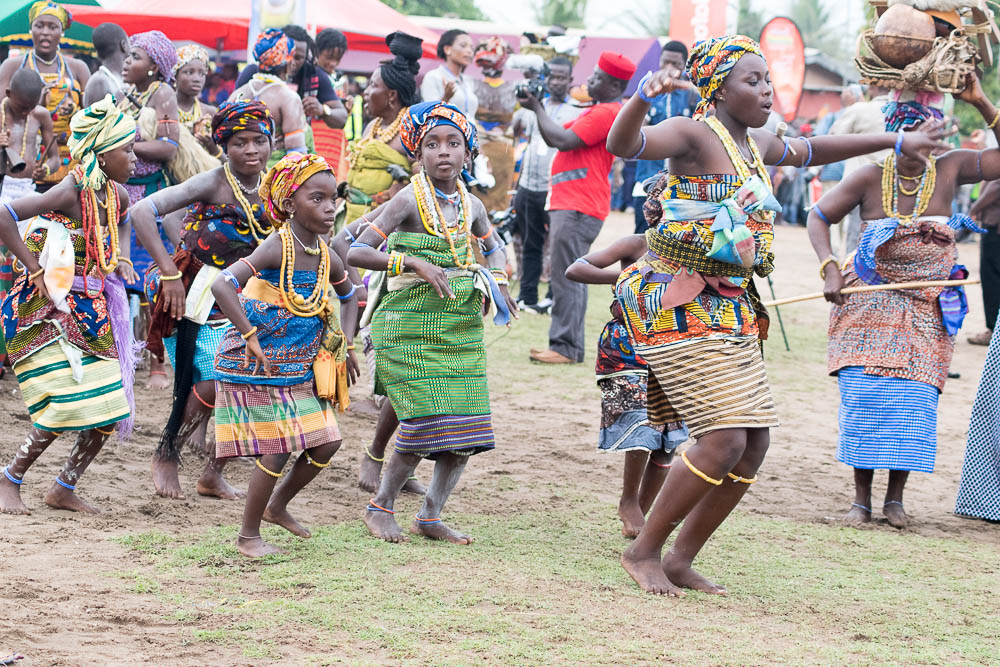 AgbadzaAn Ewe music and dance, born of war songs and kept for funerals, weddings and festivals
 LibationThe ceremonial gift of drink given to deities, ancestors, and the earth
 Nón láA pointed leaf and bamboo hat worn across Vietnam for shelter, work and celebration
Good reading and sources
The facts on this page come from the Wikipedia article "Gele (headdress)", written by its contributors and used under the CC BY-SA 4.0 licence, and from its Wikidata record (CC0). EveryParampara rewrote the text in its own words, with AI assistance, and compares every page with the article to make sure no passage is copied. It may be reused under the same CC BY-SA 4.0 licence with a link back.
It may contain mistakes. Traditions differ from one family, village and community to the next, and the people who keep them know them best. If something is wrong, tell us. Last refreshed 2026-10-07.
More from Nigeria
All the traditions of Nigeria
🇳🇬 Lagos, Nigeria and 2 moreAso ebiAsọ-Ẹbí
Matching cloth worn by family and friends at Yoruba weddings, funerals and partiesDress
 🇰🇪 Kenya and 5 moreKitenge
A printed cloth tied at the waist or chest, worn as a wrap, head cover or baby slingDress
🇰🇪 Kenya and 5 moreKitenge
A printed cloth tied at the waist or chest, worn as a wrap, head cover or baby slingDress
 🇳🇬 Oyo, Nigeria and 1 moreEgungunEgúngún
Yoruba ancestral masquerades bringing blessings, counsel and moral renewalSpiritual
🇳🇬 Oyo, Nigeria and 1 moreEgungunEgúngún
Yoruba ancestral masquerades bringing blessings, counsel and moral renewalSpiritual
 🇳🇬 Calabar, NigeriaCalabar Carnival
An annual December street festival and cultural gathering held in Calabar, NigeriaFestival
🇳🇬 Calabar, NigeriaCalabar Carnival
An annual December street festival and cultural gathering held in Calabar, NigeriaFestival
The same idea elsewhere
Weddings compared 🇼🇸 Samoa and 1 moreʻIe tōga
Precious woven mats exchanged in Samoan ceremonies to honor family ties and chiefly status.Dress
🇼🇸 Samoa and 1 moreʻIe tōga
Precious woven mats exchanged in Samoan ceremonies to honor family ties and chiefly status.Dress
 🇹🇱 Timor-LesteUma Lulik
Sacred ancestral clan houses and ritual shrines in East TimorSpiritual
🇹🇱 Timor-LesteUma Lulik
Sacred ancestral clan houses and ritual shrines in East TimorSpiritual
 🇮🇩 Indonesia and 2 moreKenduri
A communal prayer meal and gathering shared across Indonesia, Malaysia and BruneiSpiritual · Feasts and festival meals
🇮🇩 Indonesia and 2 moreKenduri
A communal prayer meal and gathering shared across Indonesia, Malaysia and BruneiSpiritual · Feasts and festival meals
 🇹🇷 Samsun, TurkeyHoronχορόν
Line dances of Turkey's eastern Black Sea coast, danced with shaking shouldersPerformance
🇹🇷 Samsun, TurkeyHoronχορόν
Line dances of Turkey's eastern Black Sea coast, danced with shaking shouldersPerformance