Hambiliya
In its own language: හැඹිලිය
A small woven purse tucked into the folds of a Sri Lankan osariya
Hambiliya is a small purse woven from reed, rush and other plant fibres, used in Sri Lanka to keep money and small belongings safely on the person. It takes the place of a pocket, because the osariya worn by women and the sarong worn by men have none.
Hambiliya is the Sinhala name for a small purse that holds money and other small things close to the body. In Sri Lanka it does the work of a pocket, since neither the osariya worn by women nor the sarong worn by men has one. Women tuck it into the folds of the osariya. Most are woven from reed or rush and coloured with dyes from leaves, clays and plants.
What it is
A hambiliya is a small purse, made to keep money and other small belongings safely about the person. It is used in Sri Lanka. The name is Sinhala, හැඹිලිය, and it is glossed as a cache, a small store. What the purse does is the work of a pocket: it holds the things a person wants close and out of sight. A hambiliya is small enough to sit against the body. It is not a bag for a day's load, but a place for the few things someone wants near.
A pocket substitute
The hambiliya exists because of what people wear. Neither the osariya, the draped garment worn by women, nor the sarong worn by men has a pocket. Something therefore has to hold small items. Women carry the hambiliya in the folds of the osariya, where the cloth keeps it in place against the body. That position keeps money and other valuables close and hidden. It is worn on the person rather than carried in the hand.
Weaving and colour
Hambiliya are usually woven, most often from reed or rush. Makers also work with palm, screwpine, eraminiya and indi kola, all plant materials. The weave makes a small, firm purse for the things a person keeps close. Colour belongs to the craft as well. Leaves are dyed, and natural colours taken from clays and other plant material are used to produce patterns. That is why a hambiliya is often colourful, and why its look is tied to the plants and earth colours a maker chooses.
How Hambiliya is kept
A hambiliya is kept by the person who carries it. A woman tucks the purse into the folds of her osariya, where the draped cloth holds it against the body. Money and other small things go inside, and the purse keeps them safe and out of sight until they are needed. Because the osariya and the sarong have no pockets, the hambiliya does that work instead. It is made by hand, woven from reed, rush or other plant fibres.
When and where
The hambiliya belongs to Sri Lanka, where the osariya and the sarong are worn and where the plants used to make it grow. The source names no city, town or region for it, and describes it as part of dress in the country as a whole.
What Hambiliya means
For the person who uses it, the hambiliya is about keeping things safe. It holds money and small valuables close to the body, hidden in the folds of a garment that has no pocket. Woven from plants and coloured with dyes from leaves and clays, it also carries the work of the maker's hands and the materials of the place. The source records nothing further about meaning or belief attached to the purse.
Questions people ask about Hambiliya
What is a hambiliya?
A hambiliya is a small purse used in Sri Lanka to keep money and other small belongings safely on the person. It is woven, often from reed or rush, and it works as a pocket does. Women carry it tucked into the folds of the osariya.
Why do people use one?
Because the clothes have no pockets. The osariya worn by women and the sarong worn by men both lack them, so small items need somewhere to go. The hambiliya serves that purpose, holding things close to the body rather than in a pocket.
Where is it used?
In Sri Lanka. The name is Sinhala, and the purse is carried with the osariya, the draped garment worn by women there. The source names no single city or region, describing it as part of dress across the country.
What is it made from?
Usually reed or rush, woven into a small purse. Makers also use palm, screwpine, eraminiya and indi kola. Leaves are dyed, and clays and other plant material give natural colours, so a hambiliya is often colourful, with patterns built from those dyes.
Is it kept for a festival or season?
The source ties it to no festival, season or ceremony. It belongs to ordinary dress, carried when someone needs to keep money or small things with them. It is not fixed to one date, month or day of the week.
See also
 SariAn unstitched length of cloth that women drape around the body, worn across South Asia
 OsariyaSri Lanka's national dress: a sari with a waist frill and a full blouse
 SherwaniA long buttoned coat for men, worn at weddings and state occasions in South Asia
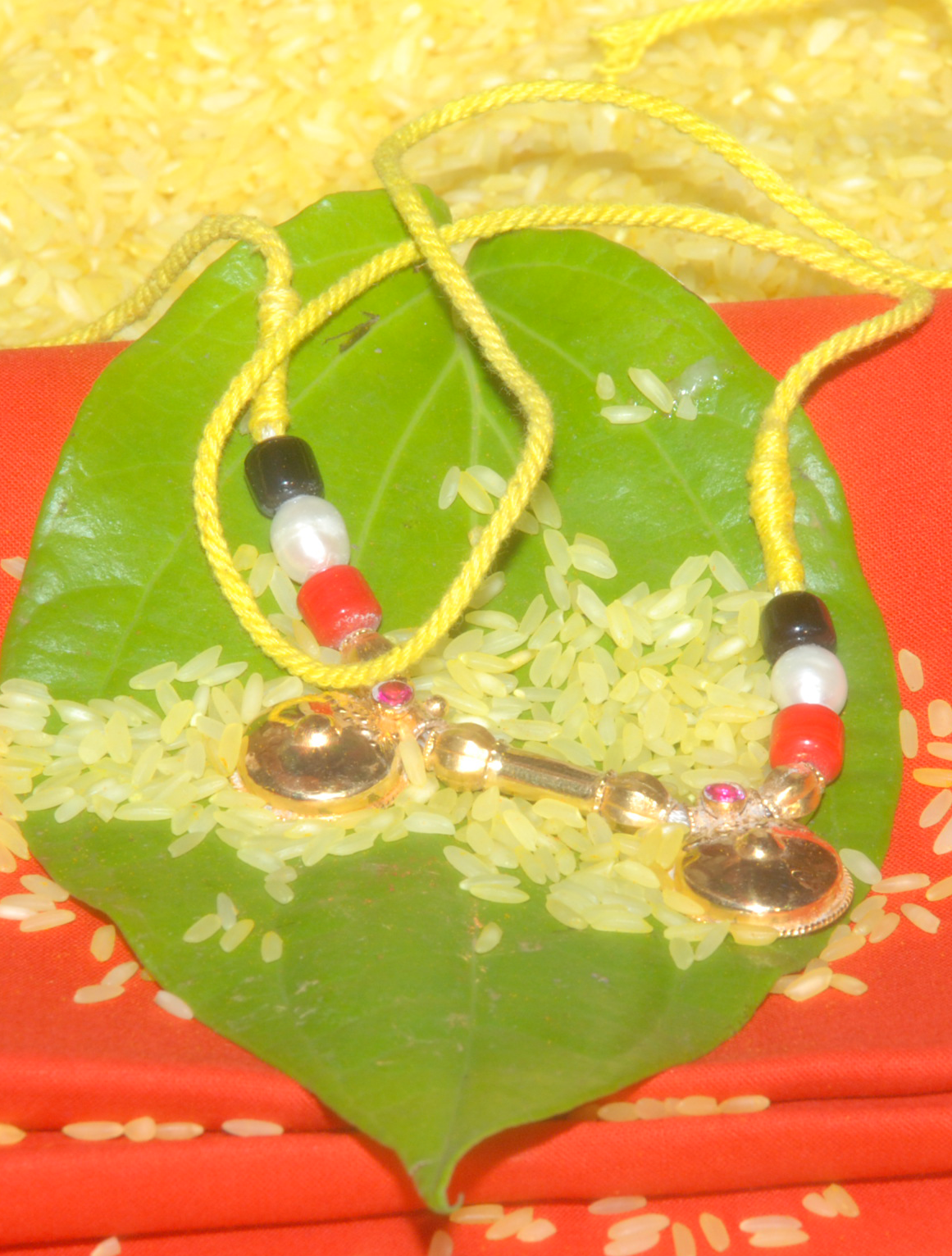 MangalasutraA necklace tied by the groom at a wedding, worn through married life
Good reading and sources
The facts on this page come from the Wikipedia article "Hambiliya", written by its contributors and used under the CC BY-SA 4.0 licence, and from its Wikidata record (CC0). EveryParampara rewrote the text in its own words, with AI assistance, and compares every page with the article to make sure no passage is copied. It may be reused under the same CC BY-SA 4.0 licence with a link back.
It may contain mistakes. Traditions differ from one family, village and community to the next, and the people who keep them know them best. If something is wrong, tell us. Last refreshed 2026-10-12.
More from Sri Lanka
All the traditions of Sri Lanka
🇮🇳 India and 4 moreSariसाड़ी
An unstitched length of cloth that women drape around the body, worn across South AsiaDress
🇮🇳 Lucknow, India and 3 moreSherwani
A long buttoned coat for men, worn at weddings and state occasions in South AsiaDress
🇮🇳 India and 2 moreMangalasutraमङ्गलसूत्रम् (maṅgalasūtram)
A necklace tied by the groom at a wedding, worn through married lifeDress
 🇮🇳 India and 5 moreBindi
A dot worn between the eyebrows, red for marriage and devotion, worn daily by many womenDress
🇮🇳 India and 5 moreBindi
A dot worn between the eyebrows, red for marriage and devotion, worn daily by many womenDress
The same idea elsewhere
All of this kind 🇮🇱 Israel and 1 moreTzitzitצִיצִית
Knotted ritual fringes worn on a four-cornered garment, a reminder of the commandmentsDress
🇮🇱 Israel and 1 moreTzitzitצִיצִית
Knotted ritual fringes worn on a four-cornered garment, a reminder of the commandmentsDress
 🇪🇬 Egypt and 5 moreTraditional tattooing
The ancient custom of marking the skin for protection, healing, status and sacred ritesDress
🇪🇬 Egypt and 5 moreTraditional tattooing
The ancient custom of marking the skin for protection, healing, status and sacred ritesDress
 🇼🇸 Samoa and 1 moreʻIe tōga
Precious woven mats exchanged in Samoan ceremonies to honor family ties and chiefly status.Dress
🇼🇸 Samoa and 1 moreʻIe tōga
Precious woven mats exchanged in Samoan ceremonies to honor family ties and chiefly status.Dress
 🇺🇦 Chernivtsi, Ukraine and 5 moreVyshyvanka DayДень вишиванки
An annual day for wearing traditional Ukrainian embroidered shirts across the worldDress
🇺🇦 Chernivtsi, Ukraine and 5 moreVyshyvanka DayДень вишиванки
An annual day for wearing traditional Ukrainian embroidered shirts across the worldDress