Games, sport and playEast AsiaSecular and civic
House
A traditional children's make-believe game of acting out domestic family roles

House is a traditional make-believe game played by children at home and in daycare settings. Participants step into the roles of household members such as parents, infants, and pets, often using miniature kitchens and toy foods.
House is a classic pretend game where children act out domestic family life. Players take on everyday household identities, including mothers, fathers, young children, infants, or domestic animals. The game is played during informal childhood play at home, nursery, or day care. Children create make-believe routines by using their imagination alongside play kitchens, miniature appliances, and replica items.
Roles and make-believe
In this game of imagination, participants divide household identities among themselves. The most frequent roles mimic a nuclear household, with children pretending to be mothers, fathers, sons, daughters, and newborns. Sometimes children also cast themselves or their toys as household pets. By acting out these parts, young players imitate adult behaviour and family routines. Dolls and soft toys often fill vacant parts when there are not enough participants to cover every role. The pretend scenarios shift freely depending on what the players decide to invent during their play session.
Props and playthings
Children frequently support their pretend stories with dedicated toys and household props. Miniature play kitchens and small model homes are built specifically for this activity, giving players a physical setting for their imagined domestic routines. Fake food items and mock cooking appliances allow participants to prepare pretend meals and serve them to other family members. When manufactured toys are absent, children use simple everyday objects or dolls to stand in for relatives, infants, and kitchen utensils. These physical objects help ground the make-believe drama in relatable domestic activities.
Names across cultures
Different cultures have their own descriptive names for this childhood pastime. In German, Dutch, Swedish, and Thai, titles translate directly to family roles like mother, father, and child. The Japanese term mamagoto translates to playing cooking, while the Indonesian name rumah-rumahan means fake house. In Persian, expressions such as auntie play or mother play highlight a traditional association with young girls. Russian children call it daughters-and-mothers, while Hindi speakers know it as ghar-ghar, and Turkish children refer to it as evcilik. Each language reflects a focus on domestic life.
How House is kept
Children begin by deciding which family roles each person will assume, choosing parts such as parents, children, babies, or pets. Dolls and soft toys are set up to represent missing relatives or infants. The players then use model houses, toy kitchens, and faux food items to act out daily domestic chores, meals, and family conversations. Play unfolds spontaneously in living rooms, nursery spaces, or daycare centres.
When and where
The game does not follow a calendar date or set schedule. Children play house whenever free playtime is available, engaging in make-believe sessions during regular days at home or in group care facilities.
House is played indoors and outdoors across the globe. It is commonly found in family homes, kindergartens, nurseries, and day care centres where play spaces and toys are accessible.
What House means
Playing house allows children to explore family relationships and domestic responsibilities through pretend play. By acting out adult roles, children process everyday experiences of caretaking, food preparation, and household routines. The activity reflects how children perceive the social dynamics and domestic structures of the grown-up world around them.
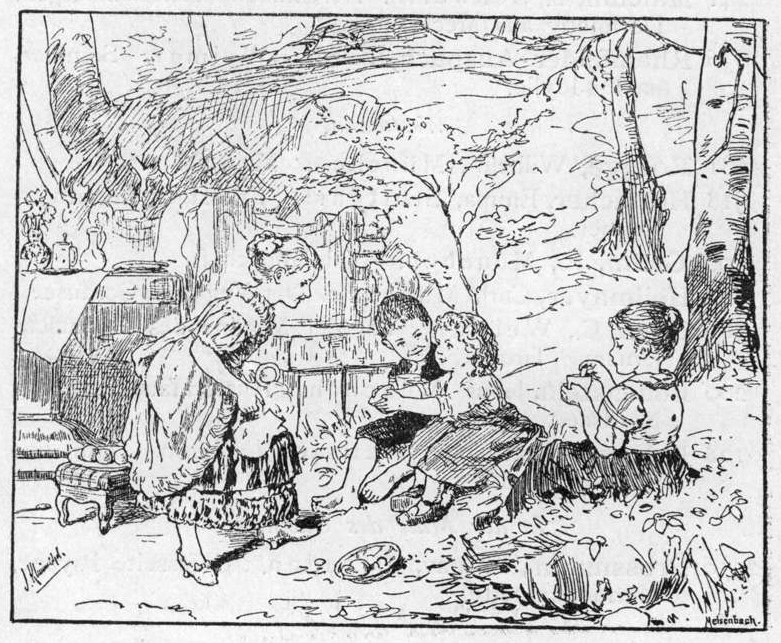


Questions people ask about House
What is the game of house?
House is a traditional children's make-believe game where players take on the roles of family members, such as parents, siblings, babies, and pets. Children act out everyday domestic routines using their imagination and toy props.
Where do children usually play house?
Children play the game in private homes, day care facilities, kindergartens, and nurseries. Any area with space for make-believe play or toy kitchen sets can serve as the setting.
What toys are used while playing house?
Common props include toy food, miniature kitchen appliances, model houses, and play kitchens. Dolls and stuffed animals are also frequently used to represent babies or additional family members.
What are some international names for the game?
The game is known as ghar-ghar in Hindi, mamagoto in Japanese, vadertje en moedertje in Dutch, Mutter, Vater, Kind in German, and rumah-rumahan in Indonesian, among many other regional terms.
See also
 Hunting with eaglesThe Central Asian tradition of hunting foxes and hares from horseback with golden eagles.
 KarutaJapanese playing cards from the 16th century, still raced over poems each New Year
 Pencak silatIndonesia's many schools of full-body fighting, with strikes, locks, throws and blades
 DreidelA four-sided top spun for small stakes, most often by Jewish families at Hanukkah
Good reading and sources
The facts on this page come from the Wikipedia article "House (game)", written by its contributors and used under the CC BY-SA 4.0 licence, and from its Wikidata record (CC0). EveryParampara rewrote the text in its own words, with AI assistance, and compares every page with the article to make sure no passage is copied. It may be reused under the same CC BY-SA 4.0 licence with a link back.
It may contain mistakes. Traditions differ from one family, village and community to the next, and the people who keep them know them best. If something is wrong, tell us. Last refreshed 2026-10-06.
More from Japan
All the traditions of Japan 🇯🇵 Japan and 2 moreKyūdō弓道
The Japanese martial art of archery, practiced with an asymmetrical longbowGame
🇯🇵 Japan and 2 moreKyūdō弓道
The Japanese martial art of archery, practiced with an asymmetrical longbowGame
 🇨🇳 China and 2 moreCuju蹴鞠
An ancient Chinese kicking game played without hands using a stuffed or air-filled ballGame
🇨🇳 China and 2 moreCuju蹴鞠
An ancient Chinese kicking game played without hands using a stuffed or air-filled ballGame
 🇯🇵 Kyoto, JapanKendo剣道
A Japanese martial art of swordsmanship using bamboo swords and protective armourGame
🇯🇵 Ōmuta, JapanKarutaかるた
Japanese playing cards from the 16th century, still raced over poems each New YearGame
🇯🇵 Kyoto, JapanKendo剣道
A Japanese martial art of swordsmanship using bamboo swords and protective armourGame
🇯🇵 Ōmuta, JapanKarutaかるた
Japanese playing cards from the 16th century, still raced over poems each New YearGame
The same idea elsewhere
All of this kind 🇺🇸 Fairbanks, United States and 2 moreWorld Eskimo-Indian Olympics
An annual Arctic gathering of traditional survival games, athletics, and cultural artsGame
🇺🇸 Fairbanks, United States and 2 moreWorld Eskimo-Indian Olympics
An annual Arctic gathering of traditional survival games, athletics, and cultural artsGame
 🇲🇽 MexicoRarájipari
A traditional endurance running ball game of the Rarámuri people in northern MexicoGame
🇲🇽 MexicoRarájipari
A traditional endurance running ball game of the Rarámuri people in northern MexicoGame
 🇨🇭 Aproz, Switzerland and 2 moreCombat de Reines
An annual Swiss pushing contest where Hérens cows compete for herd dominanceGame
🇨🇭 Aproz, Switzerland and 2 moreCombat de Reines
An annual Swiss pushing contest where Hérens cows compete for herd dominanceGame
 🇸🇪 Mora, SwedenVasaloppet
A 90 km cross-country ski race from Sälen to Mora, run every March since 1922Game
🇸🇪 Mora, SwedenVasaloppet
A 90 km cross-country ski race from Sälen to Mora, run every March since 1922Game