Games, sport and playMiddle East
Karakucak
In its own language: Karakucak Güreşi
Turkish wrestling on grass, in baggy trousers, with oiling forbidden
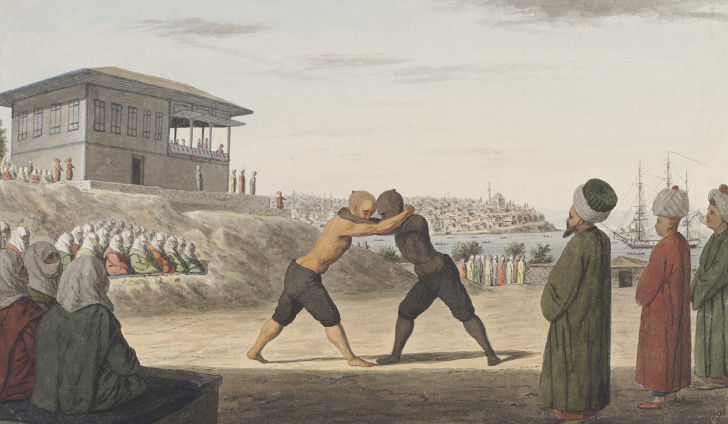
Karakucak is a wrestling style from Turkey; with one other Turkish wrestling tradition it is followed right across the country, and the Turkish Wrestling Federation sanctions both. Matches are held on grass, wrestlers wear baggy trousers or canvas pırpıt, oil is banned, and the rules otherwise follow Turkish oil wrestling.
Karakucak is a wrestling style from Turkey, followed in matches all over the country. Two Turkish wrestling traditions are followed right across the country, and this is one of them; the Turkish Wrestling Federation sanctions both. Contests happen on grass fields. Oiling the body or the clothing is not allowed. Wrestlers wear baggy trousers or pırpıt, sturdy trousers made from canvas. In Çukurova, a local form called Köprülü karakucak follows rules much like Olympic freestyle wrestling.
What it is
Karakucak is a wrestling style from Turkey. Two Turkish wrestling traditions are followed right across the country, and this is one of them; the Turkish Wrestling Federation sanctions both. The style also carries the longer name Karakucak Güreşi. Its contests are staged on fields of grass, and the same is true of the other Turkish wrestling traditions. Nothing about a bout depends on oil: greasing the body or the clothing is banned outright. Wrestlers turn out in loose trousers, and the whole look of the sport is plain, outdoor and ungreased.
Clothing and rules
Competitors dress in şalvar, the baggy trousers worn in many parts of Turkey, or in a special pair called pırpıt. Pırpıt are cut from canvas or from another fabric of similar toughness. Oiling is strictly prohibited, whether it is the body or the garment that would be greased. Beyond that, the rules of karakucak closely resemble the rules of Turkish oil wrestling, the better known of the country's wrestling traditions, in which competitors are slicked with oil before they grapple. Karakucak keeps the same contest but removes the oil. Matches are still held outdoors on grass.
Local styles
Karakucak is not one single rule set. Several local styles exist, each kept in its own part of the country. One of them, Köprülü karakucak, is practised mainly in Çukurova, in southern Turkey. Its rules come very close to those of Olympic freestyle wrestling, which marks it out from the rest. The other local styles are known only as a group, with no detail on how they differ from one another. What the whole group shares is the base: contests on grass, baggy trousers or tough canvas pırpıt, no oil, and a rulebook that follows the pattern of Turkish oil wrestling.
How Karakucak is kept
The people who take part are wrestlers, and they meet on a field of grass rather than indoors. Before a bout they dress in şalvar, the baggy trousers, or in pırpıt, sturdy trousers of canvas or a similar cloth. No oil goes on the body or on the garments. Once both wrestlers are ready, the match is run under rules that come close to those of Turkish oil wrestling, but with nothing to make the grip slick. In Çukurova the local Köprülü style is run under rules very near Olympic freestyle. The Turkish Wrestling Federation sanctions the competitions.
When and where
Karakucak is kept in Turkey, where it is practised from place to place across the country rather than in one single town. The Turkish Wrestling Federation sanctions competitions. The local form Köprülü karakucak belongs mainly to Çukurova, in the south of the country. All contests are held on grass fields, which is the common setting for Turkey's wrestling traditions.
Questions people ask about Karakucak
What is karakucak?
It is a wrestling style from Turkey. Two Turkish wrestling traditions are followed right across the country, and this is one of them; the Turkish Wrestling Federation sanctions both. Matches happen on grass, and the wrestlers wear baggy trousers or canvas pırpıt, with oil forbidden.
Where do people wrestle karakucak?
In Turkey, all over the country. Every competition is staged on a field of grass. One local version, Köprülü karakucak, is practised mainly in Çukurova in southern Turkey, and its rules come very close to those of Olympic freestyle wrestling.
Is oil used in karakucak?
No. Oiling the body or the clothing is strictly prohibited. That is the main difference from Turkish oil wrestling, where competitors are greased before they grapple. Apart from the oil, the two styles share a very similar set of rules.
What clothing do the wrestlers wear?
Baggy trousers called şalvar, or a special pair named pırpıt. Pırpıt are made from canvas or from another fabric of similar strength. Bodies and garments alike must stay free of oil.
See also
 World Nomad GamesA two-yearly contest of Central Asian nomadic sports, first staged in Kyrgyzstan in 2014
 JereedRiders on horseback throw blunt wooden javelins at rivals in this Turkish team sport
 KurashCentral Asian traditional upright folk wrestling using cloth belts or towels
 KırkpınarA three-day Turkish oil wrestling contest near Edirne, held each June since 1360
Good reading and sources
The facts on this page come from the Wikipedia article "Karakucak", written by its contributors and used under the CC BY-SA 4.0 licence, and from its Wikidata record (CC0). EveryParampara rewrote the text in its own words, with AI assistance, and compares every page with the article to make sure no passage is copied. It may be reused under the same CC BY-SA 4.0 licence with a link back.
It may contain mistakes. Traditions differ from one family, village and community to the next, and the people who keep them know them best. If something is wrong, tell us. Last refreshed 2026-10-10.
More from Turkey
All the traditions of Turkey
🇰🇬 Cholpon-Ata, Kyrgyzstan and 2 moreWorld Nomad GamesДүйнөлүк көчмөндөр оюндары
A two-yearly contest of Central Asian nomadic sports, first staged in Kyrgyzstan in 2014Game
🇺🇿 Uzbekistan and 5 moreKurashкөрәш
Central Asian traditional upright folk wrestling using cloth belts or towelsGame
 🇹🇷 Edirne, Turkey and 3 moreOil wrestlingYağlı güreş
Oiled wrestlers in leather trousers: Turkey's national sport, centred on KırkpınarGame
🇹🇷 Edirne, TurkeyKırkpınar
A three-day Turkish oil wrestling contest near Edirne, held each June since 1360Game
🇹🇷 Edirne, Turkey and 3 moreOil wrestlingYağlı güreş
Oiled wrestlers in leather trousers: Turkey's national sport, centred on KırkpınarGame
🇹🇷 Edirne, TurkeyKırkpınar
A three-day Turkish oil wrestling contest near Edirne, held each June since 1360Game
The same idea elsewhere
All of this kind 🇺🇸 Fairbanks, United States and 2 moreWorld Eskimo-Indian Olympics
An annual Arctic gathering of traditional survival games, athletics, and cultural artsGame
🇺🇸 Fairbanks, United States and 2 moreWorld Eskimo-Indian Olympics
An annual Arctic gathering of traditional survival games, athletics, and cultural artsGame
 🇨🇭 Aproz, Switzerland and 2 moreCombat de Reines
An annual Swiss pushing contest where Hérens cows compete for herd dominanceGame
🇨🇭 Aproz, Switzerland and 2 moreCombat de Reines
An annual Swiss pushing contest where Hérens cows compete for herd dominanceGame
 🇲🇽 MexicoRarájipari
A traditional endurance running ball game of the Rarámuri people in northern MexicoGame
🇲🇽 MexicoRarájipari
A traditional endurance running ball game of the Rarámuri people in northern MexicoGame
 🇸🇪 Mora, SwedenVasaloppet
A 90 km cross-country ski race from Sälen to Mora, run every March since 1922Game
🇸🇪 Mora, SwedenVasaloppet
A 90 km cross-country ski race from Sälen to Mora, run every March since 1922Game