Festivals and celebrationsEuropeChristian
Kupala Night
A summer solstice folk festival marked by bonfires, water rituals and herbal gatherings across Eastern Europe.

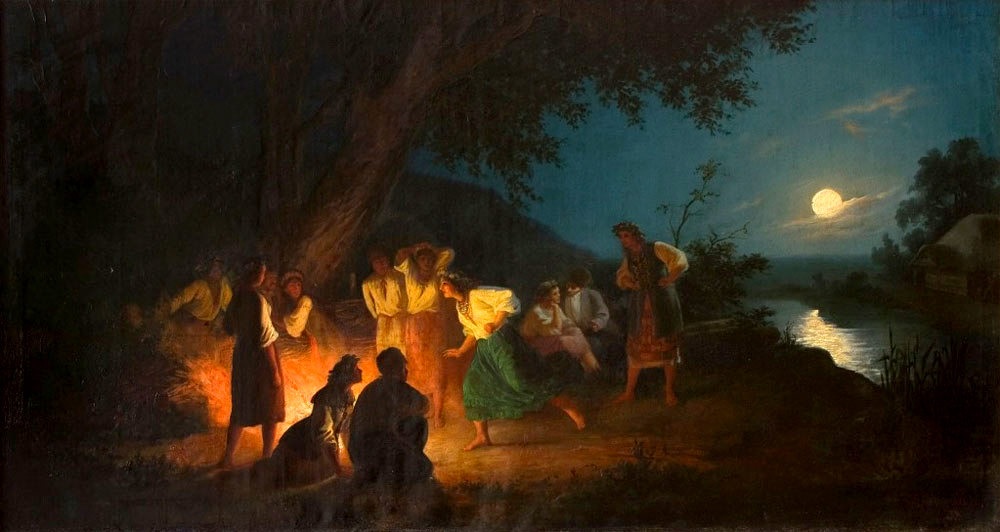
Kupala Night is a major folk holiday celebrated in several Slavic nations. It aligns with the Christian feast of Saint John the Baptist but retains older customs tied to the summer solstice. Participants gather herbs, light fires, bathe in rivers and perform divination rites on the longest night of the year.
When is Kupala Night kept?
Kupala Night is kept on june 21-24 or July 6-7 depending on the calendar used.
Kupala Night stands as one of the most significant folk holidays among Slavic peoples. It merges ancient solstice traditions with the Christian celebration of Saint John the Baptist. Communities gather to honor the peak of summer through fire, water and plant rituals that seek purification and good fortune.
Origins and history
Scholars generally view this event as a Christianized version of an older Proto-Slavic solstice celebration. Some researchers argue it blends pagan and Christian elements, while others debate its pre-Christian roots. The name likely stems from the Proto-Slavic word for bathing. Historical records show the term appearing in Old East Slavic texts centuries ago. Modern historians note that the holiday may have been dedicated to a deity named Kupala, though such a figure is not confirmed in surviving sources.
Rituals and practices
Celebrants engage in activities centered on water, fire and plants. People collect herbs and flowers to decorate homes and animals. Bathing in rivers or lakes is mandatory, as the water is believed to hold magical healing powers. Bonfires are lit on hills or near water, often using friction wood. Young people jump over these flames for protection and luck. Wreaths made of flowers are floated on water for divination, predicting marriage or longevity.
Dates and calendars
The timing varies by region and calendar system. In Western Slavic areas like Poland and Czechia, it falls around June 21 to 24. Ukraine adopted these dates recently. Belarus, Russia and parts of Ukraine follow the Julian calendar, placing the celebration between July 6 and 7. This shift aligns the festival with the traditional summer solstice period in those specific locales.
Food and drink
Communities prepare special meals to mark the occasion. In Russian villages, girls make votive porridge from barley, sharing it with the poor and eating it themselves with butter. Belarusians bring delicacies like vareniki, cheese and sweet dough to communal gatherings. Alcohol consumption is common, with vodka drunk in Belarus and wine in Podlachia and the Carpathians. Eating cherries before the holiday was traditionally forbidden in some regions.
How Kupala Night is kept
Young men and women participate in gathering herbs and lighting large bonfires. They jump over the flames to purify themselves and ensure happiness. Wreaths are placed on rivers to predict future marriages. People bathe in natural waters early in the morning. Communities burn unwanted items and perform songs and dances around the fires. Divination rituals involve floating flower crowns on the water.
When and where
It occurs annually around the summer solstice. Western Slavs celebrate in late June. Eastern Slavs using the Julian calendar observe it in early July. The exact date shifts slightly based on local calendar traditions.
The tradition is strongest in Ukraine, Belarus and Russia. It is also observed in Poland, Slovakia and Bulgaria. Celebrations typically take place near rivers, on hills or in forest glades where fires can be safely lit.
What Kupala Night means
The festival symbolizes the union of opposing forces like fire and water. It represents purification, fertility and the peak of solar power. Jumping over fires wards off evil spirits and disease. Floating wreaths seeks blessings for love and life. The rituals aim to restore balance and ensure community well-being for the coming season.
On the table
- votive porridge
- vareniki
- cheese
- tvarog
- kulaha
- babka
- cold borscht
- cherries


Questions people ask about Kupala Night
When is Kupala Night kept?
Kupala Night is kept on june 21-24 or July 6-7 depending on the calendar used.
What is Kupala Night?
It is a major Slavic folk holiday celebrating the summer solstice. It combines ancient nature rituals with the Christian feast of Saint John the Baptist. People use fire, water and herbs to seek purification and good fortune.
Where is it kept?
It is widely observed in Ukraine, Belarus and Russia. It is also practiced in Poland, Slovakia and Bulgaria. Celebrations happen outdoors near water bodies or on elevated ground suitable for bonfires.
What are the main rituals?
Participants light bonfires, jump over them for luck and bathe in rivers. They float flower wreaths on water for divination and gather medicinal herbs. Songs and dances accompany these activities throughout the night.
See also
 ChristmasA festival of Jesus's birth, kept on 25 December with gifts, lights and shared meals
 NowruzThe Iranian new year at the March equinox, kept with fire, greenery and picnics
 MaslenitsaA seven-day Eastern Slavic festival of pancakes and bonfires marking the end of winter before Lent.
 SabantuyA summer festival of folk sports and feasting celebrated by Tatar, Bashkir, Chuvash, and Kazakh communities.
Good reading and sources
- Kupala Night on WikipediaEncyclopedia
- More photos on Wikimedia CommonsPhotos and video
- Wikidata recordOpen data
The facts on this page come from the Wikipedia article "Kupala Night", written by its contributors and used under the CC BY-SA 4.0 licence, and from its Wikidata record (CC0). EveryParampara rewrote the text in its own words, with AI assistance, and compares every page with the article to make sure no passage is copied. It may be reused under the same CC BY-SA 4.0 licence with a link back.
It may contain mistakes. Traditions differ from one family, village and community to the next, and the people who keep them know them best. If something is wrong, tell us. Last refreshed 2026-10-04.
More from Ukraine
All the traditions of Ukraine 🇺🇦 Kyiv, Ukraine and 7 morePysankaписанка
A wax-resist egg decorating tradition kept by Slavic communities for Easter and spring renewal.Festival
🇺🇦 Kyiv, Ukraine and 7 morePysankaписанка
A wax-resist egg decorating tradition kept by Slavic communities for Easter and spring renewal.Festival
 🇺🇦 Kyiv, UkraineChristmas in UkraineРіздво (Rizdvo)
A Ukrainian Christmas celebration with a twelve-dish vegan supper on Christmas Eve and observance on January 6 or DecembFestival · Supper
🇺🇦 Kyiv, UkraineChristmas in UkraineРіздво (Rizdvo)
A Ukrainian Christmas celebration with a twelve-dish vegan supper on Christmas Eve and observance on January 6 or DecembFestival · Supper
 🇺🇦 Ukraine and 7 moreKoliadaКоляда
A traditional winter caroling and solstice festival kept across Slavic EuropeFestival
🇺🇦 Ukraine and 7 moreKoliadaКоляда
A traditional winter caroling and solstice festival kept across Slavic EuropeFestival
 🇩🇪 Saalfeld, Germany and 5 moreEaster egg treeOstereierbaum
A German springtime custom of dressing living trees and branches with blown eggsFestival
🇩🇪 Saalfeld, Germany and 5 moreEaster egg treeOstereierbaum
A German springtime custom of dressing living trees and branches with blown eggsFestival
The same idea elsewhere
Remembering the ancestors compared
🇮🇷 Iran and 7 moreNowruzنوروز
The Iranian new year at the March equinox, kept with fire, greenery and picnicsSeasonal
 🇮🇳 Mathura, India and 5 moreHoliहोली (Hindi)
A spring festival of colours and bonfires that marks the end of winter and the triumph of good over evil.Festival
🇮🇳 Mathura, India and 5 moreHoliहोली (Hindi)
A spring festival of colours and bonfires that marks the end of winter and the triumph of good over evil.Festival
 🇰🇷 Jeju, South KoreaGut굿
Sacred rites of song, dance, and spirit communion performed by Korean shamansSpiritual
🇰🇷 Jeju, South KoreaGut굿
Sacred rites of song, dance, and spirit communion performed by Korean shamansSpiritual
 🇮🇳 Guwahati, IndiaBihu dance
A folk dance from Assam that celebrates spring, fertility and the new year with energetic movement and music.Performance
🇮🇳 Guwahati, IndiaBihu dance
A folk dance from Assam that celebrates spring, fertility and the new year with energetic movement and music.Performance