Spiritual and religiousEuropeChristian
Lazarice
In its own language: лазарице
A spring procession of girls in flower wreaths, singing door to door before Palm Sunday
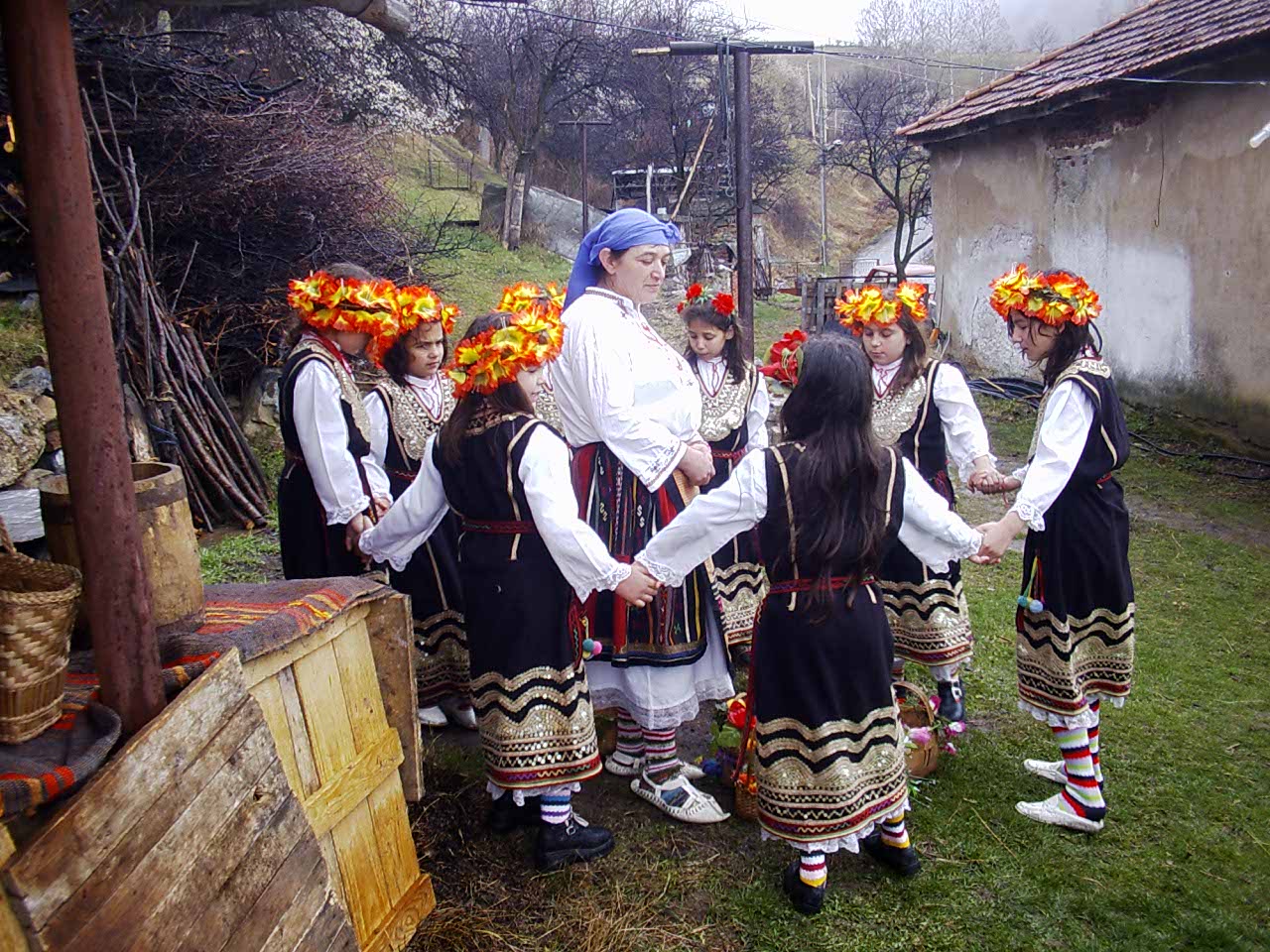
Lazarice is a spring procession kept by South Slavic communities, in which young unmarried girls known as lazarki walk through a village singing and blessing each home. It falls on Lazareva Subota, the Saturday before Palm Sunday, and is still strongest in small villages rather than large cities.
When is Lazarice marked?
Lazarice is kept as part of Palm Sunday, which is on Sunday, 21 March 2027.
Lazarice is a procession that young unmarried girls, called lazarki, keep in South Slavic villages on the Saturday before Palm Sunday. Wearing wreaths of flowers and ribbons, they move from house to house with songs and blessings for each home, and are given small presents and food in return. The custom is tied to the Orthodox feast of Lazareva Subota and to a girl's place in village life.
What it is
Lazarice is a spring procession kept in parts of the Balkans. The girls who take part are called lazarki, a word from the name Lazarus. They are usually about sixteen and not yet married. The group walks through the village and sings. In the past a group might have held around fourteen girls, though the number differs from place to place. The ritual belongs to Lazareva Subota, the Orthodox feast on the eve of Palm Sunday. In Bulgarian the custom is called Lazaruvane, and Greek speakers know a form of it as Lazarines.
Origins and history
According to historians and anthropologists, the procession descends from Rosalia, a festival of the Roman Empire. Romans brought it to southeastern Europe after they took control of the Balkans in the second century BC. Slavic tribes who settled in the region during the sixth and seventh centuries took over part of these Greek and Roman customs and gave them their own shape. Today the rite sits inside the Orthodox feast of Lazareva Subota, named for Lazarus, so an older seasonal custom and a Christian holy day are kept together.
How it is kept
On the day, the lazarki gather and dress their hair with wreaths, often made of flowers and coloured ribbons. They go from door to door, singing as they walk, and each household receives a song and a blessing. The people inside, usually the men, give the girls small gifts and food. Later the group meets at a river and sets the wreaths on the water. People say the girl whose wreath drifts ahead of the others will be the first of the group to marry.
What it means
For the village, the procession is a blessing on the homes it visits and a sign that spring has come. For the girls it marks a step in growing up: a girl who has never joined the lazarki, tradition says, may not be engaged or married. So taking part is not only a performance but a public sign of adulthood and readiness for marriage. The floating wreaths carry the same hope, turning the river into a way of reading who will wed first.
Today and change
Large cities no longer see the procession much, because many people live there and village ties are looser. The custom survives mainly in smaller settlements, and it depends on having young girls who are willing to take part. Where the ritual is kept, families and neighbours pass it on to the next group of girls. Scholars have written about it in Serbia and Bulgaria; studies of village life around Leskovac and of spring customs from Chiprovtsi are among the sources.
How Lazarice is kept
Unmarried girls, usually around sixteen, make up a lazarki group. They dress their hair with wreaths of flowers and ribbons. The group walks through the village singing, stopping at one house after another. At each home they sing and bless the household; the hosts, usually the men, hand over small presents and food. Afterwards the girls meet by a river and place their wreaths on the water. The wreath that moves ahead is read as a sign of who will marry first. Groups once numbered about fourteen, with local differences.
When and where
It is kept once a year on Lazareva Subota, the Saturday that falls before Palm Sunday, so its date moves with the Orthodox Easter cycle. The feast is named for Lazarus. In English-speaking Orthodox churches the same day is known as Lazarus Saturday.
The procession belongs to South Slavic communities in the Balkans. The sources tie it to Serbia and Bulgaria in particular, and records also connect it with Kosovo and Moldova. It is strongest in villages, not in the big cities, where it is no longer widely practised.
What Lazarice means
The girls' songs and blessings are meant to bring good to the homes they visit, and the procession announces spring and the coming of Easter. Participation also carries a promise about the future: tradition holds that a girl who has never been a lazarka may not be engaged or married. The wreaths set on the river turn that hope into something visible, since the one that floats ahead is said to belong to the girl who will wed first.

Days Lazarice is marked
Questions people ask about Lazarice
When is Lazarice marked?
Lazarice is kept as part of Palm Sunday, which is on Sunday, 21 March 2027.
What is Lazarice?
It is a spring procession kept by South Slavic village communities. Young unmarried girls, called lazarki, walk from house to house singing, bless each home and receive small presents and food. It falls on Lazareva Subota, the Orthodox feast before Palm Sunday.
Who may take part?
The performers are young unmarried girls, usually around sixteen. Tradition says that a girl who has never joined the procession may not become engaged or be married. Taking part therefore matters for her standing in the village.
Where is it still kept?
Mainly in small villages of the Balkans, since it is no longer widely practised in large cities. The sources link it to Serbia and Bulgaria, and records also connect it with Kosovo and Moldova.
Where does it come from?
Historians and anthropologists trace the procession to Rosalia, a festival of the Roman Empire that spread through southeastern Europe after the Roman conquest of the Balkans. Slavic tribes who settled there in the sixth and seventh centuries adopted parts of these customs and developed them further.
See also
 Saint George's DayA saint's feast on 23 April, kept by churches and patron nations from England to Georgia
 Saint Nicholas DayThe feast day of Saint Nicholas, kept in Advent with gifts, shoes and church services
 SlavaAn annual Serbian family feast honouring their patron saint with blessed bread and wine
 RadonitsaA spring day when Orthodox families visit graves, share Easter food and greet the dead
Good reading and sources
The facts on this page come from the Wikipedia article "Lazarice", written by its contributors and used under the CC BY-SA 4.0 licence, and from its Wikidata record (CC0). EveryParampara rewrote the text in its own words, with AI assistance, and compares every page with the article to make sure no passage is copied. It may be reused under the same CC BY-SA 4.0 licence with a link back.
It may contain mistakes. Traditions differ from one family, village and community to the next, and the people who keep them know them best. If something is wrong, tell us. Last refreshed 2026-10-05.
More from Serbia
All the traditions of Serbia
🇷🇸 SerbiaSlavaСлава
An annual Serbian family feast honouring their patron saint with blessed bread and wineSpiritual · Feasts and festival meals
 🇷🇸 Serbia and 5 moreSerbian ChristmasБожић
A three-day midwinter observance focused on oak logs, floor straw and family gatheringsSpiritual · Dinner
🇷🇸 Serbia and 5 moreSerbian ChristmasБожић
A three-day midwinter observance focused on oak logs, floor straw and family gatheringsSpiritual · Dinner
 🇧🇬 Bulgaria and 4 moreKukeriкукери (kukeri)
Masked and belled figures who tour Bulgarian villages at New Year to drive off harmSpiritual
🇬🇧 United Kingdom and 5 moreSaint George's Day
A saint's feast on 23 April, kept by churches and patron nations from England to GeorgiaSpiritual
🇧🇬 Bulgaria and 4 moreKukeriкукери (kukeri)
Masked and belled figures who tour Bulgarian villages at New Year to drive off harmSpiritual
🇬🇧 United Kingdom and 5 moreSaint George's Day
A saint's feast on 23 April, kept by churches and patron nations from England to GeorgiaSpiritual
The same idea elsewhere
Spring and renewal compared 🇳🇿 Auckland, New ZealandWharenui
A Māori carved communal meeting house at the centre of tribal life in New ZealandHome
🇳🇿 Auckland, New ZealandWharenui
A Māori carved communal meeting house at the centre of tribal life in New ZealandHome
 🇮🇩 Indonesia and 2 moreKenduri
A communal prayer meal and gathering shared across Indonesia, Malaysia and BruneiSpiritual · Feasts and festival meals
🇮🇩 Indonesia and 2 moreKenduri
A communal prayer meal and gathering shared across Indonesia, Malaysia and BruneiSpiritual · Feasts and festival meals
 🇳🇪 In-Gall, NigerCure Salée
A yearly gathering of Tuareg and Wodaabe nomads in In-Gall to mark the end of the rainy season.Festival
🇳🇪 In-Gall, NigerCure Salée
A yearly gathering of Tuareg and Wodaabe nomads in In-Gall to mark the end of the rainy season.Festival
 🇳🇿 New ZealandTivaevaetīvaevae
A traditional Polynesian art of artistic quilting made by women for gifts and ceremonies.Craft
🇳🇿 New ZealandTivaevaetīvaevae
A traditional Polynesian art of artistic quilting made by women for gifts and ceremonies.Craft