Spiritual and religiousEuropeChristian
Serbian Christmas
In its own language: Божић
A three-day midwinter observance focused on oak logs, floor straw and family gatherings

Serbian Christmas, known locally as Božić, is a three-day religious observance celebrated on January 7 by Serbs across the Balkans and diaspora. Families mark the feast with church services, the burning of an oak log called the badnjak, floor straw, and a festive fast.
When is Serbian Christmas marked?
Serbian Christmas is kept as part of Christmas, which is on Friday, 25 December 2026.
Serbian Christmas, called Božić, is a sacred midwinter observance kept for three days starting on January 7. Families prepare for the feast through shared prayers, special greetings, and a fasting dinner on Christmas Eve. The celebration centers on the home hearth and parish church, combining liturgical worship with domestic rituals involving oak boughs, scattered straw, and symbolic foods intended to bring health and abundance to the household.
The badnjak oak log
On Christmas Eve morning, men go out to harvest an oak branch or small tree, preferably Turkey oak. The woodcutter stands facing east, sprinkles grain upon the tree, offers a prayer, and fells it with an axe so that it drops toward the sunrise. In the evening, the branch, known as the badnjak, is carried inside over the threshold with the right foot first. Household members sprinkle it with grain, place it upon the hearth fire, and pour wine over the embers while speaking toasts for the health of the family, bountiful harvests, and growing flocks. In modern apartments, families display smaller bunches of dry oak twigs tied with straw and cornel wood.
Christmas Eve rituals
Before the evening meal, an armful of straw is spread across the room floor, and walnuts are tossed across it. Children often pretend to be chicks peeping while adults mimic a clucking hen. The Christmas Eve dinner, though plentiful, follows strict fasting rules. The menu features an unleavened bread loaf called badnjački kolač, salt, baked fish, stewed beans, sauerkraut, and noodles topped with ground walnuts and honey. The host lights a candle and carries incense through every room. In some regions, children walk from house to house after dark singing Nativity verses in exchange for fruit, nuts, and sweets.
Christmas Day and greetings
Christmas morning begins with ringing church bells and celebratory gunshots at daybreak. Believers attend the morning liturgy, breaking their fast only after eating a portion of blessed church bread brought home by the family head. Throughout the three days of celebration, Serbs greet one another with the phrase Christ is Born, answering Truly He is Born. The household welcomes a designated first visitor, known as the polažajnik, who steps inside to stir the fireplace embers and speak blessings of prosperity for the coming year.
How Serbian Christmas is kept
Celebrations begin early on Christmas Eve when male relatives cut an oak log. At dusk, the log is brought into the house, greeted with scattered grain, and burned in the hearth with a wine offering. Straw and walnuts are strewn over the floor before a fasting dinner of fish, beans, and unleavened bread is served. At dawn on Christmas Day, church bells announce the feast. Families attend the morning liturgy and break their fast with blessed church bread. A special first guest visits the home to speak blessings of good fortune, and relatives exchange traditional Nativity greetings for three consecutive days.
When and where
The observance takes place annually across three consecutive days beginning on January 7, which corresponds to Christmas Day on the Julian calendar. The broader festive cycle opens three weeks prior and concludes on Epiphany.
The custom is observed in Serbia and across Serb communities in Montenegro, Bosnia and Herzegovina, Croatia, Romania, and Slovenia. Celebrations take place both in private homes and during public churchyard gatherings organized by local Orthodox parishes.
What Serbian Christmas means
The name Božić means young god, referencing the birth of Christ. The badnjak log placed on the hearth represents light, warmth, and the renewal of life. Straw spread across the living space reflects the humble setting of the Nativity, while offerings of grain, wine, and protective garlic ward off misfortune and invite abundance for livestock and fields.
On the table
Flavours: Garlic
Days Serbian Christmas is marked
Questions people ask about Serbian Christmas
When is Serbian Christmas marked?
Serbian Christmas is kept as part of Christmas, which is on Friday, 25 December 2026.
What is Serbian Christmas?
Serbian Christmas, or Božić, is a three-day religious observance celebrated by Serbs to mark the Nativity of Jesus. It is characterized by church services, fasting meals, oak log rituals, and domestic blessings.
What is the badnjak?
The badnjak is an oak branch or log cut on Christmas Eve morning. It is brought into the house at nightfall, placed on the hearth fire, and anointed with wine to bring good fortune and fertility to the household.
How do people greet each other during Christmas?
During the three days of Christmas, Serbs greet each other by saying Hristos se rodi, meaning Christ is Born. The standard response is Vaistinu se rodi, which means Truly He is Born.
See also
 SlavaAn annual Serbian family feast honouring their patron saint with blessed bread and wine
 CălușariAn acrobatic Romanian spring dance and ritual brotherhood tied to folklore and healing
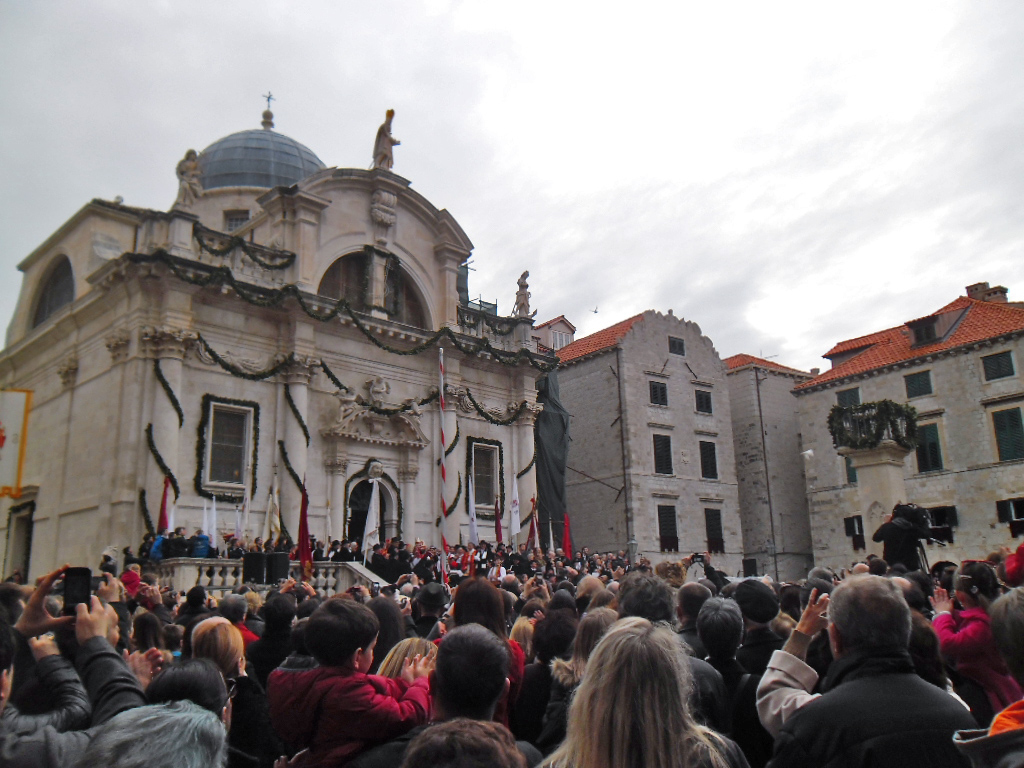 Festivity of Saint BlaiseAn annual patron saint festival in Dubrovnik with processions, relics and doves
 KoliadaA traditional winter caroling and solstice festival kept across Slavic Europe
Good reading and sources
- Christmas in Serbia on WikipediaEncyclopedia
- More photos on Wikimedia CommonsPhotos and video
- Wikidata recordOpen data
The facts on this page come from the Wikipedia article "Christmas in Serbia", written by its contributors and used under the CC BY-SA 4.0 licence, and from its Wikidata record (CC0). EveryParampara rewrote the text in its own words, with AI assistance, and compares every page with the article to make sure no passage is copied. It may be reused under the same CC BY-SA 4.0 licence with a link back.
It may contain mistakes. Traditions differ from one family, village and community to the next, and the people who keep them know them best. If something is wrong, tell us. Last refreshed 2026-10-04.
More from Serbia
All the traditions of Serbia
🇷🇸 SerbiaSlavaСлава
An annual Serbian family feast honouring their patron saint with blessed bread and wineSpiritual · Feasts and festival meals
 🇪🇹 Ethiopia and 5 moreNativity Fast
A forty-day Christian period of abstinence and prayer observed in preparation for Christmas.Spiritual
🇪🇹 Ethiopia and 5 moreNativity Fast
A forty-day Christian period of abstinence and prayer observed in preparation for Christmas.Spiritual
 🇧🇬 Bulgaria and 4 moreKukeriкукери (kukeri)
Masked and belled figures who tour Bulgarian villages at New Year to drive off harmSpiritual
🇧🇬 Bulgaria and 4 moreKukeriкукери (kukeri)
Masked and belled figures who tour Bulgarian villages at New Year to drive off harmSpiritual
 🇵🇱 Poland and 5 moreZaduszkiZaduszki, Dzień Zaduszny
A Polish day of prayer for the dead on 2 November, kept with candles at the gravesSpiritual
🇵🇱 Poland and 5 moreZaduszkiZaduszki, Dzień Zaduszny
A Polish day of prayer for the dead on 2 November, kept with candles at the gravesSpiritual
The same idea elsewhere
Midwinter and the longest night compared 🇦🇺 AustraliaSmoking ceremonyNumbuk Yabbun
An Aboriginal Australian ritual of burning native plants to cleanse, heal and welcomeSpiritual
🇦🇺 AustraliaSmoking ceremonyNumbuk Yabbun
An Aboriginal Australian ritual of burning native plants to cleanse, heal and welcomeSpiritual
 🇲🇦 Morocco and 4 moreMimounaמִימוּנָה
A Maghrebi Jewish celebration marking the end of Passover with sweets and open doorsFestival · Dinner
🇲🇦 Morocco and 4 moreMimounaמִימוּנָה
A Maghrebi Jewish celebration marking the end of Passover with sweets and open doorsFestival · Dinner
 🇮🇩 Indonesia and 4 moreLebaranHari Raya Lebaran
Indonesia's festive season of homecoming, seeking forgiveness and shared feastsFestival · Breakfast
🇮🇩 Indonesia and 4 moreLebaranHari Raya Lebaran
Indonesia's festive season of homecoming, seeking forgiveness and shared feastsFestival · Breakfast
 🇹🇷 Turkey and 5 moreEid al-Fitrعيد الفطر
The feast that ends Ramadan, opened with morning prayers, sweets and visits homeFestival · Feasts and festival meals
🇹🇷 Turkey and 5 moreEid al-Fitrعيد الفطر
The feast that ends Ramadan, opened with morning prayers, sweets and visits homeFestival · Feasts and festival meals