Music, dance and storytellingEast AsiaIndigenous and traditional
Musok eumak
In its own language: 무속 음악 (巫俗音樂)
Ritual music of Korean shamanism, sung and drummed to carry a shaman into trance
Musok eumak is the music of Korean shamanism, made for the gut, the shaman's ritual. Singing, dancing and percussion are believed to help the shaman into a trance, where contact with gods, ancestors and spirits becomes possible, and the same music is heard outside ritual as a way into older Korean sound.
When is Musok eumak kept?
Musok eumak is kept at and during the gut, the shamanistic ritual, whenever it is held.
Musok eumak is the music of Korean shamanism, made for the gut, the shaman's ritual. A performance brings together singing, dancing and percussion. Those sounds are believed to help the shaman enter trance and so speak with gods, ancestors and spirits. The music also lives outside ritual: listeners treat it as a way into the older layers of Korean music.
What it is
Musok eumak is the traditional shamanistic music of Korea, written in Korean as 무속 음악 and also called muak, 무악. It belongs to Korean shamanism and sounds at and during the gut, the shaman's ritual. A performance is never only sound: it joins singing, dancing and percussion. The sources present it as ritual music rather than a concert form, although it has a public life too. It is kept in South Korea, where it is treated as one of the older layers of the country's music.
In the ritual
The gut is the ritual setting, and inside it the music has a task. It is believed to help the shaman enter a trance, and trance is understood as the state in which gods, ancestors and spirits can be reached. Singing, dancing and percussion all serve that end, and the shaman stands at the centre while the sound carries the rite forward. The sources fix the music to no calendar day and give no fixed running order for the ritual. What they make clear is that the music and the gut belong together.
Beyond the ritual
Musok eumak is not played only for spiritual rites. Heard outside them, it lets listeners meet what the sources call an archetype of traditional Korean music, a model of older Korean sound. Its reach shows in later music: Samul nori, a present-day South Korean genre, draws in part on muak. The same body of sound therefore has two lives in the sources, one inside the ritual and one in Korean music more widely, where it is valued as a root that anyone who listens can experience.
How Musok eumak is kept
The music is played at and during the gut, a shamanistic ritual. A performance joins three things: singing, dancing and percussion. The shaman is the central figure, and the music is what is believed to carry the shaman toward trance. Within the rite, trance is understood as the state in which gods, ancestors and spirits can be reached, so the sound is doing the ritual's work. The sources give no fixed order of events and tie the music to no set date; it belongs to the gut whenever a gut is held.
When and where
The music belongs to the gut, the shamanistic ritual, and sounds at and during that rite. The sources give no fixed date. It is kept whenever a gut is held, rather than on one day of the year or one day of the week.
It belongs to South Korea and to Korean shamanism. The sources describe it as traditional Korean shamanistic music and note its place in Korean music more widely. They name no particular city, shrine or region as its home.
What Musok eumak means
For those who keep it, the sound is a means, not an ornament. Singing, dancing and percussion are believed to help the shaman enter trance, and trance is understood as the state in which gods, ancestors and spirits can be reached. The music therefore carries the purpose of the ritual. At the same time it is valued as an archetype, a model of older Korean music that anyone who hears it can experience, whether or not they take part in the rite.
Questions people ask about Musok eumak
When is Musok eumak kept?
Musok eumak is kept at and during the gut, the shamanistic ritual, whenever it is held.
What is musok eumak?
It is the traditional shamanistic music of Korea, also called muak. It is performed at and during the gut, a shamanistic ritual, and it joins singing, dancing and percussion.
Where is it kept?
It is part of Korean shamanic practice in South Korea. The sources name no single city, shrine or region as its home, describing it simply as Korean shamanistic music.
What is the music for?
It helps the shaman enter a trance, a state in which gods, ancestors and spirits are believed to be reachable. It is also played outside spiritual rites, where listeners experience the archetype of traditional Korean music.
Is it linked to other Korean music?
Yes. Samul nori, a present-day South Korean genre, is partly based on muak, which is the same music under its other name.
See also
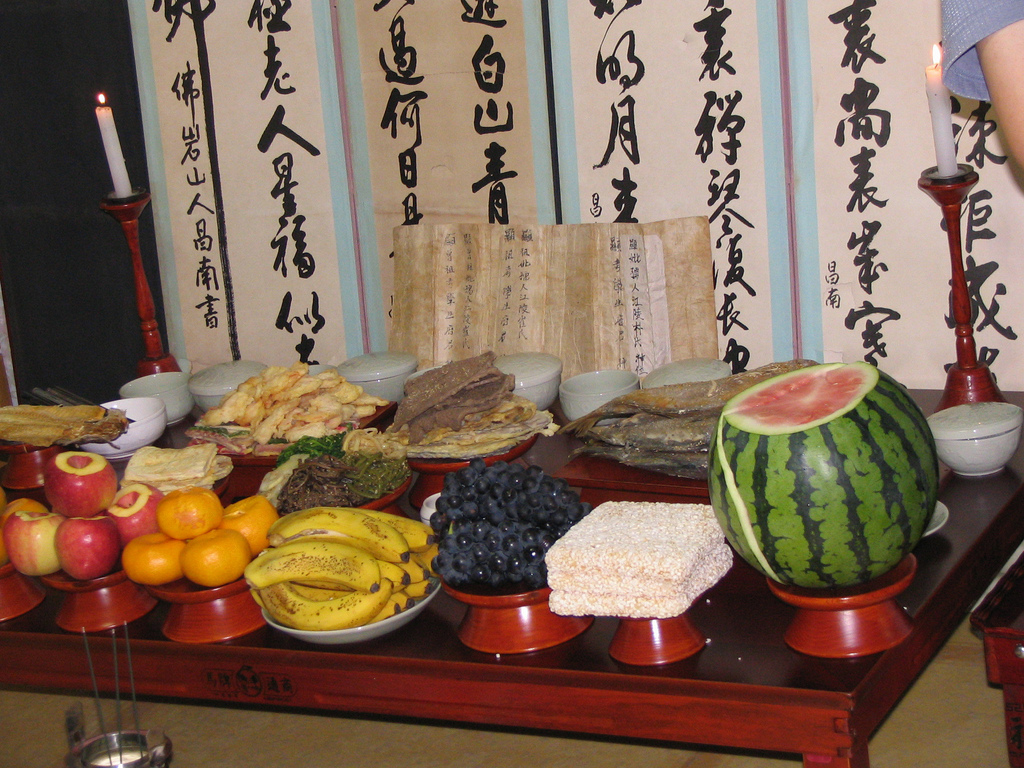 JesaA Korean ancestral memorial ceremony held on death anniversaries and major holidays.
 Water lanternSmall lamps floated on water to honour the dead and ask for good fortune
 GutSacred rites of song, dance, and spirit communion performed by Korean shamans
 Buddha's BirthdayA festival marking the birth of Siddhartha Gautama, observed across Asia with temple rituals and community gatherings.
Good reading and sources
The facts on this page come from the Wikipedia article "Musok eumak", written by its contributors and used under the CC BY-SA 4.0 licence, and from its Wikidata record (CC0). EveryParampara rewrote the text in its own words, with AI assistance, and compares every page with the article to make sure no passage is copied. It may be reused under the same CC BY-SA 4.0 licence with a link back.
It may contain mistakes. Traditions differ from one family, village and community to the next, and the people who keep them know them best. If something is wrong, tell us. Last refreshed 2026-10-09.
More from South Korea
All the traditions of South Korea 🇰🇷 Seoul, South Korea and 1 moreTalchum탈춤
A Korean mask dance drama in which masked actors sing, dance and mock the powerfulPerformance
🇰🇷 Seoul, South Korea and 1 moreTalchum탈춤
A Korean mask dance drama in which masked actors sing, dance and mock the powerfulPerformance
 🇰🇷 South Korea and 1 moreGanggangsullae강강술래
A Korean harvest dance where women hold hands and sing in circles under the full moonPerformance
🇰🇷 South Korea and 1 moreGanggangsullae강강술래
A Korean harvest dance where women hold hands and sing in circles under the full moonPerformance
 🇰🇷 Honam, South Korea and 2 morePansori판소리
A Korean art of sung storytelling, with one singer, one drummer and a listening crowdPerformance
🇰🇷 Honam, South Korea and 2 morePansori판소리
A Korean art of sung storytelling, with one singer, one drummer and a listening crowdPerformance
 🇰🇷 South KoreaSinawi시나위
An improvisational Korean musical style played for shamanic rituals.Performance
🇰🇷 South KoreaSinawi시나위
An improvisational Korean musical style played for shamanic rituals.Performance
The same idea elsewhere
Remembering the ancestors compared 🇮🇪 Ireland and 5 moreHalloween
An annual observance on 31 October marking the eve of All Saints' Day, rooted in Christian tradition and Celtic heritageFestival · Sweets given and shared
🇮🇪 Ireland and 5 moreHalloween
An annual observance on 31 October marking the eve of All Saints' Day, rooted in Christian tradition and Celtic heritageFestival · Sweets given and shared
 🇮🇳 Ayodhya, India and 7 moreDiwaliदीपावली (Dīpāvalī)
A five-day festival of lights celebrated across India and its diaspora to mark the victory of light over darkness.Festival · Feasts and festival meals
🇮🇳 Ayodhya, India and 7 moreDiwaliदीपावली (Dīpāvalī)
A five-day festival of lights celebrated across India and its diaspora to mark the victory of light over darkness.Festival · Feasts and festival meals
 🇮🇷 Iran and 7 moreNowruzنوروز
The Iranian new year at the March equinox, kept with fire, greenery and picnicsSeasonal
🇮🇷 Iran and 7 moreNowruzنوروز
The Iranian new year at the March equinox, kept with fire, greenery and picnicsSeasonal
 🇮🇱 Jerusalem, Israel and 1 moreHanukkahחֲנֻכָּה
An eight-day Jewish festival marking the rededication of the Second Temple in Jerusalem and the miracle of a single day'Festival
🇮🇱 Jerusalem, Israel and 1 moreHanukkahחֲנֻכָּה
An eight-day Jewish festival marking the rededication of the Second Temple in Jerusalem and the miracle of a single day'Festival