Music, dance and storytellingEurope
Oberek
A rapid Polish spinning dance in triple metre with athletic lifts and jumps
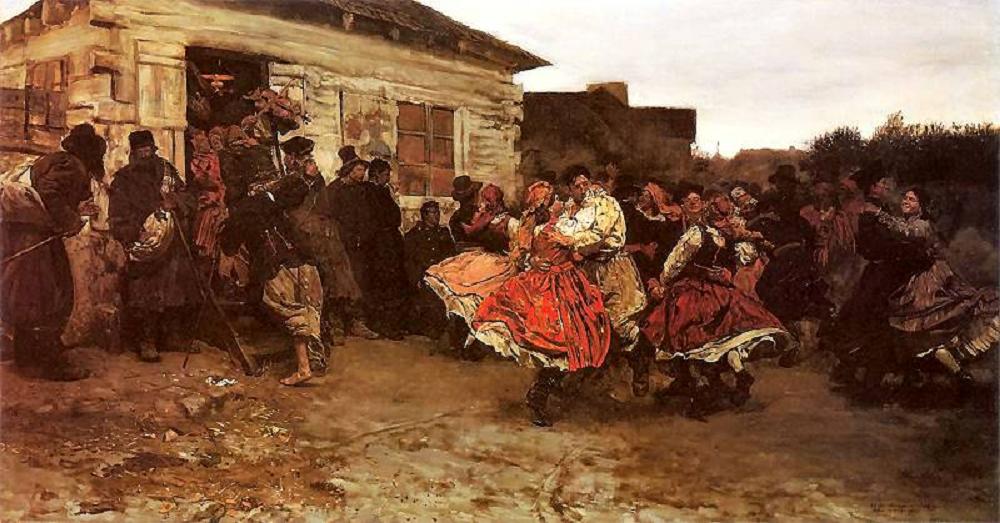
The oberek is a fast-spinning Polish national dance in triple metre, featuring energetic lifts and jumps. Performed by folk dancers and social groups in Poland and the United States, it highlights swift footwork accompanied by lively violin and polka bands.
The oberek is a rapid Polish folk dance defined by swift rotations, energetic leaps and partners lifting each other into the air. Recognized as the fastest among Poland's five official national dances, it moves to lively triple-metre music. It originated in rural Polish communities and later crossed the Atlantic, where it remains a celebrated social dance at Polish-American gatherings.
Movement and technique
The name of the dance comes from the Polish verb for spinning, which reflects its central motion. Dancers execute rapid steps while turning constantly across the floor. Individual ability is tested by how gracefully one can spin at high velocity. The choreography incorporates dramatic jumps and physical lifts, creating a vigorous display that moves far faster than a standard Polish waltz. It also shares certain footwork patterns with the mazur, another prominent traditional Polish dance.
Musical accompaniment
Traditional music for the dance follows a brisk triple metre. In its home region of central Poland, tunes were historically played by a small village ensemble called a kapela. Within these ensembles, the violin served as the lead melodic instrument, driving the speed of the performance. The fast tempo sets the rhythm for the dancers' swift footwork and aerial maneuvers, requiring tight coordination between the musicians and the performers on the floor.
The Polish-American tradition
Polish immigrants introduced the oberek to the United States during the late nineteenth and early twentieth centuries. In this new setting, the tradition evolved into a popular social dance. While closely connected to the original folk style, the American variation features modified dance steps and adapted musical arrangements. Polka bands across the country frequently include it in their repertoires, making it the second-most common dance in the Polish-American musical scene after the polka.
How Oberek is kept
Dancers take to the floor in pairs or groups, moving in quick rotations to triple-time music. Performers execute rapid steps, sweeping turns, and athletic jumps, often lifting their partners off the floor during the fastest passages. In formal performances, dancers showcase traditional folk footwork, while at community social events, participants dance to live polka bands playing adapted arrangements of classic melodies.
When and where
The dance originated in central Poland and is performed nationwide as one of the country's five national dances. It is also widely practiced across the United States within Polish-American communities, where live polka bands play it at social gatherings.

Questions people ask about Oberek
What is the oberek?
The oberek is a rapid Polish national folk dance performed in triple metre, famous for its constant spinning movements, quick steps, and athletic partner lifts.
How did the dance get its name?
Its name comes from the Polish term obracać się, which translates to "to spin", describing the continuous turning motion dancers perform throughout the piece.
Where is the oberek danced today?
It is performed across Poland as one of its five national dances and throughout the United States as a beloved social dance at Polish-American events.
What instruments typically play oberek music?
In rural central Poland, the music was traditionally played by a small village band known as a kapela, led primarily by the violin. In the United States, polka bands perform it.
See also
 PlenaPuerto Rican folk songs and dance sharing community news with rhythmic frame drums
 Christmas carolFestive songs and hymns sung during the Christmas season and door to door
 Morris danceA rhythmic English folk dance performed in costume with bells, sticks and handkerchiefs
 Irish traditional musicA living folk practice of dance tunes, airs, songs and communal pub sessions
Good reading and sources
- Oberek on WikipediaEncyclopedia
- More photos on Wikimedia CommonsPhotos and video
- Wikidata recordOpen data
The facts on this page come from the Wikipedia article "Oberek", written by its contributors and used under the CC BY-SA 4.0 licence, and from its Wikidata record (CC0). EveryParampara rewrote the text in its own words, with AI assistance, and compares every page with the article to make sure no passage is copied. It may be reused under the same CC BY-SA 4.0 licence with a link back.
It may contain mistakes. Traditions differ from one family, village and community to the next, and the people who keep them know them best. If something is wrong, tell us. Last refreshed 2026-10-04.
More from Poland
All the traditions of Poland 🇵🇱 Kraków, PolandKrakowiak
A lively Polish folk dance from Kraków that became a popular ballroom style across Europe.Performance
🇬🇧 United Kingdom and 5 moreChristmas carol
Festive songs and hymns sung during the Christmas season and door to doorPerformance
🇵🇱 Kraków, PolandKrakowiak
A lively Polish folk dance from Kraków that became a popular ballroom style across Europe.Performance
🇬🇧 United Kingdom and 5 moreChristmas carol
Festive songs and hymns sung during the Christmas season and door to doorPerformance
 🇵🇱 Poland and 2 morePolonaisePolonez
A traditional Polish partner dance in triple metre, kept as a national custom and UNESCO heritage.Performance
🇵🇱 Poland and 2 morePolonaisePolonez
A traditional Polish partner dance in triple metre, kept as a national custom and UNESCO heritage.Performance
 🇭🇺 Hungary and 5 moreCsárdás
A Hungarian folk dance that moves from a slow start to a fast finish, kept in Hungary and neighboring regions.Performance
🇭🇺 Hungary and 5 moreCsárdás
A Hungarian folk dance that moves from a slow start to a fast finish, kept in Hungary and neighboring regions.Performance
The same idea elsewhere
All of this kind 🇹🇷 Kayseri, Turkey and 4 moreHalay
A traditional line and circle folk dance kept across Turkey, Azerbaijan, Armenia, Iran, and Syria.Performance
🇹🇷 Kayseri, Turkey and 4 moreHalay
A traditional line and circle folk dance kept across Turkey, Azerbaijan, Armenia, Iran, and Syria.Performance
 🇳🇿 Auckland, New ZealandPoi
A Māori performing art of swinging tethered weights in rhythmical patterns.Performance
🇳🇿 Auckland, New ZealandPoi
A Māori performing art of swinging tethered weights in rhythmical patterns.Performance
 🇵🇭 Philippines and 1 morePangalay
A traditional fingernail dance of the Tausūg and Bajau peoples in the Sulu Archipelago and Sabah.Performance
🇵🇭 Philippines and 1 morePangalay
A traditional fingernail dance of the Tausūg and Bajau peoples in the Sulu Archipelago and Sabah.Performance