Folklore and beliefEuropePagan and ancient
Perchta
A midwinter Alpine figure who checks spinning and tests good behaviour

Perchta is a female figure in Alpine folklore, told of in Austria, southern Germany, Slovenia, Czechia and nearby lands. People told of her moving through the countryside in the twelve nights between Christmas and Epiphany, looking at spinning, punishing carelessness and rewarding good work.
When is Perchta marked?
Perchta is kept as part of Epiphany and Three Kings, which is on Wednesday, 6 January 2027.
Perchta belongs to the folklore of the eastern Alps, where she was remembered as a midwinter visitor who came into homes during the twelve nights from Christmas to Epiphany. She watched over spinning, dealt out punishment to the idle and rewards to the diligent, and was said to know whether the fast had been kept. Costumed processions called Perchtenlauf still act out her two faces.
A goddess of the Alps
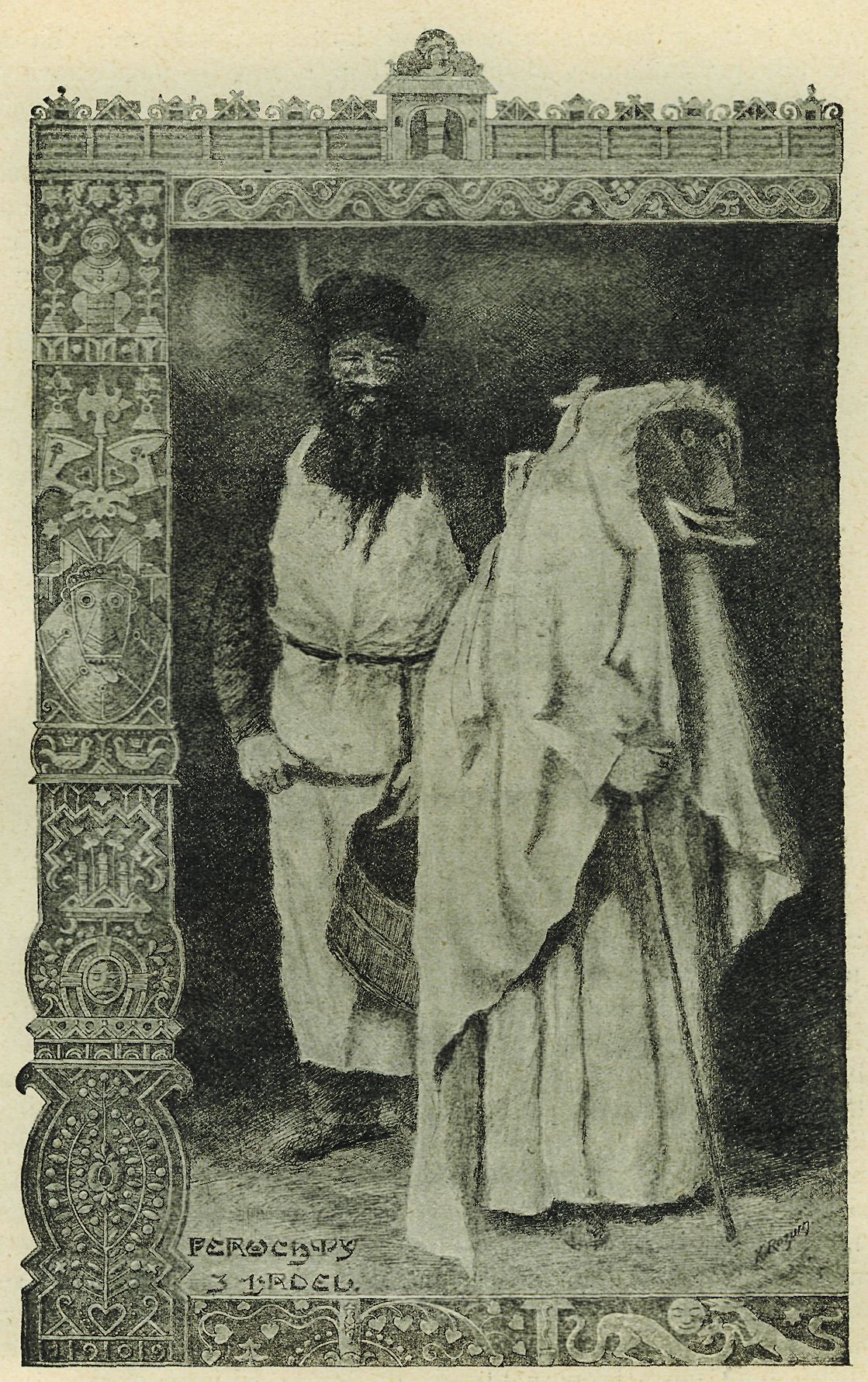
Writers on Alpine belief called Perchta a goddess of Alpine paganism, known in the Upper German lands, in Austria and in the Slovene Alps. She was often linked with Holda: both were said to come from one Germanic goddess and to divide the map between them, Perchta on the southern side. Each watched over spinning and guarded wild animals. In the Tyrol she was pictured as a small old woman with a lined face, bright eyes, a long hooked nose and untidy hair. She had a fair form and a frightful one. Older accounts give her a foot of unusual size, which Grimm read as a sign of a being able to take animal shape; Bertha Broadfoot, Charlemagne's mother, is thought by some to have fed the image.
Names and regions
The name appears as Perchta or Berchta, and shortened to Percht, with spellings such as Perhta and Bercht; people also said Frau Perchta, meaning Mrs Perchta. In Slovene Carinthia she is Pehtra Baba, with forms like Pechtra, and Perhtra Baba in the Möll valley. Around Bovec she is Perta or Pêrte, and in Upper Carniola, Pehta. Czech tellers know her as Perchta, Peruta or Parychta, and as Šperechta in Moravia. In southern Bohemia the word came to mean a mare prop made of linen, so a costumed Perchta there is something different.
The twelve nights
Her season was midwinter. She walked the countryside and stepped into houses during the twelve days from Christmas to Epiphany, most of all on Twelfth Night, and Epiphany eve carried her name as Berchta's Day. The stretch was called the Rauhnächte, the rough nights, counted from St Thomas's Night on 21 December. In those days she looked at the distaff. A woman who had left flax unspun was scratched and slapped on the fingers, and some stories went further: the lazy spinner's belly opened and packed with flax. The same fate was told for anyone who ate more than fish and gruel on a fast day, though a milder telling left the wrongdoer with a nightmare.
The Perchten run
The festival is the Perchtenlauf, a run or race, mentioned by Lorenz Hübner in 1796 and described as widespread across the Pongau and Pinzgau districts, where 100 to 300 masked and armed people danced in daylight. Two kinds took part. Ugly Perchten wore sheepskin, badger-skin caps and belts hung with bells, with carved wooden masks showing long teeth and horns, or beast faces with beaks and moving jaws. Beautiful Perchten at Bad Gastein and St. Johann wore a huge decorated headdress of 40 to 50 pounds, held on metal frames. The courts at Zell am See and Mittersill banned the ugly Perchten as numbers fell.
Offerings and children
People set out food and drink for Fraw Percht and her company, hoping for wealth and plenty. Church writers in Bavaria condemned the custom, among them the Thesaurus pauperum of 1468, and Thomas Ebendorfer von Haselbach in 1439. A story from Kalwang in Styria tells of a farm woman who left milk for the Perchtl; a farmhand hid in the stove to watch and was struck blind, then had his sight returned the following year. Perchta was also thought to guard children's souls. In the Tyrol, Berchta was said to live in a cave near Luserna with unborn children, and women hoping to give birth went there. She was said to walk with children who died unbaptized.
How Perchta is kept
Before the holiday, households finished their spinning and kept the fast. During the twelve nights Perchta was said to look at the distaff; a careful worker might find full spindles, gold thread, or coins in a bucket by the well. For the Perchtenlauf, participants gather at a fixed place and march together in costume. The ugly Perchten carry torches or lamps on poles. With them go the fools called Lapp and Lappin, a jester who swings a wool-filled roll at women he knows, and a quack doctor, the Oeltrager, with oils and ointments in a basket. The beautiful Perchten appear in the tall decorated headdress, with a boy in woman's dress as their associate, the G'sellin.
When and where
Her time is midwinter, within the twelve nights that run from Christmas to Epiphany. Epiphany eve is called Berchta's Day, and Twelfth Night is when she is most looked for. The whole period is known as the Rauhnächte, the rough nights, counted from St Thomas's Night on 21 December through to Epiphany.
The lore belongs to the eastern Alps: Upper Germany, above all Bavaria, Swabia and the Vogtland, Austria and in particular the country around Salzburg, Italian South Tyrol, Slovene Carinthia, Alsace and Switzerland. The Perchtenlauf was strongest in the Pongau and Pinzgau districts of the Salzburg region. In Carinthia, Slovenes in the Möll valley kept a related figure, the Perchtra-baba.
What Perchta means
Perchta stood for the rules a village kept. She was said to check that the year's spinning was finished and that people fasted as they should, and she punished breaches of shared custom rather than petty offences. To careful workers she brought full spindles, gold thread and coins. She guarded the wild animals of the woods, and was thought to watch over the souls of children, dwelling near springs and wells where women came for healing and fertility. Later storytellers made her a bogeyman who frightened children, a change writers place well after her first mentions.


Days Perchta is marked
Questions people ask about Perchta
When is Perchta marked?
Perchta is kept as part of Epiphany and Three Kings, which is on Wednesday, 6 January 2027.
What is Perchta?
She is a female figure of Alpine folklore, called a goddess of Alpine paganism by early writers. People told of her visiting homes in midwinter, checking how much spinning was done, punishing the idle and rewarding careful workers. In Slovene Carinthia she is known as Pehtra Baba.
Where is she known?
In the eastern Alps: Upper Germany, Austria, above all the country around Salzburg, Italian South Tyrol, Slovene Carinthia, Alsace and Switzerland. The Perchtenlauf processions were strongest in the Pongau and Pinzgau districts of the Salzburg region.
What happens at a Perchtenlauf?
Costumed participants meet at a fixed place and march together. The ugly Perchten wear sheepskin, badger-skin caps and belts with bells, in carved masks, and carry torches. The beautiful Perchten appear in a tall decorated headdress. Fools, a jester and a quack doctor with a basket of oils walk among them.
Why was she said to punish people?
Her punishments fell on those who broke shared village rules. She was said to scratch spinners who left their flax unfinished, and to punish people who ate something other than fish and gruel on a fast day. The frightening of children came later, according to writers.
See also
 Friday the 13thA Western folk superstition regarding the unluckiness of a Friday falling on the 13th.
 MolybdomancyPouring molten lead or tin into water, then reading the shape as an omen
 Evil eyeA belief in harm cast by envious glares, met with protective charms and spoken blessings
 ChristmasA festival of Jesus's birth, kept on 25 December with gifts, lights and shared meals
Good reading and sources
- Perchta on WikipediaEncyclopedia
- More photos on Wikimedia CommonsPhotos and video
- Wikidata recordOpen data
The facts on this page come from the Wikipedia article "Perchta", written by its contributors and used under the CC BY-SA 4.0 licence, and from its Wikidata record (CC0). EveryParampara rewrote the text in its own words, with AI assistance, and compares every page with the article to make sure no passage is copied. It may be reused under the same CC BY-SA 4.0 licence with a link back.
It may contain mistakes. Traditions differ from one family, village and community to the next, and the people who keep them know them best. If something is wrong, tell us. Last refreshed 2026-10-05.
More from Austria
All the traditions of Austria
🇫🇮 Finland and 5 moreMolybdomancy
Pouring molten lead or tin into water, then reading the shape as an omenFolklore
 🇦🇹 Austria and 2 morePerchten
Masked midwinter walks in the Alps, with carved wooden masks and sheepskinFolklore
🇦🇹 Austria and 2 morePerchten
Masked midwinter walks in the Alps, with carved wooden masks and sheepskinFolklore
 🇨🇭 Bern, Switzerland and 4 moreTatzelwurm
A cat-faced dragon of Alpine lore, said to hiss, poison the air and guard old tunnelsFolklore
🇨🇭 Bern, Switzerland and 4 moreTatzelwurm
A cat-faced dragon of Alpine lore, said to hiss, poison the air and guard old tunnelsFolklore
 🇦🇹 Austria and 5 moreKrampus
Saint Nicholas's horned companion, who comes for misbehaving children on 5 DecemberFolklore
🇦🇹 Austria and 5 moreKrampus
Saint Nicholas's horned companion, who comes for misbehaving children on 5 DecemberFolklore
The same idea elsewhere
Midwinter and the longest night compared 🇮🇱 Israel and 4 moreTorah readingקריאת התורה
The public reading of the Torah scroll in synagogue, chanted to a special tuneSpiritual
🇮🇱 Israel and 4 moreTorah readingקריאת התורה
The public reading of the Torah scroll in synagogue, chanted to a special tuneSpiritual
 🇨🇳 China and 5 morePostpartum confinement
A period of rest, nourishment, and seclusion for mothers after giving birth.Rite of passage
🇨🇳 China and 5 morePostpartum confinement
A period of rest, nourishment, and seclusion for mothers after giving birth.Rite of passage
 🇺🇸 United States and 1 moreDreamcatcherᐊᓴᐱᑫᔒᓐᐦ (asabikeshiinh)
A hand-woven hoop from Anishinaabe tradition, hung above a cradle to protect a childCraft
🇺🇸 United States and 1 moreDreamcatcherᐊᓴᐱᑫᔒᓐᐦ (asabikeshiinh)
A hand-woven hoop from Anishinaabe tradition, hung above a cradle to protect a childCraft
 🇦🇺 AustraliaSmoking ceremonyNumbuk Yabbun
An Aboriginal Australian ritual of burning native plants to cleanse, heal and welcomeSpiritual
🇦🇺 AustraliaSmoking ceremonyNumbuk Yabbun
An Aboriginal Australian ritual of burning native plants to cleanse, heal and welcomeSpiritual