Life-cycle ritesSoutheast AsiaBuddhist
Shinbyu
In its own language: ရှင်ပြု
A Burmese Buddhist rite in which a boy goes forth as a novice monk, often at New Year

Shinbyu is the Burmese novitiation ceremony in which a boy under twenty is ordained as a novice monk, or sāmaṇera, in Theravada Buddhism. Families in Myanmar hold it so that a son may live in a monastery for a time, and it is counted among the most important duties parents owe a son.
When is Shinbyu marked?
Shinbyu is kept as part of Thingyan, which runs from 13 to 16 April 2027.
Shinbyu is the Burmese name for the ceremony in which a boy under twenty is ordained as a novice monk, or sāmaṇera, in Theravada Buddhism. Families hold it so that a son may go forth and live for a time in a monastery, and many treat it as a coming of age rite. Burmese Buddhists count it among the most important duties parents owe a son.
What it is
Shinbyu, also spelt shinpyu, is the Burmese word for a novitiation ceremony, or pabbajja, in Theravada Buddhism. It marks the admission of a boy younger than twenty as a sāmaṇera, a novice monk. The Burmese count it among the Twelve Auspicious Rites. For the family, letting a son enter the sangha, the monastic community, and live for a while with the Buddha's teaching, the Dhamma, is the greatest religious gift parents can offer. A boy may be ordained as a novice more than once. At twenty he may take full ordination, the upasampada, and become a bhikkhu, called bazin in Burmese.
Origins and history
The tradition looks back to the Buddha's own son. According to Burmese accounts, Rahula came to his father, at his mother Yasodharā's wish, to ask for his inheritance. The Buddha answered that he would give the boy his legacy, and had a disciple shave his head and dress him in an ascetic's robe in place of princely clothes. Rahula then followed his father to the forest monastery. Burmese Buddhists believe this first novitiation happened in the Buddha's lifetime, some two and a half thousand years ago. A couple without a son may invite an orphan or a boy from a poor household to be ordained, so that they too gain merit.
Getting ready
The abbot of the village monastery, called the Sayadaw, picks an auspicious day. Thingyan, the New Year festival, is a favourite season. Boys from one extended family, or from several households in the same village, may be prepared together. They learn to recite the request for robes, the thingan daung, and the Ten Precepts, the seba thila. The Five Precepts, ngaba thila, they already know. Parents scold them for climbing trees or swimming, for fear of accidents or a bad cold before the great day. Sisters and older relatives go from house to house carrying pickled tea, lahpet, in a lacquerware dish, inviting each household to the shinbyu a-hlu. Accepting the invitation means eating some of the tea. In towns, printed invitations are now more common.
Procession and feast
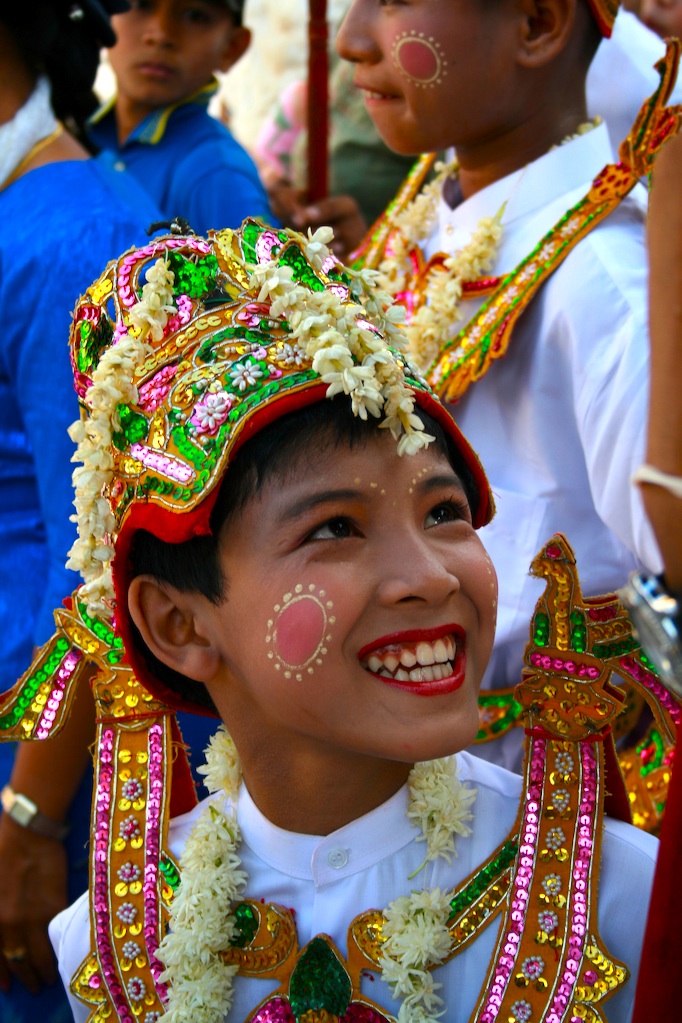
The night before, called a-hlu win, brings a pwè, a performance of music, dance and comedy, with tea for the guests. A bamboo and papier mâché pavilion, the mandat, rises in the street overnight. Sweets, fried peas, peanuts, garlic, sesame, dried shrimp and preserved ginger are served with green tea and with a-hlu lahpet, pickled tea mixed with sesame oil. In cities, cakes, ice cream and coffee have largely replaced the older sweets. On the day itself, the boy rides to the monastery in the shinlaung hlè pwe procession, dressed in gold-embroidered silk as a prince under a gold umbrella, led by an orchestra whose clown, U Shwe Yoe, carries a parasol and dances. The procession recalls Prince Siddhartha leaving his palace. Family and friends follow with the robes.
The ordination
Monks gather to receive the boy, the alms and the offerings. A feast is laid out for everyone on low round tables, or at long bamboo tables under a marquee. The village keeps a smokeless day, with no cooking fires, and all are welcome, dogs included. The meal runs to meat and poultry, soup, curried salted fish, bean sprouts or fermented green mango, then a dessert and lahpet. A brahmin may be hired to lead the rites, but monks perform the ordination. They shave the boy's head in the hsan cha. His parents catch the hair in a white cloth and kneel beside him as he recites in Pali on the impurity of the body. He receives the saffron robe, an alms bowl and a palm-leaf fan.
How Shinbyu is kept
The abbot chooses an auspicious day, often in the New Year season. The boy learns the request for robes and the Ten Precepts, and the household invites neighbours with pickled tea. On the eve, a pwè is staged and a painted pavilion goes up in the street. Next morning the boy, dressed as a prince, rides to the monastery in a procession led by a dancing clown with a parasol; family and friends follow with the robes, paan and lotus blossoms. At the monastery, monks shave his head, he recites the Precepts, receives the saffron robe, alms bowl and fan, and is ordained as a sāmaṇera. The village feasts, and the evening brings another show.
When and where
The day is set by the monastery abbot, who chooses an auspicious date. Thingyan, the Burmese New Year festival, is a favourite season, and several boys from one family or village may be ordained together. A boy may go through shinbyu more than once before he turns twenty, when full ordination may follow.
Shinbyu belongs to Burma, now Myanmar, and is kept wherever Burmese Buddhists live. In Yangon, a procession's first stop is usually the Shwedagon Pagoda. Shan communities in northern Thailand keep a related novitiation.
What Shinbyu means
For the family, the boy goes forth as the Buddha's son once did, leaving comfort behind for a while. Parents gain merit by giving a son to the sangha, and the boy takes on the Buddha's mantle, so they bow to him. He receives a new Dhamma name in Pali. Until he leaves the monastery, no open show of affection is thought fitting. The ceremony is counted the most important duty parents owe a son, and its effect is believed to last through his life.
On the table



Days Shinbyu is marked
Questions people ask about Shinbyu
When is Shinbyu marked?
Shinbyu is kept as part of Thingyan, which runs from 13 to 16 April 2027.
What is shinbyu?
Shinbyu is the Burmese term for a novitiation ceremony in Theravada Buddhism. It is the celebration in which a boy under twenty is ordained as a sāmaṇera, or novice monk, and it counts among the Twelve Auspicious Rites of Burmese culture.
Who takes part?
The boy, his parents, his sisters and the wider family, and often the whole village. Boys from one extended family or neighbourhood may be prepared together. If a couple has no son, they may invite an orphan or a boy from a poor family to be ordained.
Why do parents hold it?
Burmese Buddhists regard letting a son go forth as the most important duty parents owe him and the best religious gift they can give. Parents gain merit, and the time spent in the monastery is believed to leave a lasting mark on the boy's life.
What happens to the boy afterwards?
He wears the saffron robe and lives in the monastery as a novice, addressed as koyin even by his parents. He takes a new Pali Dhamma name. He may stay a short while or longer, and at twenty he may seek full ordination as a bhikkhu.
See also
 Tribal youth dormitoryA communal house where a tribe's unmarried young people sleep, learn and serve
 Tā mokoThe traditional permanent tattooing of the Māori people of New Zealand, marking identity and status.
 PeʻaThe traditional Samoan rite of full-body tattooing for men, tapped by master artists
 Rite of passageA ceremony that marks leaving one group and entering another, with a new status
Good reading and sources
- Shinbyu on WikipediaEncyclopedia
- More photos on Wikimedia CommonsPhotos and video
- Wikidata recordOpen data
The facts on this page come from the Wikipedia article "Shinbyu", written by its contributors and used under the CC BY-SA 4.0 licence, and from its Wikidata record (CC0). EveryParampara rewrote the text in its own words, with AI assistance, and compares every page with the article to make sure no passage is copied. It may be reused under the same CC BY-SA 4.0 licence with a link back.
It may contain mistakes. Traditions differ from one family, village and community to the next, and the people who keep them know them best. If something is wrong, tell us. Last refreshed 2026-10-05.
More from Myanmar
All the traditions of Myanmar 🇲🇲 Yangon, MyanmarThadingyutသီတင်းကျွတ်
A Burmese celebration and calendar month marking the completion of Buddhist Lent.Seasonal
🇨🇳 Hong Kong, China and 5 moreFace
The shared social etiquette of honour, dignity and mutual respect across culturesEtiquette
🇲🇲 Yangon, MyanmarThadingyutသီတင်းကျွတ်
A Burmese celebration and calendar month marking the completion of Buddhist Lent.Seasonal
🇨🇳 Hong Kong, China and 5 moreFace
The shared social etiquette of honour, dignity and mutual respect across culturesEtiquette
 🇲🇲 Bagan, MyanmarNat worshipနတ်
Veneration of guardian spirits and nature deities alongside Buddhism in MyanmarSpiritual
🇲🇲 Bagan, MyanmarNat worshipနတ်
Veneration of guardian spirits and nature deities alongside Buddhism in MyanmarSpiritual
 🇲🇲 MyanmarYoke théရုပ်သေး
A classical Burmese string puppet theatre performed with complex marionettes and music.Performance
🇲🇲 MyanmarYoke théရုပ်သေး
A classical Burmese string puppet theatre performed with complex marionettes and music.Performance
The same idea elsewhere
Coming of age compared 🇪🇬 Egypt and 5 moreTraditional tattooing
The ancient custom of marking the skin for protection, healing, status and sacred ritesDress
🇼🇸 Samoa and 1 morePeʻa
The traditional Samoan rite of full-body tattooing for men, tapped by master artistsRite of passage
🇪🇬 Egypt and 5 moreTraditional tattooing
The ancient custom of marking the skin for protection, healing, status and sacred ritesDress
🇼🇸 Samoa and 1 morePeʻa
The traditional Samoan rite of full-body tattooing for men, tapped by master artistsRite of passage
 🇵🇬 Maprik, Papua New GuineaHaus Tambaran
A sacred house of the Sepik peoples, used for ancestor worship and male initiationSpiritual
🇵🇬 Maprik, Papua New GuineaHaus Tambaran
A sacred house of the Sepik peoples, used for ancestor worship and male initiationSpiritual
 🇮🇱 IsraelTallitטלית
A four-cornered Jewish prayer shawl with ritual fringes worn during worshipSpiritual
🇮🇱 IsraelTallitטלית
A four-cornered Jewish prayer shawl with ritual fringes worn during worshipSpiritual