Music, dance and storytellingEast AsiaShinto, Taoist and folk ChineseBuddhist
Taiko
In its own language: 太鼓 (taiko)
Japanese drums, and the ensemble style of playing them

Taiko are Japanese drums, and in English the word also names the ensemble style of playing them, kumi-daiko. The drums reached the Japanese archipelago by the 6th century CE. Today groups perform on stages and at local festivals in Japan and in the United States, Brazil, Canada, Australia and Taiwan.
When is Taiko kept?
Taiko is kept on through the year, at festivals, shrine and temple rites, theatre and concerts.
Taiko is the Japanese word for a drum, and in English it names a family of Japanese drums as well as the ensemble drumming built around them. Players strike the skins with sticks, alone or in groups, at shrines, local festivals, theatres and concerts. Groups in Japan and overseas have carried the form far from its beginnings, and the drums still mark sacred and communal time.
What it is
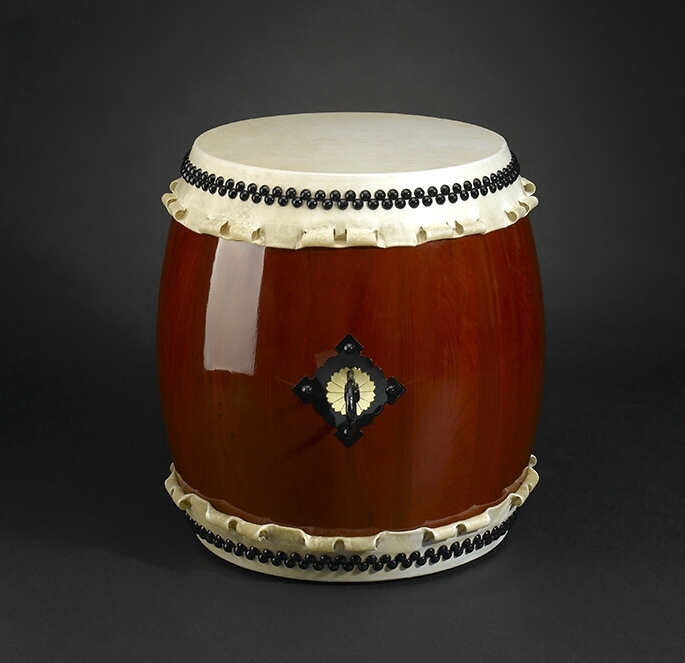
In Japanese the word taiko means any drum at all. Outside Japan it usually points to wadaiko, the Japanese drums, and to kumi-daiko, the ensemble style of playing them. The family is wide. Most are barrel-shaped shells with a skin on each side and a closed space inside, and the skins are held on by rope, nails, bolts or turnbuckles. Some can be tuned and some cannot. Makers sort them three ways: byō-uchi-daiko, with the head nailed down; shime-daiko, tightened with rope or bolts; and tsuzumi, an hourglass drum skinned with deerskin. The nagadō-daiko, shaped like a wine barrel, is the commonest of the large ones.
Origins and history
Where the drums first came from is not settled. Japanese folklore gives them a mythological beginning, and the Nihon Shoki tells of the goddess Ame-no-Uzume, who coaxed Amaterasu out of a cave by dancing on top of an emptied barrel of sake; historians read that dance as the mythic birth of taiko music. Written records suggest something else: that the drums arrived through Chinese and Korean influence, with the earliest accounts from 588 CE describing young Japanese men who travelled to Korea to study the kakko, a drum from South China. Court styles such as gigaku and gagaku came by the same routes. Figures of clay called haniwa, found in Gunma Prefecture, show drums being played in the 6th century.
Drums in war and theatre
Taiko have served many purposes. In feudal Japan they rallied troops, carried orders and set a marching pace of six steps to a beat. Texts from the 16th-century Warring States period record calls for retreat and advance; the chronicle Gunji Yoshū says nine sets of five beats summoned an ally, while nine sets of three, quickened three or four times, was the signal to pursue. Folklore about the 6th-century Emperor Keitai tells of a large drum brought from China and named Senjin-daiko, the front drum. In kabuki, taiko build tension in scenes set in the pleasure quarters. Noh uses set rhythmic patterns, and the Konparu school keeps 65 basic ones and 25 special ones.
Ensemble drumming
Kumi-daiko, playing as a group, is a 20th-century form. Daihachi Oguchi, a jazz musician from Nagano, was given an old piece of taiko notation in 1951; he could not read it, had it transcribed, added his own rhythms and spread the parts across drums of different sizes. His group Osuwa Daiko took the style to audiences. Oedo Sukeroku Daiko formed in Tokyo in 1959 and is described as the first taiko group to tour professionally. Den Tagayasu gathered young men on Sado Island from 1968, drawn by ondeko, the island's demon drumming, and his group Ondekoza ran the Boston Marathon before its first American performance in 1975. In 1981 some members left and formed Kodo under Eitetsu Hayashi.
Today and change
Ensembles now play in Japan and well beyond it: in the United States, Brazil, Canada, Australia, Taiwan and Europe. Estimates of how many groups exist in Japan range from about 800, counted through the Nippon Taiko Foundation, to as many as 5,000. Early pieces still in the repertoire include Yatai-bayashi from Ondekoza, Isami-goma, 'galloping horse', from Osuwa Daiko, and Zoku, 'tribe', from Kodo. Alongside the stage, the drums remain part of local festivals, Shinto kagura and Buddhist Bon rites, where they are set on towers draped in red-and-white cloth and give the rhythm to dancers circling below.
How Taiko is kept
An ensemble usually gathers around several barrel-shaped nagadō-daiko and smaller shime-daiko. Players take a stance, grip the sticks and lean toward or away from the drum by bending a knee, so the body adds to the stroke. In festival and ritual settings the drums stand on towers hung with red-and-white cloth, and dancers circle around the players. Concert groups may add voices, strings and woodwinds. A performance can pass through many drums, with players moving between them, and the pieces are carried by rhythm, form, stick grip, dress and the choice of instruments.
When and where
There is no single date. Taiko is heard through the year: at local festivals across Japan, in Shinto kagura at shrines, in Buddhist Bon Festival dances, in gagaku and theatre seasons, and at concerts given by ensembles at home and abroad.
The drums belong to Japan, where they are played at shrines, temples, festivals and theatres, and where the largest numbers of groups are found. The ensemble style has travelled: groups are active in the United States, Brazil, Canada, Australia, Taiwan and Europe. Sado Island, where Ondekoza and Kodo trained, and Tokyo, home of an early professional group, are two places closely tied to kumi-daiko.
What Taiko means
For many players and audiences, taiko carries more than sound. Its mythic origin, a goddess dancing a god out of a cave, ties the drum to renewal and to calling something forth. Historically the beat carried orders and encouraged armies, and in shrines, temples and festivals it marks sacred time. In recent decades taiko has also been a meeting place for minorities inside and outside Japan, a way of belonging and of being heard.


Questions people ask about Taiko
When is Taiko kept?
Taiko is kept on through the year, at festivals, shrine and temple rites, theatre and concerts.
What is taiko?
In Japanese, taiko means any drum. In English it usually means wadaiko, the Japanese drums, and kumi-daiko, the ensemble style of playing them. The drums are barrel-shaped, with skins on both sides, and are struck with sticks. They are used at festivals, in rituals, in theatre and at concerts.
Where is taiko kept?
Japan is its home, and groups work across the country. Ensembles are also active in the United States, Brazil, Canada, Australia, Taiwan and Europe. Sado Island is known for the training of Ondekoza and Kodo and for ondeko, the island's own demon drumming.
How old are the drums?
No one knows exactly. Written records mention taiko from 588 CE, and archaeological finds, including haniwa figures from Gunma Prefecture, show drums in use in Japan in the 6th century, during the Kofun period. Japanese folklore gives them an older, mythological beginning.
What is kumi-daiko?
Kumi-daiko means ensemble drumming, rather than festival, ritual or theatrical use of the drums. Daihachi Oguchi shaped it in 1951 by arranging old drum music for several players on drums of different sizes. Groups such as Osuwa Daiko, Oedo Sukeroku Daiko, Ondekoza and Kodo built on that format.
See also
 TiniklingA Philippine folk dance where dancers step between clapping bamboo poles
 Dragon danceA long dragon puppet on poles, danced by a team at Chinese New Year and other festivalsBaiãoA syncopated folk rhythm and partnered dance from northeastern Brazil
 IkebanaThe Japanese art of arranging cut branches and flowers in a vessel
Good reading and sources
- Encyclopaedia BritannicaArticle
- Library of Congress CatalogLibrary of Congress, Article
- Library of Congress CatalogLibrary of Congress, Article
- Taiko on WikipediaEncyclopedia
- More photos on Wikimedia CommonsPhotos and video
- Wikidata recordOpen data
The facts on this page come from the Wikipedia article "Taiko", written by its contributors and used under the CC BY-SA 4.0 licence, and from its Wikidata record (CC0). EveryParampara rewrote the text in its own words, with AI assistance, and compares every page with the article to make sure no passage is copied. It may be reused under the same CC BY-SA 4.0 licence with a link back.
It may contain mistakes. Traditions differ from one family, village and community to the next, and the people who keep them know them best. If something is wrong, tell us. Last refreshed 2026-10-05.
More from Japan
All the traditions of Japan 🇯🇵 Kyoto, JapanKyōgen狂言
A traditional Japanese comic theatre of short farces, spoken dialogue and satirePerformance
🇯🇵 Kyoto, JapanKyōgen狂言
A traditional Japanese comic theatre of short farces, spoken dialogue and satirePerformance
 🇨🇳 China and 5 moreLion dance舞獅
A dynamic ritual dance featuring costumed lions, drums and martial acrobaticsPerformance
🇨🇳 China and 5 moreLion dance舞獅
A dynamic ritual dance featuring costumed lions, drums and martial acrobaticsPerformance
 🇯🇵 Tokyo, JapanRakugo落語
Japanese solo comic storytelling told from a cushion using a fan and a clothPerformance
🇨🇳 China and 3 moreDragon dance舞龍 / 舞龙
A long dragon puppet on poles, danced by a team at Chinese New Year and other festivalsPerformance
🇯🇵 Tokyo, JapanRakugo落語
Japanese solo comic storytelling told from a cushion using a fan and a clothPerformance
🇨🇳 China and 3 moreDragon dance舞龍 / 舞龙
A long dragon puppet on poles, danced by a team at Chinese New Year and other festivalsPerformance
The same idea elsewhere
All of this kind 🇹🇷 Kayseri, Turkey and 4 moreHalay
A traditional line and circle folk dance kept across Turkey, Azerbaijan, Armenia, Iran, and Syria.Performance
🇧🇷 BrazilBaião
A syncopated folk rhythm and partnered dance from northeastern BrazilPerformance
🇹🇷 Kayseri, Turkey and 4 moreHalay
A traditional line and circle folk dance kept across Turkey, Azerbaijan, Armenia, Iran, and Syria.Performance
🇧🇷 BrazilBaião
A syncopated folk rhythm and partnered dance from northeastern BrazilPerformance
 🇺🇦 Kyiv, UkraineBanduraБандура
A Ukrainian plucked string instrument played to accompany epic songs and folk balladsPerformance
🇺🇦 Kyiv, UkraineBanduraБандура
A Ukrainian plucked string instrument played to accompany epic songs and folk balladsPerformance
 🇳🇿 Auckland, New ZealandPoi
A Māori performing art of swinging tethered weights in rhythmical patterns.Performance
🇳🇿 Auckland, New ZealandPoi
A Māori performing art of swinging tethered weights in rhythmical patterns.Performance