Customs of food and drinkEast Asia
Haenyeo
In its own language: 해녀
Female free-divers of Jeju Island who harvest seafood from the ocean.

Haenyeo are women on South Korea's Jeju Island who dive without breathing apparatus to gather abalone, seaweed, and other marine life. This livelihood shaped a semi-matriarchal society where women were primary earners. The practice dates back centuries and is now recognized as intangible cultural heritage despite declining numbers.
When is Haenyeo kept?
Haenyeo is kept on year-round, depending on season and tides.
The haenyeo are female divers from Jeju Island in South Korea. They harvest seafood by holding their breath and diving into the ocean. Their work defined the island's economy and family structures for generations. Today, they are celebrated guardians of a unique living tradition.
What they do
Haenyeo dive to collect abalone, sea urchins, oysters, and various seaweeds. They use simple tools like masks, fins, gloves, and nets attached to flotation devices. A whistling breathing technique called sumbisori helps them manage air underwater. Dives can reach depths of twenty meters. Before wetsuits, winter dives lasted only an hour due to cold water. Modern gear allows five or six hours of diving even in colder months. The oldest active divers are over eighty years old.
History and change
Diving began around four hundred thirty-four AD. Men originally held this role until women took over by the eighteenth century. Wars and accidents reduced male populations, while women proved better suited for cold water. During Japanese colonization, taxes changed, allowing divers to sell catch directly. This made them primary breadwinners. Later industrialization and tourism drew younger women away from the sea. Numbers dropped sharply in the nineteen sixties and seventies.
Family structure
Because women earned the main income, Jeju developed a semi-matriarchal system. Haenyeo often supported their families financially while men handled childcare and shopping. This reversed typical gender roles found elsewhere in Korea. Families sometimes preferred girls because of their earning potential. Men still held political power and performed ancestor worship. However, domestic life centered heavily on the women's contributions to the household economy.
Modern status
The Korean government recognizes haenyeo as vital cultural treasures. Subsidies provide equipment, and exclusive rights allow them to sell fresh seafood. UNESCO added them to its Intangible Cultural Heritage list in two thousand sixteen. Environmental changes threaten marine resources, affecting their livelihood. Younger generations rarely enter the profession due to easier alternatives. The community remains small but respected as a symbol of resilience and independence.
How Haenyeo is kept
Young girls begin training at age eleven in shallow waters. After seven years, they become full-fledged divers. They wear wetsuits and use nets to store catches. The practice continues today with older women maintaining the skills. Government support helps preserve the tradition through subsidies and heritage status.
When and where
The tradition started in the fourth century. It continues year-round. Seasonal changes affect dive duration. Winter requires shorter sessions without modern gear.
Jeju Island in South Korea is the home of haenyeo. The practice is specific to this province. Some worked on nearby islands like Yeonpyeong-ri historically.
What Haenyeo means
Haenyeo represent independence and strength. They embody the semi-matriarchal spirit of Jeju. Their work ensured family survival and economic stability. They are seen as protectors of marine resources and cultural identity.
On the table
- Abalone
- Sea urchins
- Oysters
- Conch
- Octopus
- Sea squirt
- Brown alga
- Top shell


Questions people ask about Haenyeo
When is Haenyeo kept?
Haenyeo is kept on year-round, depending on season and tides.
What are haenyeo?
Haenyeo are female free-divers from Jeju Island, South Korea. They harvest seafood like abalone and seaweed by holding their breath underwater. This livelihood has shaped the island's culture for centuries.
How long does it take to train?
Training begins at age eleven in shallow water. It takes about seven years to become a full-fledged diver. Trainees gradually move to deeper waters as they gain skill and endurance.
Why are there so few young haenyeo?
Industrialization and tourism created easier jobs for women. Education opportunities also attracted younger generations away from diving. Most current divers are over fifty years old.
Is this tradition protected?
Yes. UNESCO listed haenyeo as Intangible Cultural Heritage in 2016. The Korean government provides subsidies for gear and grants exclusive selling rights to support them.
See also
 Buddha's BirthdayA festival marking the birth of Siddhartha Gautama, observed across Asia with temple rituals and community gatherings.
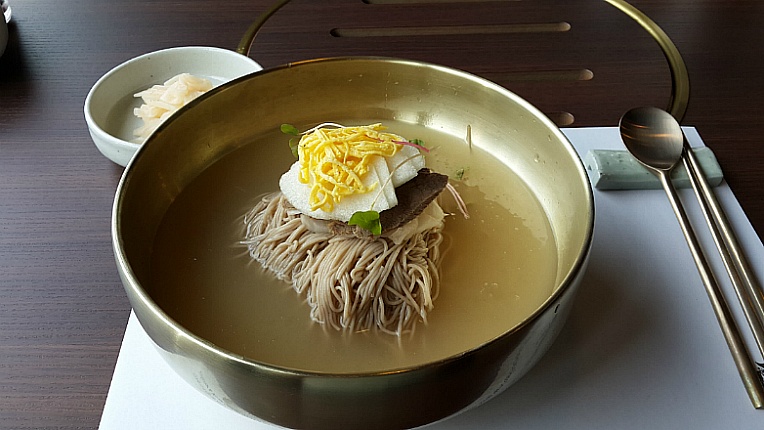 NaengmyeonLong buckwheat noodles in icy broth, born in North Korea and eaten most in summer
 ChristmasA festival of Jesus's birth, kept on 25 December with gifts, lights and shared meals
 HalloweenAn annual observance on 31 October marking the eve of All Saints' Day, rooted in Christian tradition and Celtic heritage
Good reading and sources
- 'When Life Gives You Tangerines' is story of life, love, melted into 4 seasons of Jeju IslandThe Korea Times, Article
- White Chrysanthemum by Mary Lynn Bracht reviewThe Guardian, Article
- 'When Life Gives You Tangerines' is story of life, love, melted into 4 seasons of Jeju IslandThe Korea Times, Article
- White Chrysanthemum by Mary Lynn Bracht reviewThe Guardian, Article
- Haenyeo on WikipediaEncyclopedia
- More photos on Wikimedia CommonsPhotos and video
- Wikidata recordOpen data
The facts on this page come from the Wikipedia article "Haenyeo", written by its contributors and used under the CC BY-SA 4.0 licence, and from its Wikidata record (CC0). EveryParampara rewrote the text in its own words, with AI assistance, and compares every page with the article to make sure no passage is copied. It may be reused under the same CC BY-SA 4.0 licence with a link back.
It may contain mistakes. Traditions differ from one family, village and community to the next, and the people who keep them know them best. If something is wrong, tell us. Last refreshed 2026-10-04.
More from South Korea
All the traditions of South Korea 🇰🇷 South KoreaKorean tea ceremony다례 (茶禮)
Tea served in Korea as a rite of courtesy, now mostly grain and herbal brewsTable custom · Tea, coffee and drinking ceremonies
🇰🇵 Pyongyang, North Korea and 3 moreNaengmyeon냉면
Long buckwheat noodles in icy broth, born in North Korea and eaten most in summerTable custom · Dinner
🇰🇷 South KoreaKorean tea ceremony다례 (茶禮)
Tea served in Korea as a rite of courtesy, now mostly grain and herbal brewsTable custom · Tea, coffee and drinking ceremonies
🇰🇵 Pyongyang, North Korea and 3 moreNaengmyeon냉면
Long buckwheat noodles in icy broth, born in North Korea and eaten most in summerTable custom · Dinner
 🇨🇳 China and 5 moreTea culture
How tea is prepared, shared and served, from Chinese tea houses to Tibetan butter teaTable custom · Tea, coffee and drinking ceremonies
🇨🇳 China and 5 moreTea culture
How tea is prepared, shared and served, from Chinese tea houses to Tibetan butter teaTable custom · Tea, coffee and drinking ceremonies
 🇰🇷 South KoreaGimjang김장
Korea's late-autumn work of making enough kimchi to last the winterTable custom
🇰🇷 South KoreaGimjang김장
Korea's late-autumn work of making enough kimchi to last the winterTable custom
The same idea elsewhere
Remembering the ancestors compared
🇮🇪 Ireland and 5 moreHalloween
An annual observance on 31 October marking the eve of All Saints' Day, rooted in Christian tradition and Celtic heritageFestival · Sweets given and shared
 🇮🇳 Ayodhya, India and 7 moreDiwaliदीपावली (Dīpāvalī)
A five-day festival of lights celebrated across India and its diaspora to mark the victory of light over darkness.Festival · Feasts and festival meals
🇮🇳 Ayodhya, India and 7 moreDiwaliदीपावली (Dīpāvalī)
A five-day festival of lights celebrated across India and its diaspora to mark the victory of light over darkness.Festival · Feasts and festival meals
 🇮🇷 Iran and 7 moreNowruzنوروز
The Iranian new year at the March equinox, kept with fire, greenery and picnicsSeasonal
🇮🇷 Iran and 7 moreNowruzنوروز
The Iranian new year at the March equinox, kept with fire, greenery and picnicsSeasonal
 🇮🇱 Jerusalem, Israel and 1 moreHanukkahחֲנֻכָּה
An eight-day Jewish festival marking the rededication of the Second Temple in Jerusalem and the miracle of a single day'Festival
🇮🇱 Jerusalem, Israel and 1 moreHanukkahחֲנֻכָּה
An eight-day Jewish festival marking the rededication of the Second Temple in Jerusalem and the miracle of a single day'Festival