Life-cycle ritesEast AsiaBuddhistShinto, Taoist and folk Chinese
Japanese funeral
In its own language: 葬儀 (sōgi)
A Buddhist farewell in Japan: a wake, cremation, bone-gathering and a family grave

Most funerals in Japan follow a Buddhist shape: a wake, cremation, the gathering of bones into an urn, a family grave, and memorial services in the years that follow. Relatives wash the body, offer incense, close the household shrine and keep mourning until the forty-ninth day.
When is Japanese funeral marked?
Japanese funeral is kept as part of Obon, which runs from 13 to 15 August 2027.
When someone dies in Japan, the household usually turns to a Buddhist priest. The body is washed and laid out, the family shrine is shut away, and guests come in black to offer incense and condolence money. After the funeral the body is cremated, and relatives lift the remaining bones into an urn with long chopsticks before the ashes are placed in a family grave.
After a death
In the past, relatives gave a few drops of water to the lips of someone expected to die. The same act, matsugo-no-mizu, is now done just after death. The body is washed, and cotton or gauze is used to close its openings. A woman is dressed in a white kimono, a man in a suit or a kimono, and makeup may be applied. In a few rural places a professional nōkansha carries out the old encoffining rite, dressing the body and laying it in the coffin. The coffin holds the body on dry ice, with a white headband, sandals, coins and small favourite things for the journey. Beside the bed stands a little table with flowers, incense and a candle.
The wake
A wake, tsuya, is held as soon as it can be arranged, sometimes on the same day. Guests dress in black. Some carry juzu, a string of prayer beads. Each brings condolence money in a black-and-silver envelope, and later receives a gift in return. Close relatives sit nearest the front. A priest chants from a sutra. The family offers incense three times at the urn in front of the body, and the other guests do the same at a second stand. When the chanting ends the wake is over, though the closest relatives may sit up all night with the dead.
The funeral and the name
The funeral itself, kokubetsu-shiki, usually comes the day after the wake, and follows much the same pattern, with a priest chanting and incense offered again. What sets it apart is the kaimyō, a new Buddhist name in kanji given to the dead. People say it stops the dead person from being called back by their old name. A long or fine name may be read as a mark of the person's life, or of how much the family gave the temple, and the charges for these names are argued over in Japan. At the end, flowers are laid around the head and shoulders, and the coffin is closed. In some regions mourners drive the lid shut with a stone.
Cremation and bones
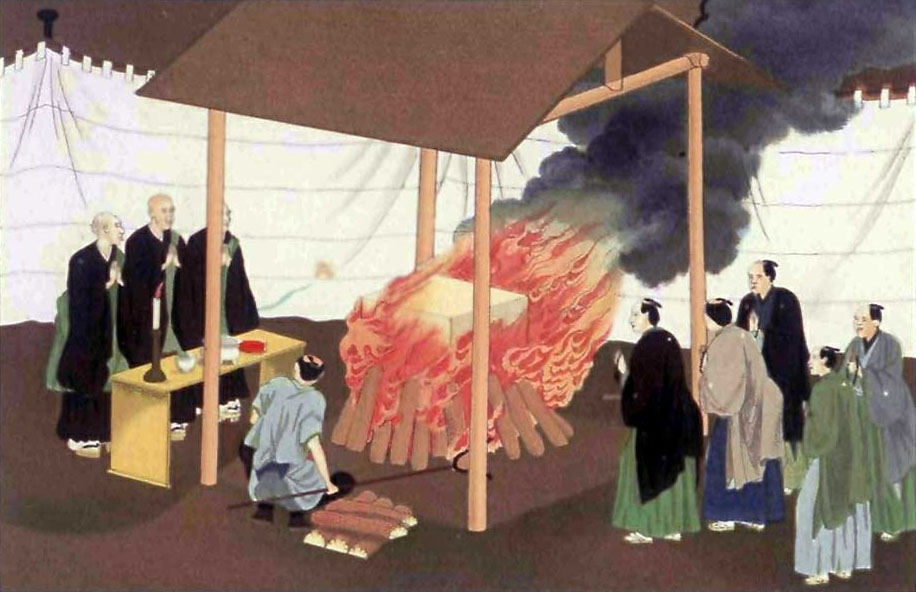
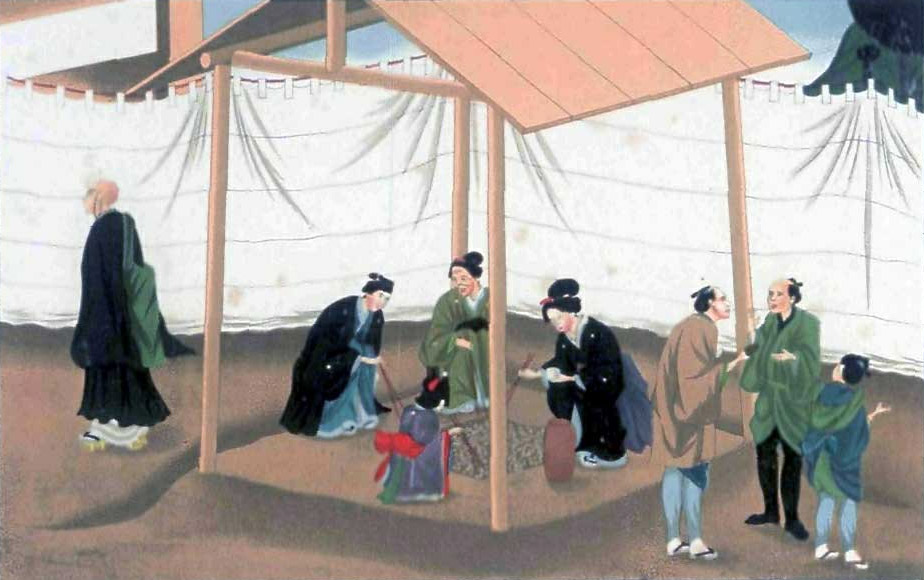
The family goes to the crematorium and watches the coffin pass into the chamber. The burning takes about two hours, and they return at a set time. The bones are then lifted from the ash with long chopsticks and laid in an urn. Two relatives may hold one bone at the same moment, or pass a bone from one pair of chopsticks to another. This is the only occasion in Japan when two people share a single thing with chopsticks, and at any other time it would be a serious social mistake. Foot bones come first and head bones last, so the person rests the right way up in the urn. The nodobotoke, the second bone of the neck, is the most important of all.
Graves and remembrance
A family grave, haka, is a stone monument with a place in front for flowers, incense and water, and a chamber below for the ashes. The names of the dead are often cut into the front, and a husband or wife who dies first may have the spouse's name cut there too, painted red until that spouse is buried and the red is wiped away. Wooden boards called sotōba stand beside the grave. Where land is costly, graves are stacked in buildings or take the form of small lockers. Mourning runs to the forty-ninth day, when the urn is placed in the grave, and services follow on Obon and on later anniversaries.
How Japanese funeral is kept
A death is announced, a certificate is issued, and the eldest son usually makes the arrangements. The body is washed and dressed. Guests gather for the wake in black, bring condolence money and offer incense while a priest chants. The funeral follows, often the next day, when the dead person receives a Buddhist name and flowers are laid in the coffin. The coffin goes to the crematorium. Relatives lift the bones into an urn with chopsticks. The urn stays at home or goes to the family grave, and memorial services are held on set days afterwards.
When and where
There is no set date. The wake is arranged as soon as possible after a death, and the funeral normally follows the next day. Families consult an old six-day cycle to avoid unlucky days, especially tomobiki, the second day, which is thought to pull friends along with the dead. Memorial services fall on the seventh and forty-ninth days, on Obon, and on later anniversaries.
Kept all over Japan, in towns and villages and among Japanese families abroad. It is strongest where a household keeps an altar and a temple, and where there is a family grave to return to. On the Ryukyu Islands an older way survived: the body rested in a family tomb for some years, and after the flesh had gone the washed bones were put in an urn.
What Japanese funeral means
The rites mark a passage and keep the living in order. White paper goes over the kamidana, the small Shinto shelf in the home, and it stays unused while the family mourns, so that death does not reach it. The body is laid facing north, or west towards the Pure Land that Buddhists place in that direction. The new Buddhist name is meant to stop the dead from being called back. Lifting the bones together, two people to a single bone, makes the loss something shared.


Days Japanese funeral is marked
Questions people ask about Japanese funeral
When is Japanese funeral marked?
Japanese funeral is kept as part of Obon, which runs from 13 to 15 August 2027.
What is a Japanese funeral?
Most funerals in Japan follow a Buddhist pattern. There is a wake, then the funeral, then cremation. Relatives lift the bones into an urn, the ashes go to a family grave, and memorial services follow on set days over the years.
Where is it kept?
Throughout Japan, in homes, temples, funeral halls and crematoriums. It is strongest among families with a household altar, a temple connection and a family grave. Some Japanese communities abroad keep a similar form. In the Ryukyu Islands the older burial practice was different.
Why do two people hold one bone with chopsticks?
Because bones are gathered with chopsticks after cremation. Two relatives may lift the same bone together, or pass bones from one pair to another. This is the only time in Japan when that is proper. At a meal it would remind people of a funeral.
Why does the dead person get a new name?
A priest gives a kaimyō, a Buddhist name written in kanji. It is said to stop the dead from returning when the old name is spoken. The name may reflect the person's life, or the size of the family's gift to the temple, which is debated.
See also
 Rite of passageA ceremony that marks leaving one group and entering another, with a new status
 WakeA gathering before a funeral, where family and friends keep watch over the dead
 HalloweenAn annual observance on 31 October marking the eve of All Saints' Day, rooted in Christian tradition and Celtic heritage
 Water lanternSmall lamps floated on water to honour the dead and ask for good fortune
Good reading and sources
- Japanese funeral on WikipediaEncyclopedia
- More photos on Wikimedia CommonsPhotos and video
- Wikidata recordOpen data
The facts on this page come from the Wikipedia article "Japanese funeral", written by its contributors and used under the CC BY-SA 4.0 licence, and from its Wikidata record (CC0). EveryParampara rewrote the text in its own words, with AI assistance, and compares every page with the article to make sure no passage is copied. It may be reused under the same CC BY-SA 4.0 licence with a link back.
It may contain mistakes. Traditions differ from one family, village and community to the next, and the people who keep them know them best. If something is wrong, tell us. Last refreshed 2026-10-05.
More from Japan
All the traditions of Japan
🇺🇸 United States and 5 moreRite of passage
A ceremony that marks leaving one group and entering another, with a new statusRite of passage
🇮🇪 Ireland and 2 moreWake
A gathering before a funeral, where family and friends keep watch over the deadRite of passage
 🇨🇳 China and 5 morePostpartum confinement
A period of rest, nourishment, and seclusion for mothers after giving birth.Rite of passage
🇨🇳 China and 5 morePostpartum confinement
A period of rest, nourishment, and seclusion for mothers after giving birth.Rite of passage
 🇯🇵 Tokyo, JapanShichi-Go-San七五三
A Japanese festival celebrating the growth of three-year-old girls, five-year-old boys, and seven-year-old girls.Rite of passage
🇯🇵 Tokyo, JapanShichi-Go-San七五三
A Japanese festival celebrating the growth of three-year-old girls, five-year-old boys, and seven-year-old girls.Rite of passage
The same idea elsewhere
Death and mourning compared 🇲🇽 Mexico City, Mexico and 1 moreDay of the DeadDía de Muertos
A Mexican remembrance of deceased family and friends with altars, marigolds and feastsFestival · Sweets given and shared
🇲🇽 Mexico City, Mexico and 1 moreDay of the DeadDía de Muertos
A Mexican remembrance of deceased family and friends with altars, marigolds and feastsFestival · Sweets given and shared
 🇳🇿 New Zealand and 2 moreMarae
A cleared, sacred gathering place at the heart of Māori and Polynesian community lifeSpiritual
🇳🇿 New Zealand and 2 moreMarae
A cleared, sacred gathering place at the heart of Māori and Polynesian community lifeSpiritual
 🇼🇸 Samoa and 1 moreʻIe tōga
Precious woven mats exchanged in Samoan ceremonies to honor family ties and chiefly status.Dress
🇼🇸 Samoa and 1 moreʻIe tōga
Precious woven mats exchanged in Samoan ceremonies to honor family ties and chiefly status.Dress
 🇹🇱 Timor-LesteUma Lulik
Sacred ancestral clan houses and ritual shrines in East TimorSpiritual
🇹🇱 Timor-LesteUma Lulik
Sacred ancestral clan houses and ritual shrines in East TimorSpiritual