Customs of food and drinkMiddle EastJewish
Kashrut
In its own language: כַּשְׁרוּת (Hebrew)
The Jewish dietary laws: what may be eaten, and how it is prepared

Kashrut is the body of Jewish dietary law. It sets out which animals, birds and fish may be eaten, how permitted meat must be killed and salted, and how meat and dairy are kept apart. Observant Jews keep it all year round at home and when eating out, and kosher labels are also read by Muslims, vegans and people with dairy allergies.
When is Kashrut kept?
Kashrut is kept every day of the year, at every meal, at home and when eating out.
Kashrut is the set of Jewish dietary laws. It sets out which animals, birds and fish may be eaten, how permitted meat is killed and salted, and why meat and milk are never cooked or served together. Observant Jews keep it every day, at home and when they eat out, and the kosher symbol on packaging is now read by many outside the community too.
What kosher means
Kosher describes food that Jewish law allows. The Hebrew word kashér, pronounced kosher in Ashkenazi speech, means fit, here fit to eat. Food that is not allowed is treif; for objects rather than food, the opposite of kosher is pasúl. Only some animals count as permitted. Mammals must chew the cud and have split hooves, so pork is out. Birds of prey are barred. Fish need fins and scales, which rules out shellfish and catfish. Reptiles, amphibians and rodents are never kosher. Locusts are the single exception among invertebrates, and many communities have no clear tradition about which kinds.
Slaughter and salting
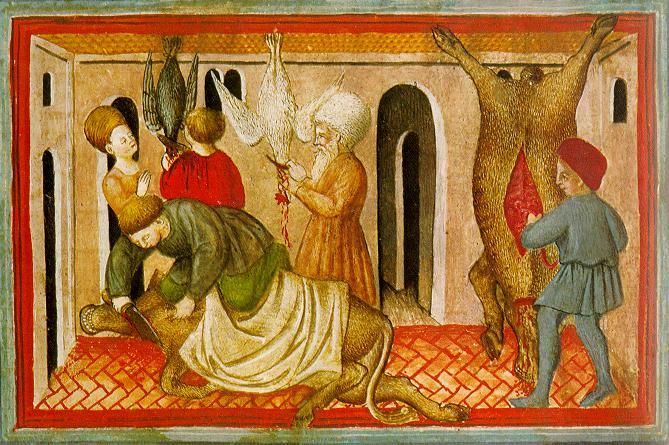
Blood may not be eaten, and that rule shapes how meat is handled. Mammals and birds must be killed by shechita, a single swift cut with a very sharp blade called a chalaf. The person who does it, the shochet, is certified, and cuts the windpipe, food pipe and the main veins of the neck so that blood drains out quickly. An animal that died another way, or that was injured or defective, is not kosher. After slaughter the meat is kashered. Three methods are accepted: broiling, roasting, and soaking followed by salting. The liver, which holds a lot of blood, gets its own procedure. Certain fats and the sciatic nerve are cut away by nikkur.
Meat, milk and pareve
Jewish law keeps three kinds of food apart. Meat, called b'sari or fleishig, includes beef, lamb, venison and permitted poultry such as chicken, goose, duck and turkey. Dairy, called c'halavi or milchig, covers milk and anything made from it, such as butter and cheese. Pareve, meaning neutral, is neither: fish with fins and scales, eggs from permitted birds, grains, produce and mushrooms. Meat and dairy are never mixed, cooked or eaten together, and separate pots, dishes and storage are kept for each. Even a pareve food that was processed on meat equipment counts as meat, and one processed on dairy equipment counts as dairy. Produce is always permitted, though tithes and Sabbatical-year crops from the Land of Israel carry their own rules.
Where the laws come from
The main rules come from the Torah, in the books of Leviticus and Deuteronomy. Their detail and everyday application sit in the Oral Torah, which was eventually written down in the Mishnah and Talmud and then discussed further in later rabbinical writing. The Torah does not explain most of the laws. One view holds that they are simply tests of obedience. Others look for reasons, whether symbolic or practical. Jewish philosophy groups the 613 commandments into three types: mishpatim, which any orderly society would make; eidot, which make sense once explained; and chukim, which have no stated reason. Maimonides agreed that the statutes are decrees, yet thought people should still seek reasons where they can. Kashrut is also a large subject in rabbinic ordination.
Kosher marks today
For about the past hundred years, agencies have certified products, manufacturers and restaurants as kosher. A certified business displays a symbol or certificate called a hechsher, which tells shoppers that the food meets the rules. These labels are read far beyond Jewish kitchens. Muslims, whose own dietary laws are similar, sometimes use them, as do people allergic to dairy and vegans checking whether a product contains meat or milk ingredients. Certification has grown into an industry of its own, and the laws behind it remain a subject of scholarship, taught in yeshivas and written about in both academic and popular books.
How Kashrut is kept
An observant household buys food that carries a hechsher, or checks it against the rules. Meat must come from an animal of a permitted kind, killed by a shochet and then kashered so that the blood is removed, usually by soaking and salting, broiling or roasting. Fats banned by law and the sciatic nerve are trimmed away by nikkur. Meat and dairy are kept in separate pots, plates and cupboards. Pareve foods such as fish, eggs, grains and vegetables may be eaten with either. The same care continues at restaurants and when eating as a guest, and certification agencies check commercial kitchens.
When and where
Kashrut has no season. It applies every day, at every meal, at home and away, and to anything bought or cooked. A few of its rules follow the calendar: new grain may not be eaten until Passover's second day, and produce from the Sabbatical year, along with tithes from the Land of Israel, is treated differently.
Observant Jews keep kashrut wherever they live, in home kitchens, restaurants, shops and institutions, and kosher certification travels with exported food. Several rules concern the Land of Israel in particular: tithes, the Sabbatical year, fruit from young trees and the planting of mixed species. The wider article names Israel, the United States, Suriname and Yemen in connection with the practice.
What Kashrut means
Many who keep kashrut treat the rules as a decree from God, obeyed without a stated reason. Others find meaning in them. Some read the permitted animals as pictures of virtue and the forbidden ones as vices, a reading found in the Letter of Aristeas and later in Rabbi Samson Raphael Hirsch. Hasidic teaching speaks of sparks of holiness released when a person uses something for a holy purpose, including eating. The ban on cooking a young animal in its mother's milk is often read as a rejection of cruelty.



Questions people ask about Kashrut
When is Kashrut kept?
Kashrut is kept every day of the year, at every meal, at home and when eating out.
What is kashrut?
Kashrut is the set of Jewish dietary laws. It covers which foods observant Jews may eat and how those foods are prepared. Food that is allowed is kosher, from a Hebrew word meaning fit. Food that is not allowed is treif, and for objects rather than food, the opposite of kosher is pasúl.
Where is kashrut kept?
Wherever observant Jews live. It shapes home kitchens, shops, restaurants and institutions, and kosher certification is used in many countries, including Israel and the United States. Several of its rules about tithes, the Sabbatical year and young fruit concern produce grown in the Land of Israel.
Why are meat and milk kept apart?
The Torah forbids cooking a young animal in its mother's milk. Jewish law reads that widely. Meat and dairy may not be cooked, eaten or stored together, and separate equipment is kept for each. Jews may not benefit from such mixtures in any way, and even a pareve food processed on meat or dairy equipment takes on that status.
Are the food laws about health?
Some writers have claimed an incidental health benefit. Maimonides raised the idea around 1190, and in 1953 David Macht tested extracts from permitted and forbidden meats on lupin seedlings. Most traditional scholars reject the theory. Lester L. Grabbe writes in the Oxford Bible Commentary that the hygiene explanation is now almost universally rejected.
See also
 Feast of the Seven FishesAn Italian-American Christmas Eve seafood dinner marking abstinence from meat.
 HarissaA spicy chili pepper paste from Tunisia, used as a condiment and ingredient across North Africa.
 Arabic coffeeA bitter, spiced brew served as a gesture of hospitality across the Arab world.RéveillonA luxurious late-night feast that stretches until dawn across the winter holidays
Good reading and sources
- Encyclopaedia BritannicaArticle
- Library of Congress CatalogLibrary of Congress, Article
- Eating locusts: The crunchy, kosher snack taking Israel by swarmBBC, Article
- Library of Congress CatalogLibrary of Congress, Article
- Eating locusts: The crunchy, kosher snack taking Israel by swarmBBC, Article
- Kashrut on WikipediaEncyclopedia
- More photos on Wikimedia CommonsPhotos and video
- Wikidata recordOpen data
The facts on this page come from the Wikipedia article "Kashrut", written by its contributors and used under the CC BY-SA 4.0 licence, and from its Wikidata record (CC0). EveryParampara rewrote the text in its own words, with AI assistance, and compares every page with the article to make sure no passage is copied. It may be reused under the same CC BY-SA 4.0 licence with a link back.
It may contain mistakes. Traditions differ from one family, village and community to the next, and the people who keep them know them best. If something is wrong, tell us. Last refreshed 2026-10-05.
More from Israel
All the traditions of Israel
🇹🇳 Nabeul, Tunisia and 4 moreHarissaهريسة
A spicy chili pepper paste from Tunisia, used as a condiment and ingredient across North Africa.Table custom · Dinner
 🇮🇱 Israel and 5 moreChallahחַלָּה
A braided Jewish bread, blessed and shared at Shabbat and holiday tablesTable custom · Feasts and festival meals
🇮🇱 Israel and 5 moreChallahחַלָּה
A braided Jewish bread, blessed and shared at Shabbat and holiday tablesTable custom · Feasts and festival meals
 🇮🇱 Jerusalem, IsraelPassoverפסח
A Jewish spring festival celebrating freedom from slavery with ritual mealsSpiritual · Dinner
🇮🇱 Jerusalem, IsraelPassoverפסח
A Jewish spring festival celebrating freedom from slavery with ritual mealsSpiritual · Dinner
 🇮🇱 Jerusalem, Israel and 1 moreHanukkahחֲנֻכָּה
An eight-day Jewish festival marking the rededication of the Second Temple in Jerusalem and the miracle of a single day'Festival
🇮🇱 Jerusalem, Israel and 1 moreHanukkahחֲנֻכָּה
An eight-day Jewish festival marking the rededication of the Second Temple in Jerusalem and the miracle of a single day'Festival
The same idea elsewhere
All of this kind 🇮🇹 Naples, ItalyCaffè
Italy's daily coffee habit: espresso taken standing at the bar, and moka coffee at homeTable custom · Tea, coffee and drinking ceremonies
🇮🇹 Naples, ItalyCaffè
Italy's daily coffee habit: espresso taken standing at the bar, and moka coffee at homeTable custom · Tea, coffee and drinking ceremonies
 🇯🇵 JapanToshikoshi soba年越し蕎麦
Buckwheat noodles eaten on New Year's Eve, cut easily to let the year goTable custom · Feasts and festival meals
🇯🇵 JapanToshikoshi soba年越し蕎麦
Buckwheat noodles eaten on New Year's Eve, cut easily to let the year goTable custom · Feasts and festival meals
 🇹🇼 Taipei, TaiwanNight markets in Taiwan夜市
Street markets that open at sunset across Taiwan, selling snacks, drinks and goodsTable custom · Tea-time and snacking customs
🇹🇼 Taipei, TaiwanNight markets in Taiwan夜市
Street markets that open at sunset across Taiwan, selling snacks, drinks and goodsTable custom · Tea-time and snacking customs
 🇺🇦 Ukraine and 1 moreBanushбануш
A Carpathian cornmeal porridge cooked with sour cream and savoury toppingsTable custom
🇺🇦 Ukraine and 1 moreBanushбануш
A Carpathian cornmeal porridge cooked with sour cream and savoury toppingsTable custom