Dress and adornmentSoutheast AsiaBuddhist
Khmer traditional clothing
How Khmer people dress: the wrapped sampot, the embroidered sbai, the checkered krama

Khmer traditional clothing is the dress of the Khmer people of Cambodia, reaching back to the early Common Era, before Indian influence arrived in Southeast Asia. Wrapped skirts called sampot, blouses, the embroidered sbai and the checkered krama are still worn in villages, at weddings and festivals, and by classical dancers.
When is Khmer traditional clothing kept?
Khmer traditional clothing is kept on worn every day in many villages, and for festivals, weddings, court ceremony and dance.
Khmer traditional clothing is the dress of the Khmer people of Cambodia, built around a length of cloth wrapped at the waist. Skirts, blouses, jackets, breast cloths and scarves are worn in villages, at temples, at weddings and on the dance stage. Weavers make the silk, and many patterns are older than the Indian influences that reached Southeast Asia.
The wrapped skirt
The base of most Khmer dress is the sampot, a piece of cloth wrapped and held at the waist. It is tied in more than one way, and each way carries its own name. Some are knotted twice at the front, with one knot longer and the other more decorative. Some hang freely like a tube skirt, and one kind is twisted, drawn up between the legs and fixed with a belt. That last style is unisex. In the countryside, women wear skirt cloth woven in checks or stripes, while dancers and court wear pleated or brocaded silk.
Origins and history
Khmer dress is older than the Indian influences that arrived in Southeast Asia. Its changes can be followed in objects and carvings from the sixth century through to the period after Angkor. A Chinese account from the Funan era says a king ordered his people to cover themselves when envoys came from China. Bas-reliefs at Angkor Wat show dancers in pleated skirts and figures with cloth tucked at the waist. Zhou Daguan, a Chinese envoy who stayed at Angkor in 1296, described looms and wrote that silk production came from Siam, along with the mulberry trees and silkworms.
Blouses and breast cloth
Above the waist there are many forms. One top is tied at the chest and leaves the underarms uncovered; another is thick and fitted close to the body. Some shirts button down the front, some carry lace or embroidery, and some have a row of pleats. Men wear loose jackets, and a groom adds a translucent jacket threaded with gold over his shirt. The sbai is embroidered silk worn as a breast-sash, with one end wrapped around the body, the other falling down the back, and one shoulder left free. It appears in dance, in ceremonies and at weddings.
Cloth and colour
Silk and cotton have been woven in Cambodia for a very long time. Three silk textiles are counted as important, among them the ikat cloth called chong kiet, or hol. For that cloth, weavers tie and dye parts of the weft threads before weaving starts, then repeat the process in other colours until the pattern is set. Lattices, stars and spots are common motifs, and they change from one region to the next. Red, yellow, green, blue and black are the colours used most. In earlier times each day of the week had its own colour, and Monday's was dark yellow.
Today and change
Khmer dress is still worn. Villagers put on wrapped skirts and simple tops, and a checkered krama goes over the shoulder, ready to serve as a towel, a sun cover, a sling for a baby or a cloth a child plays with. Dancers wear costumes of the kind temple carvings show. Some styles vanished and were later brought back. In one village in Kandal province, roughly forty families embroider sbai for weddings, festivals and visitors to Angkor. Skirts bought from Laos in the 1980s were cheap enough that Cambodians began making that style themselves. Under the Khmer Rouge, everyone was made to wear a checkered krama.
How Khmer traditional clothing is kept
Who wears what depends on the day. In the countryside, a wrapped skirt and a simple top are everyday dress, with the krama over the shoulder or around the head. Dancers rehearse in short-sleeved shirts and perform in pleated skirts, brocaded cloth and a sbai across the chest. At a wedding, the couple wear gold-threaded silk, and the groom holds the bride's sbai from behind as they walk together. Guests choose white or pale cloth for a pagoda visit and brighter colours for a festival. Families keep these garments for years, and some are rented for a single occasion.
When and where
There is no single date for Khmer dress. It is worn every day in many villages, and on festival, wedding and ceremonial days through the year, as well as by dancers at rehearsals and performances. The Cham wear one style of shirt at the Royal Plowing Ceremony. In the past, colour was also tied to the days of the week.
Khmer dress belongs to Cambodia, and it is strongest in the countryside, at temples and courts, and in the dance schools. Related wrapped garments are worn in Thailand and Laos, where they are called chong kraben. Silk for the cloth is woven in Cambodian villages, and the village of Sampan Leu in Kandal province is known for its sbai embroidery.
What Khmer traditional clothing means
The sampot has long been regarded as the national dress of Cambodia, and small differences in cloth once showed rank, region and period. Colour carried meaning too, with one given to each day of the week. The krama sets Khmer people apart from their Thai, Vietnamese and Laotian neighbours. At a wedding the sbai holds a story told in Chinese records, in which a cloth is passed over a head; as the groom holds the bride's sbai and they walk, the pair are entering her naga realm.


Questions people ask about Khmer traditional clothing
When is Khmer traditional clothing kept?
Khmer traditional clothing is kept on worn every day in many villages, and for festivals, weddings, court ceremony and dance.
What is Khmer traditional clothing?
It is the dress of the Khmer people of Cambodia: wrapped skirts called sampot, blouses and jackets, the embroidered sbai breast cloth, and the checkered krama scarf. Some pieces are everyday wear in the countryside, while others belong to weddings, festivals, the court and classical dance.
Is it only for special occasions?
No. Simple tops and wrapped skirts are everyday dress in the countryside, and the krama serves as a towel, a sun shade or a sling for a baby. Gold-threaded silk and the sbai belong to weddings, festivals, royalty and dance performances.
What does the sbai mean at a wedding?
A groom holds one end of the bride's sbai from behind while they walk together. Chinese records describe a cloth passed over a head in the account of Neang Neak and Preah Thong, and the rite is understood to remember how the Khmer people began.
Where is the cloth made?
Silk has been woven in Cambodia for centuries. In Kandal province, around forty families in one village embroider sbai, working from patterns their customers choose. Such pieces are also rented for weddings, festivals and visits to Angkor.
See also
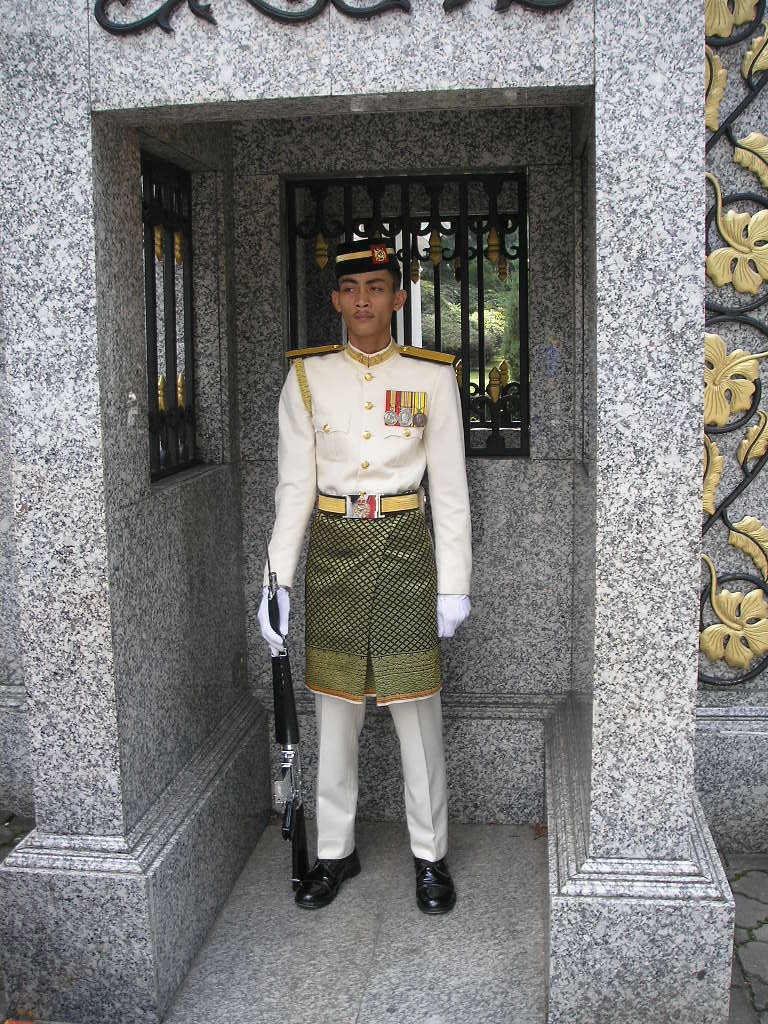 SampingA traditional Malay waist cloth worn over festive attire in Southeast Asia
 KhruiA sheer ceremonial robe worn by Thai royalty and now as academic dress at universities.
 KebayaA front-opening blouse and wrapped cloth, worn by women across Southeast Asia
 LongyiA tube of cloth worn from waist to feet in Myanmar, folded shut with no knot
Good reading and sources
The facts on this page come from the Wikipedia article "Khmer traditional clothing", written by its contributors and used under the CC BY-SA 4.0 licence, and from its Wikidata record (CC0). EveryParampara rewrote the text in its own words, with AI assistance, and compares every page with the article to make sure no passage is copied. It may be reused under the same CC BY-SA 4.0 licence with a link back.
It may contain mistakes. Traditions differ from one family, village and community to the next, and the people who keep them know them best. If something is wrong, tell us. Last refreshed 2026-10-10.
More from Cambodia
All the traditions of Cambodia 🇰🇭 Cambodia and 2 moreSampotសំពត់
A length of cloth wrapped at the waist, the everyday and ceremonial dress of CambodiaDress
🇰🇭 Cambodia and 2 moreSampotសំពត់
A length of cloth wrapped at the waist, the everyday and ceremonial dress of CambodiaDress
 🇰🇭 CambodiaAv pakអាវប៉ាក់
A Cambodian women's shirt in silk or cotton, embroidered or laced, for festivalsDress
🇰🇭 CambodiaAv pakអាវប៉ាក់
A Cambodian women's shirt in silk or cotton, embroidered or laced, for festivalsDress
 🇰🇭 CambodiaApsara Danceរបាំទេពអប្សរា
A classical Cambodian court dance inspired by the stone carvings of AngkorPerformance
🇰🇭 CambodiaApsara Danceរបាំទេពអប្សរា
A classical Cambodian court dance inspired by the stone carvings of AngkorPerformance
 🇹🇭 Thailand and 5 moreKathina
A Buddhist season of offering new robes and gifts to monks after the rains retreatSpiritual
🇹🇭 Thailand and 5 moreKathina
A Buddhist season of offering new robes and gifts to monks after the rains retreatSpiritual
The same idea elsewhere
Weddings compared 🇮🇷 Isfahan, Iran and 3 morePersian gardenباغ ایرانی
An ancient tradition of creating walled, geometric sanctuaries of shade and flowing waterCraft
🇮🇷 Isfahan, Iran and 3 morePersian gardenباغ ایرانی
An ancient tradition of creating walled, geometric sanctuaries of shade and flowing waterCraft
 🇸🇩 SudanJirtigالجَرْتِقْ
A Sudanese wedding ritual of regal adornment, protection, and blessings of fertilityRite of passage
🇸🇩 SudanJirtigالجَرْتِقْ
A Sudanese wedding ritual of regal adornment, protection, and blessings of fertilityRite of passage
 🇮🇳 Lucknow, India and 3 moreSherwani
A long buttoned coat for men, worn at weddings and state occasions in South AsiaDress
🇮🇳 Lucknow, India and 3 moreSherwani
A long buttoned coat for men, worn at weddings and state occasions in South AsiaDress
 🇹🇴 Tonga and 1 moreTaʻovala
A waist mat worn in Tonga for weddings, funerals and formal daysDress
🇹🇴 Tonga and 1 moreTaʻovala
A waist mat worn in Tonga for weddings, funerals and formal daysDress