Spiritual and religiousEast AsiaShinto, Taoist and folk Chinese
Onbashira Festival
In its own language: 式年造営御柱大祭
A rite in Nagano where massive fir logs are dragged down mountains and raised at shrines
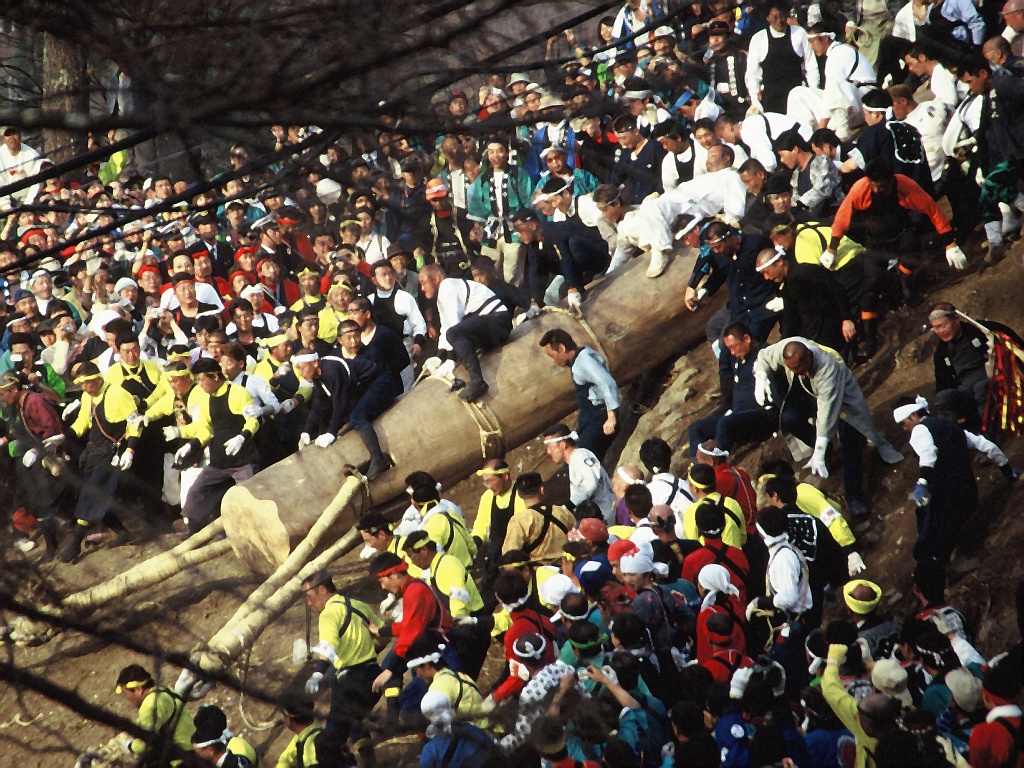
Every six years, communities around Lake Suwa in Nagano Prefecture cut down sixteen enormous fir trees and pull them down steep slopes to local shrines. Participants ride the speeding logs before erecting them upright at the four corners of Suwa Grand Shrine to mark the ritual renewal of the holy grounds.
When is Onbashira Festival kept?
Onbashira Festival is kept every six years in April and May, during the zodiac years of the Tiger and Monkey.
The Onbashira Festival is a Shinto ritual held every six years around Lake Suwa in Nagano Prefecture, Japan. To symbolically renew the sacred grounds of Suwa Grand Shrine, local residents cut down sixteen massive fir trees from the mountains. Teams drag the heavy logs across rugged terrain and down precipitous hillsides before raising one tall timber at each corner of the four shrine precincts.
Origins and history
According to fourteenth-century texts, the custom of rebuilding shrine structures dates back to Emperor Kanmu around the late eighth century. Legend connects its founding to general Sakanoue no Tamuramaro, who received divine aid during his northern campaigns. Medieval rulers established the rebuilding as an enduring obligation for the whole province of Shinano. Beyond practical reconstruction, the rite reflects early nature veneration and Chinese cosmological concepts of the five elements and zodiac cycles. Setting up new timbers every Tiger and Monkey year corresponds to the fire element and revitalises the deity's holy sanctuary.
The two festival phases
The celebration unfolds in two primary stages across spring. The first phase, Yamadashi, occurs in April, when selected fir trunks are felled and pulled down from highland forests. Men ride the sliding logs down perilous inclines, an act that carries notable danger. The second stage, Satobiki, takes place in May. During this phase, participants drag the trimmed trunks through neighborhood streets toward their designated sacred compounds. Finally, crowds hoist the four pillars upright at the corners of each precinct using ropes and manpower, accompanied by festive chants and ceremonial performances.
The sacred pillars
Each pillar, or onbashira, is crafted from a momi fir tree chosen for its height and girth. In total, sixteen logs are required to frame the Upper Shrine compounds of Honmiya and Maemiya, as well as the Lower Shrine sites of Harumiya and Akimiya. The largest post can exceed sixteen meters in height and weighs many tonnes. Before harvesting, ceremonial sickles are driven into selected trees to pacify destructive winds. Once erected, these standing trunks demarcate holy boundaries, standing guard over the precincts until the next cycle begins six years later.
How Onbashira Festival is kept
Preparations begin with choosing and felling sixteen fir trees on the mountainsides. In April, thousands of local participants haul the giant trunks across rivers and down steep hillsides during the Yamadashi stage, with riders balancing atop the moving wood. In May, during the Satobiki stage, the logs are paraded through the towns to the Upper and Lower shrines of Suwa. Teams raise the trunks upright at each corner of the four shrine compounds using ropes, while riders cling to the rising wood until the pillar stands completely vertical.
When and where
The ritual takes place once every six years, falling in the Chinese zodiac years of the Tiger and the Monkey. It spans several spring weeks, with the log-hauling Yamadashi held in April and the shrine-raising Satobiki taking place in May.
The festival takes place across the Lake Suwa basin in Nagano Prefecture, Japan. Activities center on the surrounding mountains, neighborhood roads, and the four sacred compounds of Suwa Grand Shrine across Suwa, Chino, and Shimosuwa.
What Onbashira Festival means
The raising of fresh pillars marks the periodic renewal of the shrine grounds and honors the local deity, a patron of wind and water. Scholars link the pillars to prehistoric tree worship and protective boundary markers. The ritual also aligns with five-element philosophy, where timber from eastern mountains harmonizes with southern fire and northern water to balance cosmic forces.


Questions people ask about Onbashira Festival
When is Onbashira Festival kept?
Onbashira Festival is kept every six years in April and May, during the zodiac years of the Tiger and Monkey.
What is the Onbashira Festival?
The Onbashira Festival is a Japanese Shinto rite held in Nagano Prefecture every six years. Participants harvest sixteen giant fir logs, drag them across rugged mountain slopes, and raise them at the four corners of local shrine compounds to renew the sacred space.
Where and when is it celebrated?
It takes place in the Lake Suwa region of Nagano Prefecture, Japan, including the cities of Suwa and Chino and the town of Shimosuwa. The festivities occur during the zodiac years of the Tiger and Monkey across April and May.
Why do people ride the logs?
Riding the sliding logs down hillsides and clinging to them as they are raised upright is a display of bravery and devotion during the procession. This high-speed descent down mountain slopes makes the festival known as one of the most perilous in Japan.
What happens to the logs once raised?
The sixteen upright logs stand as protective corner markers at the four sacred precincts of Suwa Grand Shrine. They remain in place for six years until the next festival, when newly felled trees arrive to replace them.
See also
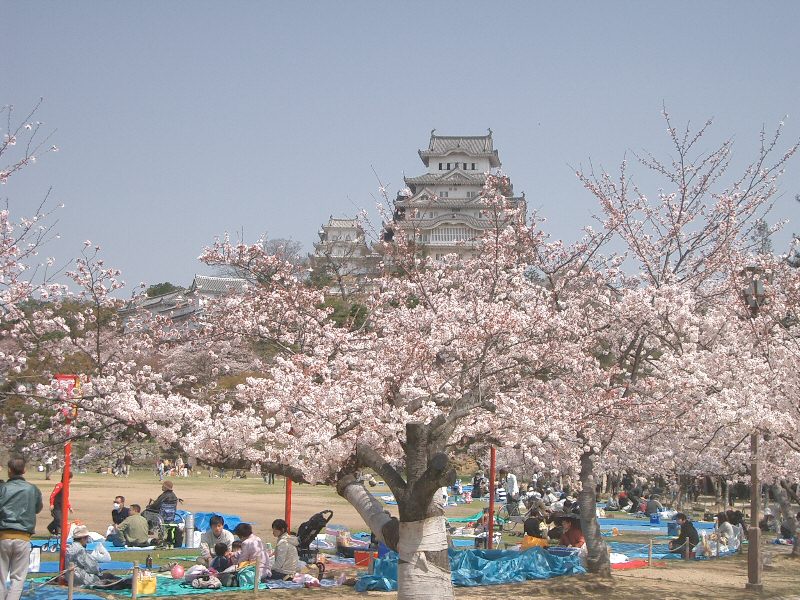 HanamiA Japanese spring custom of gathering under blooming cherry trees to eat, drink, and celebrate the fleeting beauty of th
 SetsubunA Japanese ritual of throwing roasted soybeans to banish evil spirits and welcome spring.
 Children's DayA Japanese holiday on May fifth celebrating the happiness and growth of children
 Aoi MatsuriA classical Kyoto festival with an imperial procession and ancient shrine rituals
Good reading and sources
- Onbashira on WikipediaEncyclopedia
- More photos on Wikimedia CommonsPhotos and video
- Wikidata recordOpen data
The facts on this page come from the Wikipedia article "Onbashira", written by its contributors and used under the CC BY-SA 4.0 licence, and from its Wikidata record (CC0). EveryParampara rewrote the text in its own words, with AI assistance, and compares every page with the article to make sure no passage is copied. It may be reused under the same CC BY-SA 4.0 licence with a link back.
It may contain mistakes. Traditions differ from one family, village and community to the next, and the people who keep them know them best. If something is wrong, tell us. Last refreshed 2026-10-04.
More from Japan
All the traditions of Japan 🇯🇵 JapanHigan彼岸
A Japanese Buddhist week of reflection and ancestor remembrance at the equinoxesSpiritual
🇯🇵 JapanHigan彼岸
A Japanese Buddhist week of reflection and ancestor remembrance at the equinoxesSpiritual
 🇯🇵 Kyoto, JapanTorii鳥居
A traditional Japanese gate marking the entrance to a Shinto shrine and separating the sacred from the mundane.Spiritual
🇯🇵 Kyoto, JapanTorii鳥居
A traditional Japanese gate marking the entrance to a Shinto shrine and separating the sacred from the mundane.Spiritual
 🇮🇳 India and 5 morePretaप्रेत
Offerings and rites for spirits enduring deep hunger across Asian traditions.Spiritual
🇮🇳 India and 5 morePretaप्रेत
Offerings and rites for spirits enduring deep hunger across Asian traditions.Spiritual
 🇯🇵 JapanOmikujiおみくじ
Paper fortunes drawn at Japanese shrines and temples to consult divine guidanceSpiritual
🇯🇵 JapanOmikujiおみくじ
Paper fortunes drawn at Japanese shrines and temples to consult divine guidanceSpiritual
The same idea elsewhere
Spring and renewal compared 🇺🇸 United States and 5 moreMother's Day
A worldwide annual celebration dedicated to mothers, maternal bonds and family careHome
🇺🇸 United States and 5 moreMother's Day
A worldwide annual celebration dedicated to mothers, maternal bonds and family careHome
 🇮🇷 Iran and 7 moreNowruzنوروز
The Iranian new year at the March equinox, kept with fire, greenery and picnicsSeasonal
🇮🇷 Iran and 7 moreNowruzنوروز
The Iranian new year at the March equinox, kept with fire, greenery and picnicsSeasonal
 🇮🇱 Jerusalem, IsraelPassoverפסח
A Jewish spring festival celebrating freedom from slavery with ritual mealsSpiritual · Dinner
🇮🇱 Jerusalem, IsraelPassoverפסח
A Jewish spring festival celebrating freedom from slavery with ritual mealsSpiritual · Dinner
 🇮🇳 Mathura, India and 5 moreHoliहोली (Hindi)
A spring festival of colours and bonfires that marks the end of winter and the triumph of good over evil.Festival
🇮🇳 Mathura, India and 5 moreHoliहोली (Hindi)
A spring festival of colours and bonfires that marks the end of winter and the triumph of good over evil.Festival