Salwar
Loose trousers gathered at the ankle, worn with a kameez across South Asia

Loose trousers covering each leg on its own, reaching from waist to ankle, worn with the long tunic called a kameez. Their earliest form came from Central Asia, and they became part of Punjabi dress in India and Pakistan, where Multani, Patiala and Sindhi cuts are still kept.
When is Salwar kept?
Salwar is kept on worn throughout the year, as everyday dress and as formal wear for special occasions.
A salwar is a pair of loose trousers. Each leg is covered on its own, from waist to ankle, and the trousers are worn with a long tunic called a kameez. That outfit, the shalwar kameez, is common across South Asia and is Pakistan's national dress. People value the salwar for its colours, cloth and embroidery, and for comfort that has carried it from village courtyards into city offices.
Trousers for each leg
A salwar covers the legs one by one, from waist to ankle, and is usually worn with a long tunic called a kameez. Together they make the shalwar kameez. Women in the Punjab add a chunni, a scarf, over the head or shoulders, and a jhagga tunic sewn from two rectangles with slits at the sides. Men may wear a straight-cut kurta with a salwar shaped like a slim pajama. Cloth ranges widely: cotton, silk, wool, velvet and chiffon all appear, and colour and embroidery follow the occasion and the standing of the wearer.
Origins and spread
The oldest ancestor of these trousers came from Central Asia, and their use reached South Asia, the Arab world and Turkey along with the Turkish empires of the 12th century. The Ottomans carried the salwar through their lands. It reached South Asia with the arrival of Muslims in the 13th century and was first worn by Mughal nobles. In Afghanistan the Ghaznavid Turks popularised the salwar with a tunic. The Punjab already had an older, related garment, the suthan, and a suit of head scarf, kurta and suthan came before the salwar suit, though the two are worn together.
Cuts and regional names
Many salwars are named after the place they come from. An Afghani cut hangs loose, the Peshawari falls very loose to the ankle, the Balochi uses a great length of cloth, the Punjabi runs straight, and the Saraiki is wide with many folds. A Patiala salwar is broad at the top, close along the legs and gathered at the ankles. Sindhi wear is less pleated at the waist, while the Sindhi kancha has long cuffs at the ankle. Anarkali is a slim cut. Bahawalpuri salwars are wide and full of folds, and the cloth called Sufi, cotton warp with silk weft and gold thread, is traditionally used for them.
In Multan and Sindh
During the medieval period people in Multan and the Sindh region took up the Iraqi style of salwar, which is very baggy and gathered at the ankle. Alberuni recorded such loose trousers in the 11th century, and the fashion continued in Multan between the 16th and 18th centuries. The Multani salwar looks much like the loose Punjabi suthan; the two are told apart by the suthan's tight ankle band and by the way it begins to fit closer below the knees. In Sindh, men's shalwar kameez, called suthan ain khamis, comes in a wide-ankled southern type and a narrow-ankled northern one, with few pleats in either.
Today and change
Pakistan made the salwar part of its national dress, and from the later 1960s it was worn in government offices there. In the Punjab the very wide salwar gave way to a slimmer modern cut, and men in the cities often wear a straight kurta with a salwar trimmed like a slim pajama. Sindhi men's khamis today reaches at least to the knees and may end in a round or square cut. Embroidery and other embellishment continue in Sindh, where the work is called Sindhi bhart and pieces carry names such as Gaj and Aggoti. The Punjabi suit, called Panjabi, is popular with women in Afghanistan.
How Salwar is kept
A salwar goes on like any other pair of trousers, but how it falls at the ankle and how it is gathered at the waist change from region to region. Punjabi women wear it with a jhagga and a chunni, the scarf draped over the head or shoulders; in Sindh the outfit is finished with an ajrak and a topi or patko turban. Men in Punjabi cities match a straight-cut kurta to a close-fitting salwar. Fabric and embroidery follow the occasion: everyday cloth for work, heavier decorated cloth for formal wear.
When and where
There is no fixed date. A salwar is put on every day and for formal occasions alike, and the type chosen depends on the region, the wearer and the event. Since the later 1960s it has also been worn in government offices in Pakistan. In Sindh it is now everyday clothing for men.
Its strongest home is the Punjab, on both sides of the border between India and Pakistan, and it is the national dress of Pakistan. It is also established in Afghanistan and Bangladesh, and Kurdish communities in Iraq wear a baggy form. Sindh, Balochistan, the Pothohar area and the Saraiki belt each keep their own cut. The salwar travelled with the Turks into Turkey and the Arab world.
What Salwar means
For the people who wear it, the salwar is ordinary and ceremonial at the same time. In Pakistan it stands for the country, as national dress, and its place in government offices since the 1960s made it part of public life. In the Punjab it belongs to family and village dress. In Sindh, Balochistan and the Saraiki belt, the width of the trouser, the fabric and the ankle embroidery tell where someone comes from and which occasion is being marked.


Questions people ask about Salwar
When is Salwar kept?
Salwar is kept on worn throughout the year, as everyday dress and as formal wear for special occasions.
What is a salwar?
A pair of trousers that covers each leg on its own, reaching from the waist to the ankle and ending in a band that may be loose or fitted. It is worn with a kameez, a long tunic, and the two together are the shalwar kameez.
Where is the salwar worn?
In India and Pakistan, above all in the Punjab, and also in Afghanistan and Bangladesh. It is Pakistan's national dress and has been worn in government offices there since the later 1960s. Kurdish communities in Iraq wear a very baggy form of it.
How does a salwar differ from a suthan?
The suthan is the older garment and is cut close, tightening at the knee or the ankle. The salwar is looser and finishes in a relaxed band. Even so, people often use the two words for the same loose trousers, and older sources call pajamas suthan as well.
Is it always wide?
No. Some cuts are baggy, among them the Afghani, Balochi, Saraiki and Multani styles. Others are narrow, such as the Anarkali and the modern Punjabi salwar, which is slim and no longer has the very wide ends of the older form.
See also
 PaithaniA handwoven silk sari from Maharashtra, with a squared border and a peacock pallu
 SherwaniA long buttoned coat for men, worn at weddings and state occasions in South Asia
 JambiyaA short curved dagger worn at the waist by Yemeni men, its handle a sign of statusChuraA set of bridal bangles worn across South Asia at weddings and in early marriage
Good reading and sources
The facts on this page come from the Wikipedia article "Salwar", written by its contributors and used under the CC BY-SA 4.0 licence, and from its Wikidata record (CC0). EveryParampara rewrote the text in its own words, with AI assistance, and compares every page with the article to make sure no passage is copied. It may be reused under the same CC BY-SA 4.0 licence with a link back.
It may contain mistakes. Traditions differ from one family, village and community to the next, and the people who keep them know them best. If something is wrong, tell us. Last refreshed 2026-10-10.
More from India
All the traditions of India
🇮🇳 Paithan, IndiaPaithani
A handwoven silk sari from Maharashtra, with a squared border and a peacock palluDress
🇾🇪 Hadhramaut, Yemen and 1 moreJambiyaجنبية
A short curved dagger worn at the waist by Yemeni men, its handle a sign of statusDress
🇮🇳 Lucknow, India and 3 moreSherwani
A long buttoned coat for men, worn at weddings and state occasions in South AsiaDress
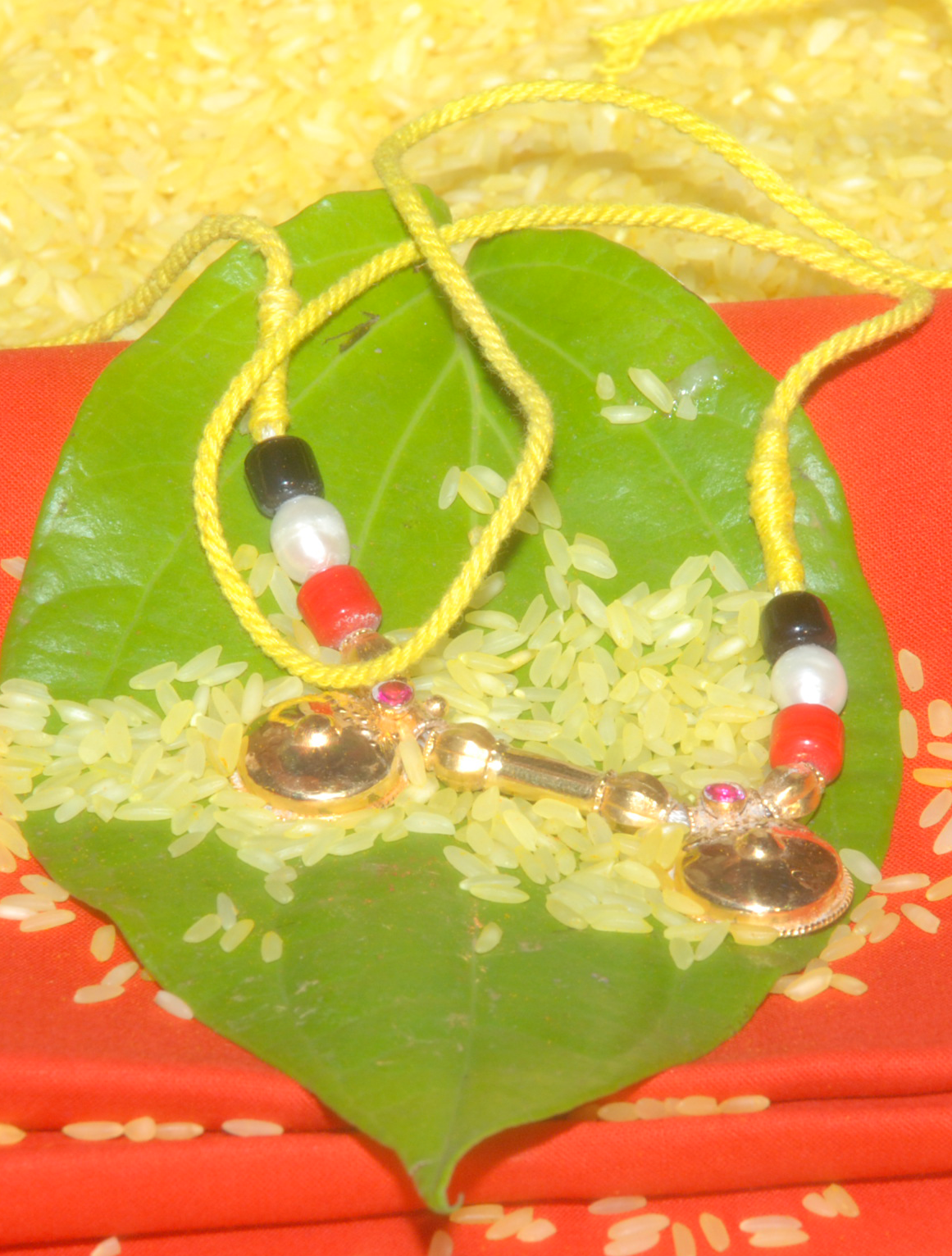 🇮🇳 India and 2 moreMangalasutraमङ्गलसूत्रम् (maṅgalasūtram)
A necklace tied by the groom at a wedding, worn through married lifeDress
🇮🇳 India and 2 moreMangalasutraमङ्गलसूत्रम् (maṅgalasūtram)
A necklace tied by the groom at a wedding, worn through married lifeDress
The same idea elsewhere
All of this kind 🇳🇴 Norway and 3 moreGákti
A traditional coat worn by the Sámi people across northern Scandinavia and Russia, signaling origin and status through cDress
🇳🇴 Norway and 3 moreGákti
A traditional coat worn by the Sámi people across northern Scandinavia and Russia, signaling origin and status through cDress
 🇮🇱 Israel and 1 moreTzitzitצִיצִית
Knotted ritual fringes worn on a four-cornered garment, a reminder of the commandmentsDress
🇮🇱 Israel and 1 moreTzitzitצִיצִית
Knotted ritual fringes worn on a four-cornered garment, a reminder of the commandmentsDress
 🇼🇸 Samoa and 1 moreʻIe tōga
Precious woven mats exchanged in Samoan ceremonies to honor family ties and chiefly status.Dress
🇼🇸 Samoa and 1 moreʻIe tōga
Precious woven mats exchanged in Samoan ceremonies to honor family ties and chiefly status.Dress
 🇪🇬 Egypt and 5 moreTraditional tattooing
The ancient custom of marking the skin for protection, healing, status and sacred ritesDress
🇪🇬 Egypt and 5 moreTraditional tattooing
The ancient custom of marking the skin for protection, healing, status and sacred ritesDress