Life-cycle ritesSoutheast AsiaBuddhist
Traditional Vietnamese wedding
A Vietnamese wedding: two families joined through proposal, engagement and ceremony

Vietnamese weddings begin with a proposal visit between the two families, continue with an engagement months later, and end with ceremonies that bring the bride to the groom's house. Confucian and Buddhist ideas shape the rites, and many couples today hold both the traditional ceremonies and a Western-style one.
When is Traditional Vietnamese wedding kept?
Traditional Vietnamese wedding is kept on a day chosen from the couple's horoscopes, after a proposal visit and an engagement that usually comes about six months earlier.
In Vietnam a wedding is a meeting of two households. The couple's parents and close relatives begin it with a proposal visit, go on to an engagement, and finally hold the ceremonies that take the bride to the groom's house. Confucian and Buddhist thinking shapes the rites, and the ancestors are told what is happening. Many couples now combine these older forms with a Western-style ceremony.
What it is
A Vietnamese wedding joins two households, not just two people. Confucian and Buddhist ideas shape how it is done, and many couples today keep the Vietnamese rites and add a Western ceremony as well. The process moves in stages: a proposal visit, an engagement, then the wedding itself. Each stage has a Vietnamese name and its own small duties for parents, grandparents and guests. The ceremonies end with a reception for both families. Running through all of it is the idea that two families are becoming relatives, and that the bride's ancestors are told what is taking place.
Asking and betrothal
Arranged marriages were once usual, and the first step, lễ dạm ngõ, was a proposal visit. The man's parents and close relatives came to the woman's home; she was usually absent. Wine, sweets, betel and areca nuts came from the man's side as a sign of agreement, and the families settled the dowry and other conditions while they ate and drank. The date, taken from the couple's horoscopes, was fixed then, sometimes after consulting a monk or a fortune teller. About half a year before the wedding came the Đám Hỏi, the engagement. Its gifts, fruit, cakes, tea, wine, tobacco, jewellery and a roasted pig, were carried in red-wrapped lacquer boxes called mâm quả.
The wedding day
Some days before the wedding the groom's side calls at the bride's home with betel nuts to ask, formally, for her. This step, once common, is now rare; where families still keep it, they do it casually over snacks and drinks, and it may stretch over several days. On the night before, the bride's mother combs her daughter's hair, a quiet moment between the two of them, and gives her advice about life in her new household. The bride is then received at her own home and taken to the groom's house, where a reception is held for both families and their guests.
Dress and headpieces
Wedding clothes have changed with place and period. From 1744, in the Nguyễn dynasty, couples began to marry in the áo tấc, a formal long-sleeved áo dài, and today a man wears either a male áo dài or a tuxedo. Bridal gowns follow the áo nhật bình once worn by court women; the outline has stayed much the same, though couples may adjust details. Dragon and phoenix motifs worked in thread or beads decorate the fabric, alongside images from nature. Brides often choose red or pink; grooms lean to blue or black. Both may wear a khăn vấn turban, the man's smaller and plainer. Attendants often wear áo dài too, and guests may change into Western clothes for the reception.
Today and change
Arranged marriage has largely gone, and with it much of the engagement ceremony, which few families now hold. Those who do usually treat it as a party to announce the engagement. Couples often plan a hybrid day, keeping the Vietnamese rites and adding a Western ceremony, and guests may wear one outfit first and change for the reception. Gowns are either made for the couple or hired, as Western wedding dress often is. Vietnamese families living in colder countries sometimes marry in warmer months or have gowns made in heavier cloth, since the traditional fabric is light.
How Traditional Vietnamese wedding is kept
The families begin with a proposal visit, where the date is settled and the dowry discussed. Months later, the engagement is marked by a procession of gifts in red-covered boxes from the groom's side, received by unmarried young women of the bride's family; elders introduce everyone, the bride pours tea, and rings and a gold necklace are put on her. Close to the wedding, the groom's family asks formally for the bride with betel nuts. Her mother combs her hair the night before. The bride is received at her home, taken to the groom's house, and a reception follows.
When and where
There is no fixed date in the calendar. A couple's horoscopes decide the day, and the choice is made during the proposal talks. The engagement is usually held about half a year before the wedding. Ceremonies around the wedding itself can spread over several days, especially the talks with the bride's family.
The tradition belongs to Vietnam, where it is kept across the country, in cities and villages alike. Vietnamese communities abroad also hold these weddings, sometimes adding a Western ceremony, and the Nguyễn-era gown styles are worn by couples both inside and outside the country. Huế is noted for its own bridal colours.
What Traditional Vietnamese wedding means
Red and odd numbers are counted as good luck for a new couple, which is why engagement gifts come in odd numbers of red-covered boxes and even quantities inside them. Betel leaves and areca nuts stand for an agreement between the two families. When the couple burn incense, they are telling the bride's ancestors that a marriage is coming. A pair of lovebirds embroidered by the bride, chim uyên ương, carries the same meaning as a ring does today: faithfulness and love.


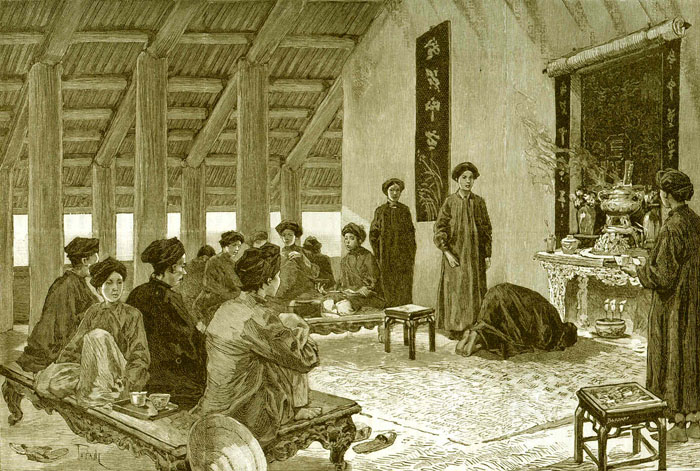
Questions people ask about Traditional Vietnamese wedding
When is Traditional Vietnamese wedding kept?
Traditional Vietnamese wedding is kept on a day chosen from the couple's horoscopes, after a proposal visit and an engagement that usually comes about six months earlier.
What is a traditional Vietnamese wedding?
It is a set of ceremonies that join two families: a proposal visit, an engagement months later, and the wedding itself, when the bride is received at her home and taken to the groom's house. Confucian and Buddhist ideas shape it, and the bride's ancestors are informed with incense.
Where is it kept?
In Vietnam, and among Vietnamese families living abroad. Couples outside the country sometimes marry in warmer months or have gowns made for a colder climate, because the traditional cloth is light.
What do people wear?
Men wear a male áo dài or a tuxedo. Brides wear a gown modelled on the áo nhật bình of the Nguyễn court, often in red or pink, with dragon and phoenix motifs. Both may wear a turban called a khăn vấn.
What happens at the engagement?
The groom's family brings offerings in red-covered lacquer boxes, carried by young unmarried men. Young unmarried women from the bride's side receive them. Elders introduce both families, the bride pours tea, and a ring, earrings and a gold necklace are placed on her.
See also
 Lion danceA dynamic ritual dance featuring costumed lions, drums and martial acrobatics
 Water lanternSmall lamps floated on water to honour the dead and ask for good fortune
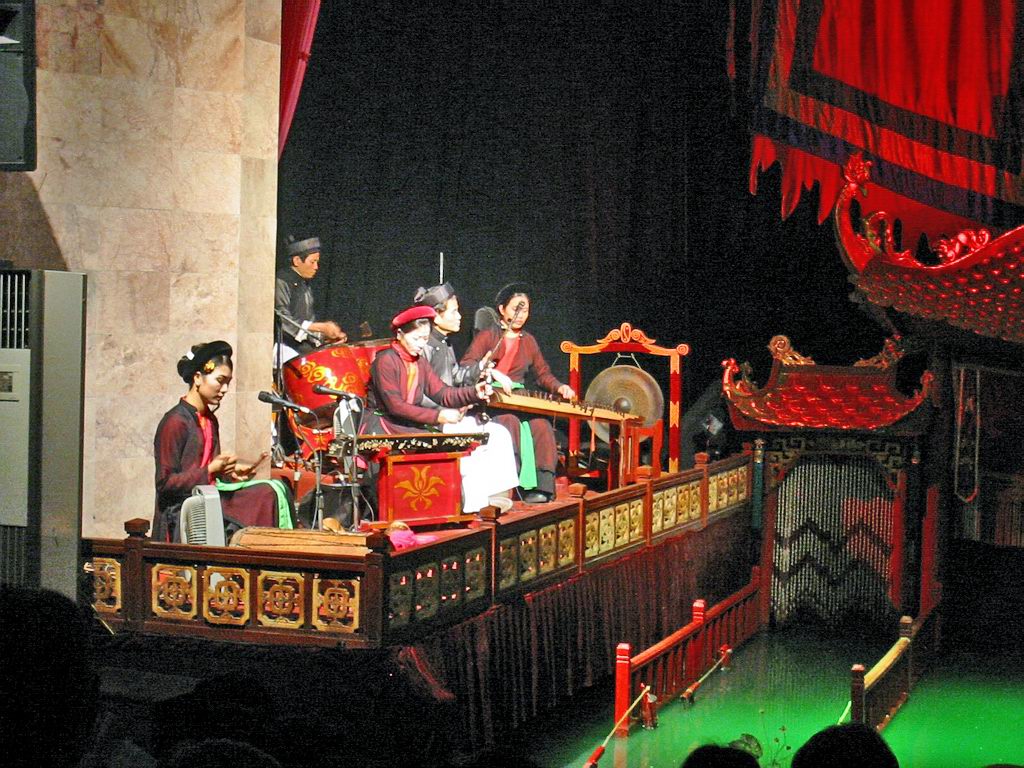 ChèoSatirical folk musical theatre performed by village troupes across northern Vietnam
 BarkclothCloth beaten from tree bark across Africa, Asia and the Pacific
Good reading and sources
- Traditional Vietnamese wedding on WikipediaEncyclopedia
- More photos on Wikimedia CommonsPhotos and video
- Wikidata recordOpen data
The facts on this page come from the Wikipedia article "Traditional Vietnamese wedding", written by its contributors and used under the CC BY-SA 4.0 licence, and from its Wikidata record (CC0). EveryParampara rewrote the text in its own words, with AI assistance, and compares every page with the article to make sure no passage is copied. It may be reused under the same CC BY-SA 4.0 licence with a link back.
It may contain mistakes. Traditions differ from one family, village and community to the next, and the people who keep them know them best. If something is wrong, tell us. Last refreshed 2026-10-05.
More from Vietnam
All the traditions of Vietnam 🇯🇵 Kyoto, Japan and 5 moreTeeth blackening
A custom of dyeing teeth black to mark adulthood and beauty in parts of Asia and Oceania.Rite of passage
🇨🇳 China and 5 moreLion dance舞獅
A dynamic ritual dance featuring costumed lions, drums and martial acrobaticsPerformance
🇻🇳 Hoa Lư, VietnamChèo嘲
Satirical folk musical theatre performed by village troupes across northern VietnamPerformance
🇯🇵 Kyoto, Japan and 5 moreTeeth blackening
A custom of dyeing teeth black to mark adulthood and beauty in parts of Asia and Oceania.Rite of passage
🇨🇳 China and 5 moreLion dance舞獅
A dynamic ritual dance featuring costumed lions, drums and martial acrobaticsPerformance
🇻🇳 Hoa Lư, VietnamChèo嘲
Satirical folk musical theatre performed by village troupes across northern VietnamPerformance
The same idea elsewhere
Weddings compared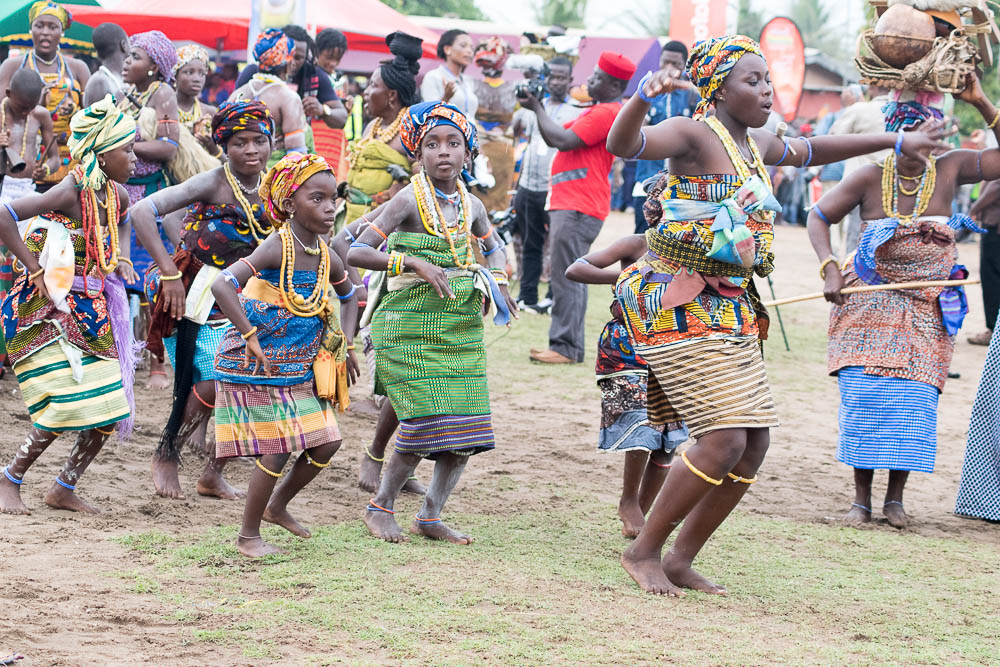 🇬🇭 Ghana and 2 moreAgbadza
An Ewe music and dance, born of war songs and kept for funerals, weddings and festivalsPerformance
🇬🇭 Ghana and 2 moreAgbadza
An Ewe music and dance, born of war songs and kept for funerals, weddings and festivalsPerformance
 🇬🇪 Tbilisi, Georgia and 4 moreGeorgian polyphonic singing
Several voices at once, sung without instruments at Georgian feasts and weddingsPerformance
🇬🇪 Tbilisi, Georgia and 4 moreGeorgian polyphonic singing
Several voices at once, sung without instruments at Georgian feasts and weddingsPerformance
 🇼🇸 Samoa and 1 moreʻIe tōga
Precious woven mats exchanged in Samoan ceremonies to honor family ties and chiefly status.Dress
🇼🇸 Samoa and 1 moreʻIe tōga
Precious woven mats exchanged in Samoan ceremonies to honor family ties and chiefly status.Dress
 🇳🇿 Auckland, New ZealandWharenui
A Māori carved communal meeting house at the centre of tribal life in New ZealandHome
🇳🇿 Auckland, New ZealandWharenui
A Māori carved communal meeting house at the centre of tribal life in New ZealandHome