Music, dance and storytellingSoutheast AsiaHinduIndigenous and traditional
Wayang
In its own language: ꦮꦪꦁ
A night-long puppet theatre from Java, where a dalang tells epics behind a lit screen

A puppet and dance theatre from Java, in Indonesia, kept by Javanese and Sundanese communities. A dalang, at once artist and spiritual leader, performs at night, often from midnight until dawn, with gamelan music, for temple prayer, cleansing rites, weddings and civic occasions.
When is Wayang marked?
Wayang is kept as part of Indonesian Independence Day, which is on Tuesday, 17 August 2027.
Wayang is a dramatic performance from Java, in Indonesia, in which puppets or dancers tell a story. The Javanese and Sundanese peoples created it. A puppeteer called a dalang sits behind a lit screen and voices every part, while a gamelan orchestra plays. Some shows run all night, and many are held for rituals, weddings and temple prayers rather than for entertainment alone.
What wayang is
A wayang is a story told in performance, using puppets, or sometimes dancers, on Java and Bali. The Javanese and Sundanese peoples of Indonesia developed it from older local traditions. The same word covers both the show and the puppet itself. A dalang, the puppeteer, works behind a screen; the audience sits on either side and may watch the figures or their shadows. In Java a gamelan orchestra plays throughout, and in Bali a smaller gender wayang ensemble does. Many plots come from the Mahabharata and the Ramayana, others from local legends such as the Panji tales, and others again from mythologies reworked in Indonesian settings.
Origins and history
Wayang is old. The first clear records are medieval. A charter of 903 CE, issued by King Balitung of the Sanjaya dynasty, tells of a show staged as a service to the gods. A 10th-century Javanese inscription lists performers called aringgit, and a poem written for the court of Airlangga in 1035 CE describes a wayang screen as the thin thing that separates people from the mover of the world. Where the art began is debated. Shadow play may have travelled from Central Asia, China or India, and some point to Indian leather puppetry or to shamanic ritual. The theatre scholar James Brandon argues instead that wayang was created in Java and has no close counterpart elsewhere.
Rites and ceremonies
In Balinese temples a puppet show serves as a form of prayer. Javanese families hold a ruwatan, a cleansing rite for children believed to carry bad luck, and a sedekah bumi, a thanksgiving for a good harvest. Weddings are marked with mantenan shows and circumcision ceremonies with sunatan ones. Wayang is also staged for Independence Day, for town and company anniversaries, and for birthdays or days of remembrance. Since the dalang is regarded as a spiritual leader as well as an artist, a ritual performance is never only entertainment, and the people who commission one treat it as a serious undertaking.
Puppets and making
Figures for wayang kulit are cut from buffalo hide, chiselled with fine tools, smoothed, primed and painted by hand, some in gold. Rods and horn handles let the dalang move them. A single puppet takes weeks of shared work; a crew may finish about ten in a week. Cheaper figures sold to children at performances are sprayed using templates or made of cardboard instead of leather. Wayang golek puppets are carved in three dimensions from wood and worked from below with a rod running through the body to the head. Styles differ from place to place, and modern touches such as bicycles or aeroplanes are added for comic effect.
Today and change
Shows once used an oil lamp that threw shadows onto a cotton sheet. In Java a halogen bulb is usual now, while Bali still uses firelight. New forms keep appearing, among them wayang sandosa, which uses Indonesian instead of Javanese and adds modern lighting and music; it was created at the arts academy in Surakarta. Wayang is also performed for tourists and at civic ceremonies. Demand for the finest carving has fallen, and the few craftspeople who still have the top skills can find it hard to earn a living from them. Most traditional puppet designs have changed little in 300 years.
How Wayang is kept
A dalang, a puppeteer who is treated as an artist and a spiritual leader, sits behind a white screen with a lamp. He moves the figures, supplies all the voices and cues the musicians. A gamelan orchestra accompanies the show in Java, while in Bali the gender wayang ensemble does. Guests may sit on either side of the screen, watching the puppets or their shadows. Shows often begin near midnight and finish at dawn. A performance can be arranged for a family rite, a temple, or a public event.
When and where
There is no single date. A show is staged when a rite, a wedding, a harvest thanksgiving or a public event calls for one. The traditional timing is a night-long performance that starts around midnight and ends at dawn. Tourist shows and civic performances are given at other hours.
It belongs to Indonesia, above all to the islands of Java and Bali. The best known and most widely copied puppet styles come from Surakarta and Yogyakarta in Central Java. Semarang, Cirebon and other towns keep their own versions, and Lombok has figures shaped like real people. Bali keeps smaller, more naturalistic puppets and lights its shows with fire rather than electricity.
What Wayang means
For the people who keep it, a wayang is more than a play. A Javanese poem of the 11th century set human life beside a performance, with the divine mover of the world as the ultimate puppeteer, only a thin screen away from us. A dalang is treated as a spiritual leader, and a show held in a temple is understood as prayer. Ritual performances ask for protection, give thanks for a harvest, free a child from bad luck, or remember the ancestors. The clown-servant Semar, a god of love who chose to live among humans, carries teaching inside the jokes.


Days Wayang is marked
Questions people ask about Wayang
When is Wayang marked?
Wayang is kept as part of Indonesian Independence Day, which is on Tuesday, 17 August 2027.
What is wayang?
It is a dramatic performance from Java and Bali in which puppets, or sometimes dancers, act out a story. One performer, the dalang, speaks every part, moves the figures and directs the musicians. The same word also refers to the puppet itself.
Where is it kept?
In Indonesia, mainly on the islands of Java and Bali. Within Java the traditions of Surakarta and Yogyakarta are the best known, and their puppet style is the most copied. Cirebon, Semarang, Lombok and other places have their own local forms.
Did wayang come from India?
Scholars disagree. Some trace shadow puppetry to India, Central Asia or China, and Indian leather puppet forms share features with wayang, while Hindu and Buddhist stories entered the plays long ago. Others, such as the theatre scholar James Brandon, hold that wayang was created in Java and has no close counterpart elsewhere.
Who can watch a performance?
Anyone who comes to a public show. People sit on both sides of the screen, so some watch the puppets and others watch their shadows. Ritual performances are arranged by the family, temple or village that asks for them and are tied to that occasion.
See also
 NgajatA traditional folk dance of the Iban people in Sarawak and Borneo, mimicking birds and warriors.
 Lion danceA dynamic ritual dance featuring costumed lions, drums and martial acrobatics
 BarongA sacred Balinese masked dance drama depicting the eternal struggle of good and evil
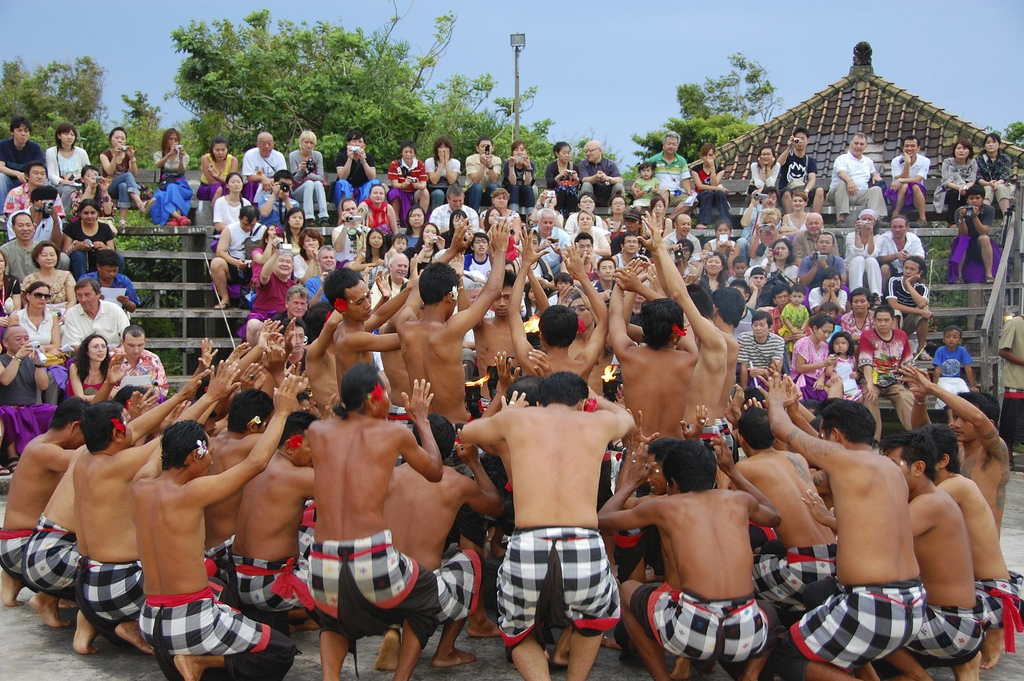 KecakA circle of men chanting chak as they dance the Ramayana epic in Bali
Good reading and sources
- Encyclopaedia BritannicaArticle
- Wayang puppet theatreUNESCO, Heritage listing
- Wayang puppet theatreUNESCO, Article
- Wayang on WikipediaEncyclopedia
- More photos on Wikimedia CommonsPhotos and video
- Wikidata recordOpen data
The facts on this page come from the Wikipedia article "Wayang", written by its contributors and used under the CC BY-SA 4.0 licence, and from its Wikidata record (CC0). EveryParampara rewrote the text in its own words, with AI assistance, and compares every page with the article to make sure no passage is copied. It may be reused under the same CC BY-SA 4.0 licence with a link back.
It may contain mistakes. Traditions differ from one family, village and community to the next, and the people who keep them know them best. If something is wrong, tell us. Last refreshed 2026-10-05.
More from Indonesia
All the traditions of Indonesia
🇲🇾 Malaysia and 2 moreNgajatTanda Ngajat
A traditional folk dance of the Iban people in Sarawak and Borneo, mimicking birds and warriors.Performance
🇮🇩 Ubud, IndonesiaBarongᬩᬭᭀᬂ
A sacred Balinese masked dance drama depicting the eternal struggle of good and evilPerformance
🇨🇳 China and 5 moreLion dance舞獅
A dynamic ritual dance featuring costumed lions, drums and martial acrobaticsPerformance
🇮🇩 Uluwatu, IndonesiaKecakᬓᬾᬘᬓ᭄ (Balinese), Tari Kecak (Indonesian)
A circle of men chanting chak as they dance the Ramayana epic in BaliPerformance
The same idea elsewhere
Remembering the ancestors compared 🇬🇭 Cape Coast, GhanaFetu Afahye
A harvest festival of cleansing, boat races and royal durbars in Cape Coast, GhanaFestival · Feasts and festival meals
🇬🇭 Cape Coast, GhanaFetu Afahye
A harvest festival of cleansing, boat races and royal durbars in Cape Coast, GhanaFestival · Feasts and festival meals
 🇪🇬 Thebes, EgyptAncient Egyptian funerary practices
Rites for the dead in ancient Egypt: preserving the body, spells and grave goodsRite of passage
🇪🇬 Thebes, EgyptAncient Egyptian funerary practices
Rites for the dead in ancient Egypt: preserving the body, spells and grave goodsRite of passage
 🇬🇭 Bonwire, Ghana and 1 moreKente clothNwentoma
Hand-woven Ghanaian cloth of silk and cotton strips, worn for ceremonies and graduationsDress
🇲🇼 Rumphi, Malawi and 2 moreTumbuka dances and festivals
Dances for healing and celebration, and the yearly festivals that keep themPerformance
🇬🇭 Bonwire, Ghana and 1 moreKente clothNwentoma
Hand-woven Ghanaian cloth of silk and cotton strips, worn for ceremonies and graduationsDress
🇲🇼 Rumphi, Malawi and 2 moreTumbuka dances and festivals
Dances for healing and celebration, and the yearly festivals that keep themPerformance