Music, dance and storytellingSoutheast AsiaHindu
Kecak
In its own language: ᬓᬾᬘᬓ᭄ (Balinese), Tari Kecak (Indonesian)
A circle of men chanting chak as they dance the Ramayana epic in Bali
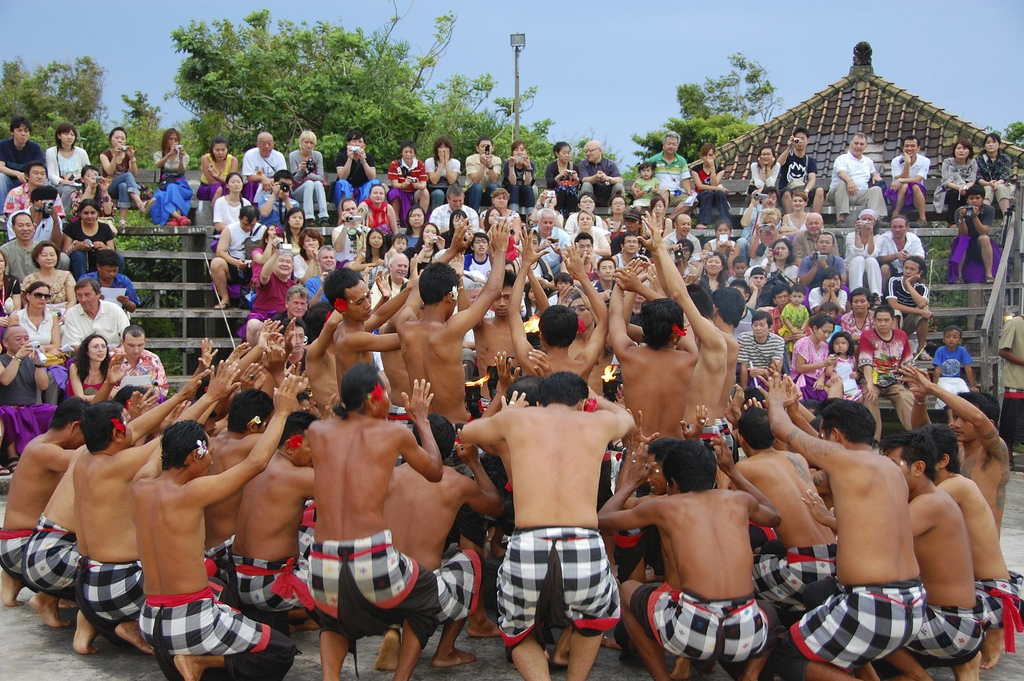
Kecak is a Balinese dance drama in which dozens of men chant 'chak' together and act out the Ramayana. It took its present shape in Bali, Indonesia, during the 1930s and is danced mostly by men, usually in the evening on temple grounds.
When is Kecak kept?
Kecak is kept on most evenings in Bali, usually from about six o'clock.
Kecak is a Balinese dance built on voices. A large ring of men chant 'chak' again and again, their sound standing in for the gamelan orchestra that normally plays, while dancers act out the Ramayana. Visitors know it as the Ramayana monkey chant. Balinese villagers keep it alive, performing it for their own ceremonies and for audiences who come to watch in the evenings.
What it is
Between fifty and a hundred men take part, sometimes as many as a hundred and fifty, chests bare and a checked cloth tied at the waist. They sit or stand in rings, one inside another, with a lamp burning coconut oil at the centre. Bodies sway left and right as the men chant 'chak' together, slowly at first, then faster. On certain beats they raise their arms and let their hands shake in the air. No instrument plays. The voices carry the whole rhythm and melody, and a performance lasts about an hour.
Origins and history
Kecak began as a trance ritual with a male chorus. In the 1930s the German painter and musician Walter Spies, then living in Bali, took an interest in it and shaped it into a drama drawn from the Ramayana, with dancing, meant for visiting audiences. He worked with the dancer Wayan Limbak, who took Balinese groups on tours abroad and made the piece known far beyond the island. The account is not settled. The performer and scholar I Wayan Dibia holds that Balinese artists were already moving in this direction: Limbak had brought baris steps into the cak leader's part in the 1920s, and Spies proposed a Ramayana spectacle with a cak chorus instead of the usual gamelan.
The Ramayana retold
The chanters carry the story as much as the solo dancers do. The bare-chested men divide into Rama's monkey army, the Vanaras, and Ravana's demon force, the Rakshasas. The plot opens with Rama and Sita in exile in the Dandaka forest. A golden deer appears, Sita is seized by Ravana, the bird Jatayu fights Ravana and falls, Hanuman searches for Sita, and the piece closes with Rama facing Ravana in battle. Sita, Rama, Lakshmana and the golden deer move quietly. Ravana, Hanuman and Sugriv are played with force. The chorus follows the mood of each scene, chanting and singing as it changes.
Trance and fire
Some passages keep the old trance element. In the scene where Hanuman is set alight, a priest blesses the man playing him, and that dancer enters a trance before the fire-kicking dance. He kicks at burning material and is said to feel no pain while in that state. The form's deeper roots lie in sanghyang, a trance dance long used in Bali to drive out harm. For the communities who keep it, the blessing and the trance belong to the ritual side of the dance rather than to the drama alone.
Today and change
Performances in Bali generally run every evening, starting near six o'clock. Temple grounds host many of them, and Uluwatu is the best known venue. Stages built for the dance stand in Ubud, Batu Bulan, Pandawa and Garuda Wisnu Kencana, among other spots. Most dancers are villagers from nearby who finish their day jobs before the show, and the takings come from tickets. Groups also perform at cultural and entertainment displays. Women were not part of the form at first; the first women's kecak group was formed in 2006. Recordings of the chant have travelled into films, games and popular music.
How Kecak is kept
Men from the village gather in rings around a coconut-oil lamp. The chorus begins a slow 'chak', swaying as it chants, and the beat tightens as the piece goes on. One man holds the pulse with a repeated 'po', another leads the group and signals stops and starts with shouts, a third sings over the chant, and the dalang narrates in Balinese and Sanskrit. Dancers then enter as Rama, Sita, Lakshmana, Ravana, Hanuman and the rest, playing out the Ramayana while the chorus answers each scene. Near the end, the Hanuman dancer is blessed, goes into trance and kicks at fire.
When and where
No date is fixed for it. In Bali the dance is usually staged on most evenings, commonly starting around six o'clock, and troupes also accept bookings for cultural displays and entertainment. It has no set place in the yearly calendar.
Kecak belongs to Bali, Indonesia, and is kept in villages and on temple grounds across the island. Uluwatu draws the largest audiences. Stages built only for kecak stand in Ubud, Batu Bulan, Pandawa and Garuda Wisnu Kencana. Balinese troupes have also toured abroad, which is how the chant became familiar outside Indonesia.
What Kecak means
The dance carries the Ramayana's contest between Rama's side and Ravana's, with Hanuman's devotion and strength at its heart. For Balinese Hindus it also stands in a longer line of trance dances meant to drive away harm and keep a village safe. The blessing of the Hanuman dancer and his walk into fire join the drama to that protective purpose. A performance gathers neighbours as performers and visitors as witnesses, so the story is both told and kept.


Questions people ask about Kecak
When is Kecak kept?
Kecak is kept on most evenings in Bali, usually from about six o'clock.
What is kecak?
It is a Balinese dance drama. A ring of men chant the syllable 'chak' in place of instruments while dancers act out scenes from the Ramayana. In English it is often called the Ramayana monkey chant.
Who takes part?
Mostly men from nearby villages, who have other work during the day. Senior performers take the solo tasks of keeping the beat, leading the chorus, singing and narrating as the dalang. Women dance too now, and a women's group began in 2006.
Is the trance real?
According to the tradition, the man playing Hanuman is blessed by a priest, enters a trance and feels no pain while kicking at fire. Balinese treat this as ritual, rooted in sanghyang, a trance dance used to drive out harm.
Why is it called the monkey chant?
The bare-chested chanters take the parts of Rama's monkey army, the Vanaras, and of Ravana's demons, the Rakshasas. Their repeated 'chak' carries the battle, which is why English speakers named the dance after the monkeys.
See also
 BarongA sacred Balinese masked dance drama depicting the eternal struggle of good and evil
 Lion danceA dynamic ritual dance featuring costumed lions, drums and martial acrobatics
 Ogoh-ogohGiant handcrafted statues paraded and burned on the eve of the Balinese Saka New Year
 Spirit houseA small roofed shrine on a pillar, kept in homes and villages across Southeast Asia to honour protective spirits.
Good reading and sources
- Kecak on WikipediaEncyclopedia
- More photos on Wikimedia CommonsPhotos and video
- Wikidata recordOpen data
The facts on this page come from the Wikipedia article "Kecak", written by its contributors and used under the CC BY-SA 4.0 licence, and from its Wikidata record (CC0). EveryParampara rewrote the text in its own words, with AI assistance, and compares every page with the article to make sure no passage is copied. It may be reused under the same CC BY-SA 4.0 licence with a link back.
It may contain mistakes. Traditions differ from one family, village and community to the next, and the people who keep them know them best. If something is wrong, tell us. Last refreshed 2026-10-05.
More from Indonesia
All the traditions of Indonesia
🇮🇩 Ubud, IndonesiaBarongᬩᬭᭀᬂ
A sacred Balinese masked dance drama depicting the eternal struggle of good and evilPerformance
🇨🇳 China and 5 moreLion dance舞獅
A dynamic ritual dance featuring costumed lions, drums and martial acrobaticsPerformance
🇲🇾 Kelantan, Malaysia and 2 moreMak yongTarian Mak Yong (Jawi: مق يوڠ)
A dance-drama of Kelantan and Patani, told in song, music and improvised speechPerformance
 🇮🇩 Yogyakarta, IndonesiaWayangꦮꦪꦁ
A night-long puppet theatre from Java, where a dalang tells epics behind a lit screenPerformance
🇮🇩 Yogyakarta, IndonesiaWayangꦮꦪꦁ
A night-long puppet theatre from Java, where a dalang tells epics behind a lit screenPerformance
The same idea elsewhere
Healing, luck and protection compared 🇩🇪 Germany and 5 moreChristmas tree
A decorated evergreen or artificial tree placed indoors to mark the Christmas season.Festival
🇩🇪 Germany and 5 moreChristmas tree
A decorated evergreen or artificial tree placed indoors to mark the Christmas season.Festival
 🇫🇷 France and 5 moreCandlemas
A Christian feast of candle blessings marking the end of the Christmas seasonSpiritual
🇫🇷 France and 5 moreCandlemas
A Christian feast of candle blessings marking the end of the Christmas seasonSpiritual
 🇺🇸 United States and 4 moreFriday the 13th
A Western folk superstition regarding the unluckiness of a Friday falling on the 13th.Folklore
🇺🇸 United States and 4 moreFriday the 13th
A Western folk superstition regarding the unluckiness of a Friday falling on the 13th.Folklore
 🇮🇪 Ireland and 2 moreJack-o'-lantern
A carved pumpkin lantern lit with a candle to brighten and protect Halloween nightsFolklore
🇮🇪 Ireland and 2 moreJack-o'-lantern
A carved pumpkin lantern lit with a candle to brighten and protect Halloween nightsFolklore