Music, dance and storytellingSoutheast AsiaHinduIndigenous and traditional
Barong
In its own language: ᬩᬭᭀᬂ
A sacred Balinese masked dance drama depicting the eternal struggle of good and evil

Barong is a Balinese masked ritual dance from Indonesia that enacts the constant clash between benevolent and destructive spirits. Performed by costumed dancers during temple rites and holidays, the drama is staged to maintain cosmic harmony and protect communities.
When is Barong marked?
Barong is kept as part of Galungan, which runs from 13 to 22 January 2027.
Barong is a sacred Balinese mask drama depicting the perpetual contest between benevolent spirits and chaotic forces. Centred on a lion-like protector creature who leads the side of virtue against the demon queen Rangda, the performance is staged to restore cosmic equilibrium. Communities across Bali preserve this theatrical ritual to safeguard their settlements, ward off misfortune, and honour local guardian spirits.
The cosmic confrontation
At the core of the drama lies the struggle between Barong and the demon queen Rangda. Barong represents the leader of all good spirits, identified with Banas Pati Raja, a protective guardian. Rangda embodies malevolent magic, linked in lore to the witch Calon Arang or the historic queen Mahendradatta, who summoned plague and forest demons to attack the court. When Rangda attempts to destroy order, Barong intervenes alongside royal warriors. The narrative demonstrates that while destructive forces can never be completely eradicated, their harm is neutralised when righteousness and spiritual protection stand firm.
The performance and trance
The enactment traditionally opens in a calm setting where two playful monkeys frolic beside Barong. The mood shifts abruptly with the arrival of Rangda, who casts spells that drive the male dancers into a trance. Compelled to take their own lives, these warriors turn their poisoned kris daggers against their chests. Barong counteracts her sorcery with protective power, rendering the performers invulnerable so the blades cannot pierce their skin. A priest sprinkles holy water during the rite. Ultimately, Barong drives Rangda away, securing safety for the village and restoring balance to the cosmos.
Masks and local varieties
While the lion-headed Barong Ket from Gianyar is the best known, different Balinese territories maintain distinct animal protectors. The Barong Bangkal takes the form of a sturdy pig covered in velvet cloth, while the Barong Macan resembles a forest tiger. In Pacung, communities venerate a sacred canine figure known as Barong Asu. Another variety resembles an elephant, called Barong Gajah. Unlike these animal disguises operated by pairs of dancers, the Barong Landung consists of two giant puppet figures named Jero Luh and Jero Gede, which are carried through the village.
Origins and belief
Scholars connect Barong to ancient Austronesian customs that predate the arrival of Hinduism in the Indonesian archipelago. The word itself likely stems from an older term for bear, recalling ancient traditions of animal spirit reverence. In local belief, the creature is animated by Banas Pati Raja, viewed as an unseen guardian sibling that accompanies each human through existence. Villages parade their sacred masks through the streets during the festive seasons of Galungan and Kuningan to banish lingering pestilence and reaffirm spiritual safety across community lands.
How Barong is kept
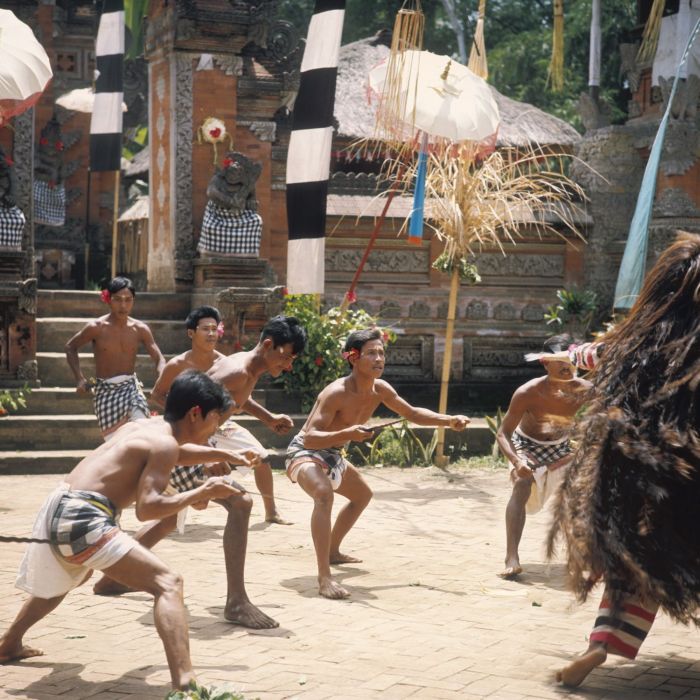
Performances take place in village streets or sacred spaces. Two dancers manipulate the heavy frame of Barong, wearing thick fur, a carved mask, and sparkling mirrored ornaments. As the dance proceeds, actors representing warriors confront the masked figure of Rangda. When Rangda casts a curse, the men fall into a trance and press kris daggers against their own chests. Barong bestows protective invulnerability, while a priest sprinkles holy water. The performance concludes as Rangda is repelled, ensuring communal safety.
When and where
The ritual is staged during critical communal ceremonies and throughout the major holidays of Galungan and Kuningan. Performances also occur during specific temple anniversaries and purification events to cleanse communities from illness and malevolent influences.
The tradition belongs to the island of Bali in Indonesia. It is especially prominent in Gianyar and the cultural centre of Ubud, though distinct animal masks are kept and danced in villages throughout the island, including Pacung in Tabanan.
What Barong means
Barong embodies Banas Pati Raja, the benevolent protector of the jungle and a spiritual guardian akin to a personal angel. The ongoing duel against Rangda does not represent the absolute destruction of evil, but rather the essential maintenance of cosmic equilibrium between opposing natural and spiritual forces. The kris dancers' invulnerability symbolises divine shielding against harm.



Days Barong is marked
Questions people ask about Barong
When is Barong marked?
Barong is kept as part of Galungan, which runs from 13 to 22 January 2027.
What is Barong?
Barong is a mythical animal figure and sacred mask dance from Bali, representing the king of spirits and the primary force of good in Balinese cosmology.
Where is this tradition practiced?
The dance is kept across the Indonesian island of Bali, with celebrated traditions rooted in Gianyar and Ubud, as well as distinct local masks preserved in villages like Pacung in Tabanan.
What happens during the Keris dance scene?
Rangda casts a spell forcing soldiers to stab their own chests with kris daggers. Barong counters the magic, making the dancers invulnerable so the blades cause no injury.
What different types of Barong exist?
Alongside the common lion mask, varieties include figures shaped like a pig, a tiger, a dog, an elephant, and a pair of tall male and female puppets called Barong Landung.
See also
 MawlidAn annual festival marking the birth of the Prophet Muhammad, marked by poetry, processions and feasts.
 Ogoh-ogohGiant handcrafted statues paraded and burned on the eve of the Balinese Saka New Year
 Qingming FestivalA spring custom of sweeping family graves and honouring ancestors across East Asia.
 Ghost FestivalA full-moon night in the seventh lunar month for feeding ghosts and guiding souls home
Good reading and sources
- Barong (mythology) on WikipediaEncyclopedia
- More photos on Wikimedia CommonsPhotos and video
- Wikidata recordOpen data
The facts on this page come from the Wikipedia article "Barong (mythology)", written by its contributors and used under the CC BY-SA 4.0 licence, and from its Wikidata record (CC0). EveryParampara rewrote the text in its own words, with AI assistance, and compares every page with the article to make sure no passage is copied. It may be reused under the same CC BY-SA 4.0 licence with a link back.
It may contain mistakes. Traditions differ from one family, village and community to the next, and the people who keep them know them best. If something is wrong, tell us. Last refreshed 2026-10-04.
More from Indonesia
All the traditions of Indonesia 🇲🇾 Malaysia and 2 moreNgajatTanda Ngajat
A traditional folk dance of the Iban people in Sarawak and Borneo, mimicking birds and warriors.Performance
🇲🇾 Malaysia and 2 moreNgajatTanda Ngajat
A traditional folk dance of the Iban people in Sarawak and Borneo, mimicking birds and warriors.Performance
 🇨🇳 China and 5 moreLion dance舞獅
A dynamic ritual dance featuring costumed lions, drums and martial acrobaticsPerformance
🇨🇳 China and 5 moreLion dance舞獅
A dynamic ritual dance featuring costumed lions, drums and martial acrobaticsPerformance
 🇮🇩 Uluwatu, IndonesiaKecakᬓᬾᬘᬓ᭄ (Balinese), Tari Kecak (Indonesian)
A circle of men chanting chak as they dance the Ramayana epic in BaliPerformance
🇲🇾 Kelantan, Malaysia and 2 moreMak yongTarian Mak Yong (Jawi: مق يوڠ)
A dance-drama of Kelantan and Patani, told in song, music and improvised speechPerformance
🇮🇩 Uluwatu, IndonesiaKecakᬓᬾᬘᬓ᭄ (Balinese), Tari Kecak (Indonesian)
A circle of men chanting chak as they dance the Ramayana epic in BaliPerformance
🇲🇾 Kelantan, Malaysia and 2 moreMak yongTarian Mak Yong (Jawi: مق يوڠ)
A dance-drama of Kelantan and Patani, told in song, music and improvised speechPerformance
The same idea elsewhere
Healing, luck and protection compared 🇬🇪 Tbilisi, Georgia and 4 moreGeorgian polyphonic singing
Several voices at once, sung without instruments at Georgian feasts and weddingsPerformance
🇬🇪 Tbilisi, Georgia and 4 moreGeorgian polyphonic singing
Several voices at once, sung without instruments at Georgian feasts and weddingsPerformance
 🇮🇳 India and 4 moreWater lantern
Small lamps floated on water to honour the dead and ask for good fortuneFestival
🇮🇳 India and 4 moreWater lantern
Small lamps floated on water to honour the dead and ask for good fortuneFestival
 🇮🇪 Ireland and 2 moreJack-o'-lantern
A carved pumpkin lantern lit with a candle to brighten and protect Halloween nightsFolklore
🇮🇪 Ireland and 2 moreJack-o'-lantern
A carved pumpkin lantern lit with a candle to brighten and protect Halloween nightsFolklore
 🇨🇬 Republic of the CongoNkisi
Spiritual vessels and figures crafted to channel ancestral power, healing and justiceSpiritual
🇨🇬 Republic of the CongoNkisi
Spiritual vessels and figures crafted to channel ancestral power, healing and justiceSpiritual