Spiritual and religiousEast AsiaBuddhist
Yeondeunghoe
In its own language: 연등회
A Korean lantern festival celebrating the Buddha's birthday with glowing lotus lights

Yeondeunghoe is a Korean lantern festival held to honor the birth of the Buddha. Across South Korea, people light handmade paper lanterns, hold street parades, and bathe infant Buddha statues on the eighth day of the fourth month of the lunar calendar.
When is Yeondeunghoe marked?
Yeondeunghoe is kept as part of Buddha's Birthday in Korea, which is on Thursday, 13 May 2027.
Yeondeunghoe is a Korean festival of illumination held to commemorate the Buddha's birthday. Every year on the eighth day of the fourth lunar month, temples, streets, and houses across South Korea fill with glowing lanterns shaped like lotus blossoms, animals, and historical figures. The festival brings communities together to celebrate light, hope, and mutual harmony while dissolving social divisions.
origins and history
The roots of the festival trace back to the Palgwanhoe ceremonies in 551 during the reign of King Jinheung. Historical documents from 866 record a celebration at Hwangnyongsa Temple in Gyeongju during the Silla Dynasty. In that era, the festival merged Buddhist offerings of light with rituals honoring the dragon god to safeguard the country and its harvest. The festival opens with the ceremonial washing of an infant Buddha statue, where participants use a special ladle to pour water over the sculpture's head and shoulders.
making the lanterns
Craftspeople build intricate lantern frames using split bamboo or flexible aluminum wire, binding the joints with paper tape. The framework is sheathed in silk or Hanji, a resilient handmade paper produced from mulberry bark. The paper sheets are trimmed and glued over every opening to withstand outdoor conditions. In community classes and private residences, people also make simpler lotus lights by affixing hand-twisted, dual-colored tissue petals in circular layers onto round white globes. While wax candles were once placed inside, battery-operated light-emitting diodes are standard today.
designs and meaning
The lotus flower is the central motif of Yeondeunghoe, representing dignity, the sublime, and spiritual awakening in Buddhist practice. Beyond the lotus, lanterns depict fish, drums, cranes, tigers, phoenixes, and sailing vessels with moving parts. Modern displays have also featured cartoon figures and King Sejong presenting the Korean alphabet. Participants carry and display these glowing creations as symbols of shared joy, light, and unity. The event brings people of different backgrounds together, setting aside social divides to wish well-being for all.
modern parades
The festival takes place nationwide, with its largest procession filling the Jongno area of Seoul around Jogyesa, the head temple of the Jogye Order. International cultural ties have also been marked in the procession, such as in 2005 when lanterns from Akita, Aomori, and Yamagata in Japan joined the Korean parade. In modern history, street parades in Jongno were cancelled only four times, including during martial law declarations in 1961 and 1980, a traffic dispute in 1970, and the health crisis of 2020.
How Yeondeunghoe is kept
Yeondeunghoe begins with a ritual bathing ceremony, where worshippers spoon water over the head and shoulders of a baby Buddha statue. Families and neighbours gather in workshops to craft lotus blossoms from twisted tissue paper and assemble larger frames using Hanji paper and wire. At night, illuminated lanterns are placed in temples and private houses, while crowds carry thousands of glowing creations through city streets during large public parades. Participants walk together regardless of social background to enjoy the lights and offer wishes of peace and happiness.
When and where
The festival takes place once a year on the eighth day of the fourth month according to the Korean lunar calendar, matching the celebration of the Buddha's birthday.
Yeondeunghoe is observed throughout South Korea. The largest and most prominent gathering takes place along the streets of the Jongno District in central Seoul, near Jogyesa Temple.
What Yeondeunghoe means
The lanterns stand for light, hope, and unity. The prominent lotus blossom embodies spiritual awakening, dignity, and the sublime in Buddhist thought. Gathering beneath the illuminated lanterns represents the removal of social boundaries, inviting people to share goodwill and hope for personal and communal happiness.


Days Yeondeunghoe is marked
Questions people ask about Yeondeunghoe
When is Yeondeunghoe marked?
Yeondeunghoe is kept as part of Buddha's Birthday in Korea, which is on Thursday, 13 May 2027.
What is Yeondeunghoe?
Yeondeunghoe is a traditional Korean Buddhist lantern-lighting festival held to celebrate the Buddha's birthday. It features sacred temple displays, lively public lantern parades, and community craft workshops.
Where is the main celebration held?
The celebration takes place across South Korea, with the largest and most famous public lantern parade held in the Jongno District of Seoul near Jogyesa Temple.
How are traditional lanterns constructed?
Lanterns are constructed from bamboo or aluminum wire frames covered in traditional mulberry Hanji paper or silk. Simple versions use round white bases layered with hand-twisted tissue petals.
See also
 Buddha's BirthdayA festival marking the birth of Siddhartha Gautama, observed across Asia with temple rituals and community gatherings.
 HaenyeoFemale free-divers of Jeju Island who harvest seafood from the ocean.
 Double Ninth FestivalAn autumn festival of mountain walks, chrysanthemum wine and ancestor remembrance
 Eid al-FitrThe feast that ends Ramadan, opened with morning prayers, sweets and visits home
Good reading and sources
- Yeondeunghoe, lantern lighting festival in the Republic of KoreaUNESCO, Heritage listing
- Yeondeunghoe, lantern lighting festival in the Republic of KoreaUNESCO, Article
- Yeondeunghoe on WikipediaEncyclopedia
- More photos on Wikimedia CommonsPhotos and video
- Wikidata recordOpen data
The facts on this page come from the Wikipedia article "Yeondeunghoe", written by its contributors and used under the CC BY-SA 4.0 licence, and from its Wikidata record (CC0). EveryParampara rewrote the text in its own words, with AI assistance, and compares every page with the article to make sure no passage is copied. It may be reused under the same CC BY-SA 4.0 licence with a link back.
It may contain mistakes. Traditions differ from one family, village and community to the next, and the people who keep them know them best. If something is wrong, tell us. Last refreshed 2026-10-04.
More from South Korea
All the traditions of South Korea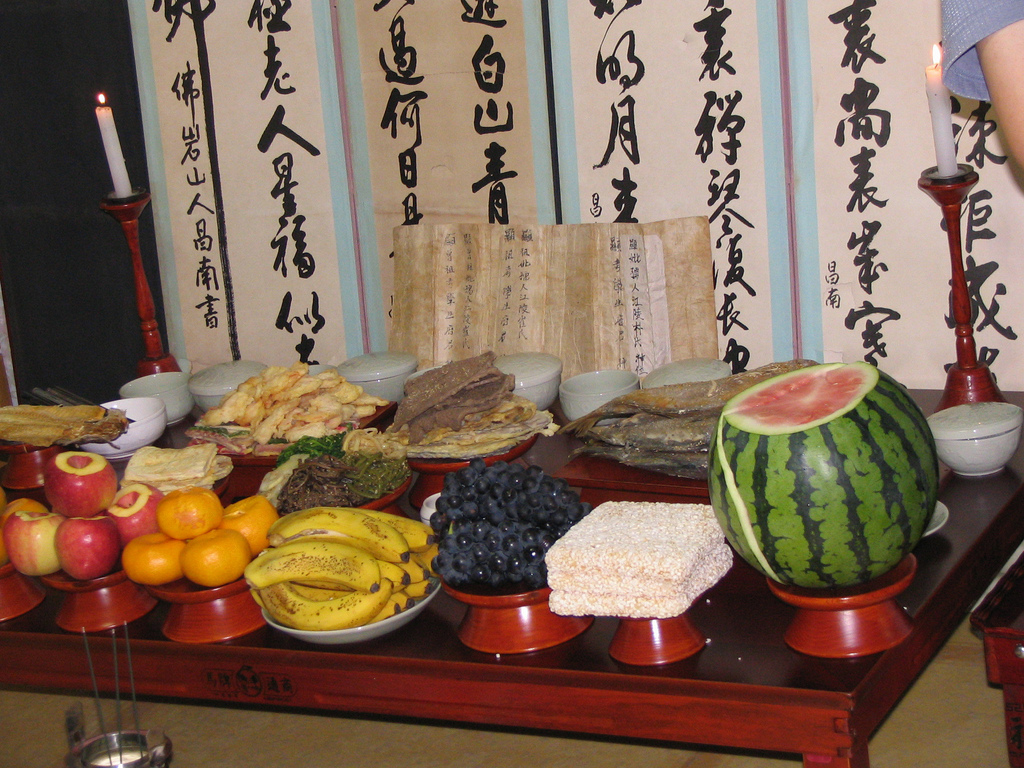 🇰🇷 South KoreaJesa제사 (Jesa)
A Korean ancestral memorial ceremony held on death anniversaries and major holidays.Spiritual · Feasts and festival meals
🇰🇷 South KoreaJesa제사 (Jesa)
A Korean ancestral memorial ceremony held on death anniversaries and major holidays.Spiritual · Feasts and festival meals
 🇰🇷 Jeju, South KoreaGut굿
Sacred rites of song, dance, and spirit communion performed by Korean shamansSpiritual
🇰🇷 Jeju, South KoreaGut굿
Sacred rites of song, dance, and spirit communion performed by Korean shamansSpiritual
 🇰🇷 Seoul, South KoreaJongmyo jerye종묘 제례
Ancestral rite for Korea's Joseon kings, with court music and a line dance, held in SeoulSpiritual
🇰🇷 Seoul, South KoreaJongmyo jerye종묘 제례
Ancestral rite for Korea's Joseon kings, with court music and a line dance, held in SeoulSpiritual
 🇰🇷 Seoul, South KoreaTemplestay템플스테이
A program that invites visitors to live in South Korean Buddhist temples and join the daily routines of monastic life.Spiritual · Dinner
🇰🇷 Seoul, South KoreaTemplestay템플스테이
A program that invites visitors to live in South Korean Buddhist temples and join the daily routines of monastic life.Spiritual · Dinner
The same idea elsewhere
Birth and new babies compared 🇹🇱 Timor-LesteUma Lulik
Sacred ancestral clan houses and ritual shrines in East TimorSpiritual
🇹🇱 Timor-LesteUma Lulik
Sacred ancestral clan houses and ritual shrines in East TimorSpiritual
 🇺🇦 Ukraine and 2 moreRushnykрушник
A sacred embroidered cloth used in East Slavic rituals, weddings and daily life.Dress
🇺🇦 Ukraine and 2 moreRushnykрушник
A sacred embroidered cloth used in East Slavic rituals, weddings and daily life.Dress