Life-cycle ritesMiddle EastJewish
Adult bar and bat mitzvah
In its own language: בַּר מִצְוָה / בַּת מִצְוָה
A Jewish coming-of-age ceremony held in adulthood, often years after the usual age
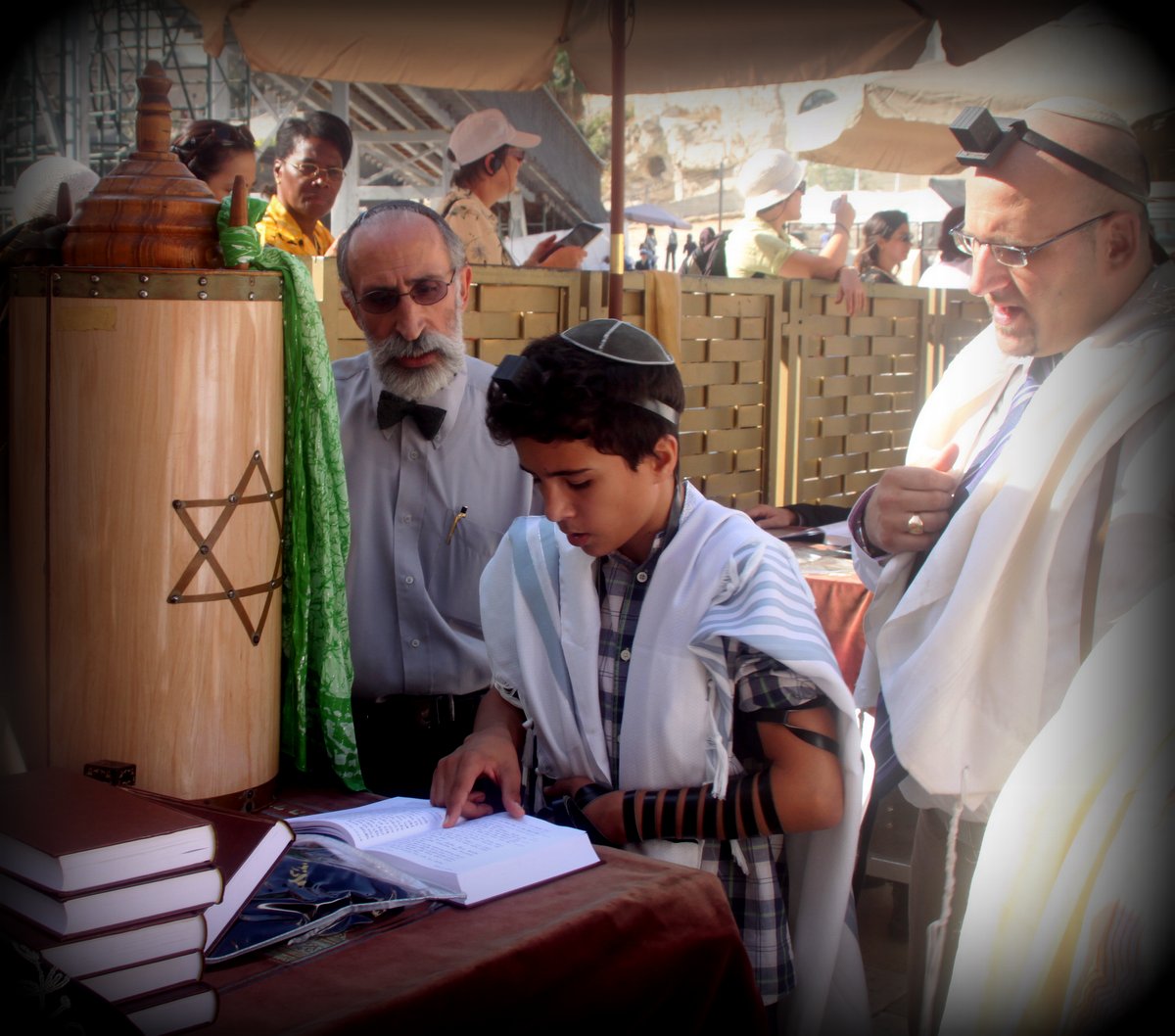
An adult bar or bat mitzvah is the Jewish ceremony of religious adulthood held after the usual ages of 13 for boys and 12 for girls. Adults who missed it, or who want a renewal, study Hebrew and the Torah readings and plan the celebration themselves.
When is Adult bar and bat mitzvah kept?
Adult bar and bat mitzvah is kept on whenever the person chooses, at whatever age in adult life.
An adult bar or bat mitzvah is a Jewish coming-of-age ceremony taken on after the usual age, which is 13 for boys and 12 for girls. Some people missed the chance as children. Others had one then and choose to do it again. Adults arrange their own celebration and spend a year or more learning Hebrew, Jewish practice and the readings they will lead.
What it is
The ceremony marks a Jewish person taking on the duties of adult religious life. For most of its history it came at a fixed point: 13 for a boy, 12 for a girl. The adult form is the same ceremony held later, at any age once someone is grown, and it can be shaped in many ways. A person who never had one may arrange it now. Someone who did may want it a second time. The clearest difference from a child's ceremony lies in who organises it. Adults plan their own, while a child's is arranged by parents or by the wider community.
Why adults choose one
People come to an adult bar or bat mitzvah from many directions. Some men and women grew up in years when a bat mitzvah for girls was uncommon, or when gender norms held it back. Others found the childhood preparation too difficult because of a learning disability. Converts to Judaism may want the ceremony to mark where they now stand. So may Jews who had little or no religious schooling as children. Some who went through it young choose it again as a renewal. Transgender Jews who had the ceremony as the gender assigned to them at birth sometimes take on the other one, with a new name. Holocaust survivors often had no opportunity at all.
Origins and history
The adult ceremony is recent. In the early 1970s a rabbi at Brandeis University, Albert Axelrad, led the earliest ones, and he urged every branch of Judaism to take up the practice. Groups followed at their own pace. Hadassah ran group bat mitzvah ceremonies for 180 women between 1995 and 2001. In 2001 the Union for Reform Judaism produced a guide for adult bar and bat mitzvah programmes, and 900 congregations took it up. The Conservative movement adopted the same guide a year later, in 2002.
Study and preparation
Preparation is the heart of it. Adults usually spend a year or more studying before the day. The learning takes in Hebrew, Jewish rituals, and the readings from the Torah and the Haftorah that the person will take part in. Many synagogues provide classes for adults who want this. Because an adult chooses the moment, the ceremony can happen at whatever point in adult life suits them, and it can be performed in a variety of ways. What stays constant is the study that comes first, which adults carry out for themselves rather than having it arranged for them.
Well-known ceremonies
Several public figures have marked the ceremony as adults. The singer Paula Abdul held hers in Safed in 2013 at 51, having moved it from the Western Wall in Jerusalem. The actor David Arquette celebrated his in 2012 at 40 at the Kotel. Comedian Tiffany Haddish had hers in December 2019 at 40. Drake held a repeat bar mitzvah at 31, after the first one at 13. James Franco marked his in 2015 at 37 with a charity event. Yisrael Kristal, then the oldest living man in the world, did so at 113. Mario Kreutzberger, known on television as Don Francisco, had a second at 83 in 2024. Armand Hammer died in 1990, the evening before the one he had planned, at 92.
How Adult bar and bat mitzvah is kept
An adult decides to take on the ceremony, sometimes alone and sometimes as part of a group. Study comes first, usually across a year or more: Hebrew, Jewish rituals, and the readings from the Torah and the Haftorah, often in classes that synagogues provide for adults. Unlike a child, whose family or community arranges the occasion, the adult plans the celebration personally. On the day the readings are taken in the congregation. Afterwards comes a gathering of the person's own making, among relatives, friends and often children. It can be held at whatever age the person decides, in many different ways.
When and where
There is no set date. An adult bar or bat mitzvah is held whenever the person chooses, once adulthood has been reached. The childhood form is fixed at 13 for boys and 12 for girls, but here the timing follows the individual, after the study is finished.
Jewish communities keep this ceremony wherever they live, in synagogues and in groups. Reform and Conservative bodies were early to adopt guides and programmes for adults. The examples named in the sources come from Israel, including the Western Wall in Jerusalem and the town of Safed, but the practice itself is not tied to one place.
What Adult bar and bat mitzvah means
At its core the ceremony means taking on the responsibilities of Jewish religious life, or taking them on again. It is symbolic rather than a legal change of standing, a coming of age that a person enters in their own time. Someone who had no chance earlier can treat the day as arriving late at something long wanted. Someone who went through it at 13 or 12 and returns to it as an adult marks how much time has passed, and chooses the same duties once more.
Questions people ask about Adult bar and bat mitzvah
When is Adult bar and bat mitzvah kept?
Adult bar and bat mitzvah is kept on whenever the person chooses, at whatever age in adult life.
What is an adult bar or bat mitzvah?
It is the same Jewish coming-of-age ceremony, held by someone older than the customary age. Traditionally boys are called at 13 and girls at 12. An adult can hold the ceremony at any point after reaching adulthood, whether or not they had one as a child.
Why would someone have one later in life?
Some had no chance as children: a bat mitzvah for girls was uncommon, gender norms held it back, or a learning disability made preparation too hard. Others are converts to Judaism, grew up with little religious education, want a renewal, or wish to mark a new gender and name. Holocaust survivors often had no opportunity.
What does the preparation involve?
Adults study for a year or longer. The learning takes in the Hebrew language, Jewish rituals, and the readings from the Torah and the Haftorah. Many synagogues provide classes, so people can prepare for the ceremony as a group rather than on their own.
Where does it take place?
In a synagogue, with the person's own community around them. The sources describe celebrated examples in Israel, at the Western Wall in Jerusalem and in Safed, along with group ceremonies that Hadassah held for 180 women between 1995 and 2001.
See also
 Bar and bat mitzvahA Jewish rite of passage marking when youth reach adulthood and take responsibility for their own actions.
 UpsherinA boy's first haircut at three, the day his Jewish learning begins
 TallitA four-cornered Jewish prayer shawl with ritual fringes worn during worship
 Profession of FaithA public declaration of religious belief across Jewish, Christian and Islamic traditions
Good reading and sources
- World's oldest man, Yisrael Kristal, 113, to hold bar mitzvahBBC, Article
- World's oldest man, Yisrael Kristal, 113, to hold bar mitzvahBBC, Article
The facts on this page come from the Wikipedia article "Adult bar and bat mitzvah", written by its contributors and used under the CC BY-SA 4.0 licence, and from its Wikidata record (CC0). EveryParampara rewrote the text in its own words, with AI assistance, and compares every page with the article to make sure no passage is copied. It may be reused under the same CC BY-SA 4.0 licence with a link back.
It may contain mistakes. Traditions differ from one family, village and community to the next, and the people who keep them know them best. If something is wrong, tell us. Last refreshed 2026-10-14.
More from Israel
All the traditions of Israel
🇮🇱 Jerusalem, Israel and 5 moreBar and bat mitzvahבַּר מִצְוָה / בַּת מִצְוָה
A Jewish rite of passage marking when youth reach adulthood and take responsibility for their own actions.Rite of passage · Feasts and festival meals
🇮🇱 Meron, Israel and 1 moreUpsherinאָפּשערן
A boy's first haircut at three, the day his Jewish learning beginsRite of passage · Sweets given and shared
 🇮🇱 Tiberias, Israel and 2 moreYahrzeitיאָרצײַט (yortsayt)
A Jewish death anniversary marked by prayer and a burning candle to honour the departed.Rite of passage
🇮🇱 Tiberias, Israel and 2 moreYahrzeitיאָרצײַט (yortsayt)
A Jewish death anniversary marked by prayer and a burning candle to honour the departed.Rite of passage
 🇰🇪 Kenya and 5 moreBurial
Placing the dead in the ground or a structure to honor them and guide their journey.Rite of passage
🇰🇪 Kenya and 5 moreBurial
Placing the dead in the ground or a structure to honor them and guide their journey.Rite of passage
The same idea elsewhere
Coming of age compared 🇪🇬 Egypt and 5 moreTraditional tattooing
The ancient custom of marking the skin for protection, healing, status and sacred ritesDress
🇪🇬 Egypt and 5 moreTraditional tattooing
The ancient custom of marking the skin for protection, healing, status and sacred ritesDress
 🇵🇬 Maprik, Papua New GuineaHaus Tambaran
A sacred house of the Sepik peoples, used for ancestor worship and male initiationSpiritual
🇵🇬 Maprik, Papua New GuineaHaus Tambaran
A sacred house of the Sepik peoples, used for ancestor worship and male initiationSpiritual
 🇳🇿 Auckland, New ZealandTā moko
The traditional permanent tattooing of the Māori people of New Zealand, marking identity and status.Rite of passage
🇳🇿 Auckland, New ZealandTā moko
The traditional permanent tattooing of the Māori people of New Zealand, marking identity and status.Rite of passage
 🇯🇵 Japan and 2 moreKyūdō弓道
The Japanese martial art of archery, practiced with an asymmetrical longbowGame
🇯🇵 Japan and 2 moreKyūdō弓道
The Japanese martial art of archery, practiced with an asymmetrical longbowGame