Seasons, harvest and the calendarEuropeChristianPagan and ancient
Jul
An eight-week Norwegian midwinter season of feasts, family gatherings, and gift-giving
Jul is Norway's midwinter holiday season, running from late November through early January. Families celebrate across five distinct phases with shared meals like salted mutton or pork ribs, sweet porridge, festive baking, and gift giving on Christmas Eve.
When is Jul marked?
Jul is kept as part of Christmas Eve, which is on Thursday, 24 December 2026.
In Norway, the holiday known as Jul stretches across roughly eight weeks of midwinter. Rooted in both early Germanic seasonal markers and the Christian liturgical year, the period centres on bringing warmth and light into dark winter nights. Families gather around elaborately prepared regional dishes, exchange presents on Christmas Eve, and mark ancient customs ranging from outdoor wheat sheaves to doorstep evergreens.
The five stages
The holiday spans five distinct periods. It opens in late November with Advent, when children count down the days using calendars filled with sweets or small building blocks. The main celebration happens on December 24, known as julaften, marked by afternoon church bells and an evening family feast. Following this is romjul, the quiet week between Christmas Day and New Year's Eve, when wild game hunting stops under the traditional rule of Christmas peace. Celebrations continue into the new year, concluding officially around Epiphany in January, when trees and decorations are packed away.
Feasting and regional foods
Holiday meals differ across the country. Western and northern regions traditionally serve pinnekjøtt, which is salted, dried, and steamed mutton ribs. In eastern and central Norway, people cook pork rib roast alongside seasoned pork patties and sausages. Southern communities often choose cod or lutefisk. On Christmas Eve lunch, many eat rice porridge hiding a peeled white almond, where finding the nut earns a marzipan pig. The big feast on Christmas Day features a cold buffet of cured meats, jellied meats, smoked fish, and cheeses, followed by seven distinct varieties of holiday baked goods.
Ancient customs and figures
Many current rituals echo older farm life and Norse lore. People still hang a wheat sheaf outside for birds and lay fresh pine or spruce boughs by their front doors. Straw figures shaped like goats, or julebukk, recall the mythical goats of the god Thor. In earlier centuries, people disguised themselves in animal masks and skins during the winter nights, visiting neighbouring houses with songs and blessings in exchange for food. Today, children look forward to Julenissen, a gift-giving figure who visits homes with parcels on Christmas Eve.
Communal banquets
Another central custom is the julebord, a lively seasonal buffet accompanied by festive drinks such as dark holiday beers, spiced sodas, and aquavit. This gathering originated in medieval communal feasts tied to regional legal assemblies. In modern times, the tradition has largely shifted from domestic dining rooms to restaurants and workplaces. Companies, schools, and social clubs organise these banquets for colleagues and clients from November onward, making the feast an essential social gathering that leads into the winter holidays.
How Jul is kept
Preparations begin in November with company banquets and Advent calendars for children. On December 23, households decorate their evergreen trees. Christmas Eve begins with classic television broadcasts, followed by afternoon church services. When church bells toll at five in the evening, families sit down to their regional holiday dinner, eat dessert, and unwrap presents brought by Julenissen. The subsequent week of romjul remains peaceful and family-oriented, filled with buffet lunches of cold cuts and fish, before fireworks welcome the New Year.
When and where
The season begins on the fourth Sunday before Christmas Day and lasts about eight weeks. The main festivities take place on Christmas Eve, December 24, with the holiday period officially concluding in mid-January on Epiphany.
Jul is kept throughout Norway across private homes, churches, and workplaces. Related celebrations under the same name occur across Scandinavia, Iceland, Greenland, and parts of Scotland.
What Jul means
Jul combines sacred Christian observances with agrarian midwinter traditions. The period marks hospitality, rest, and community safety through customs like the seasonal truce on hunting. Hanging outdoor wheat sheaves and displaying evergreen boughs celebrate nature and hospitality, while the straw goat symbolises older protective spirits from Norse myth.
On the table
- Pinnekjøtt
- Lutefisk
- Medisterkaker
- Medisterpølser
- Risengrynsgrøt
- Riskrem
- Julebrus
- Fenalår
Flavours: Ginger
Days Jul is marked
Questions people ask about Jul
When is Jul marked?
Jul is kept as part of Christmas Eve, which is on Thursday, 24 December 2026.
What is Jul in Norway?
Jul is the Norwegian midwinter holiday season, running from late November through mid-January. It blends Christian Christmas traditions with older Scandinavian midwinter customs, featuring extended family meals, seasonal baking, and gift giving.
What dishes are served for the main Christmas dinner?
Main dishes depend on the region. Steamed cured mutton ribs are standard in the west and north, pork rib roast with meatballs and sausages dominates in the east and central areas, while southern regions often serve cod or lutefisk.
What is a julebord?
A julebord is a holiday buffet featuring seasonal food and drinks. Historically held at home, it is now commonly hosted by employers and organisations in restaurants or event venues from November through December.
See also
 Advent calendarA daily countdown to Christmas using doors, images, or small gifts.
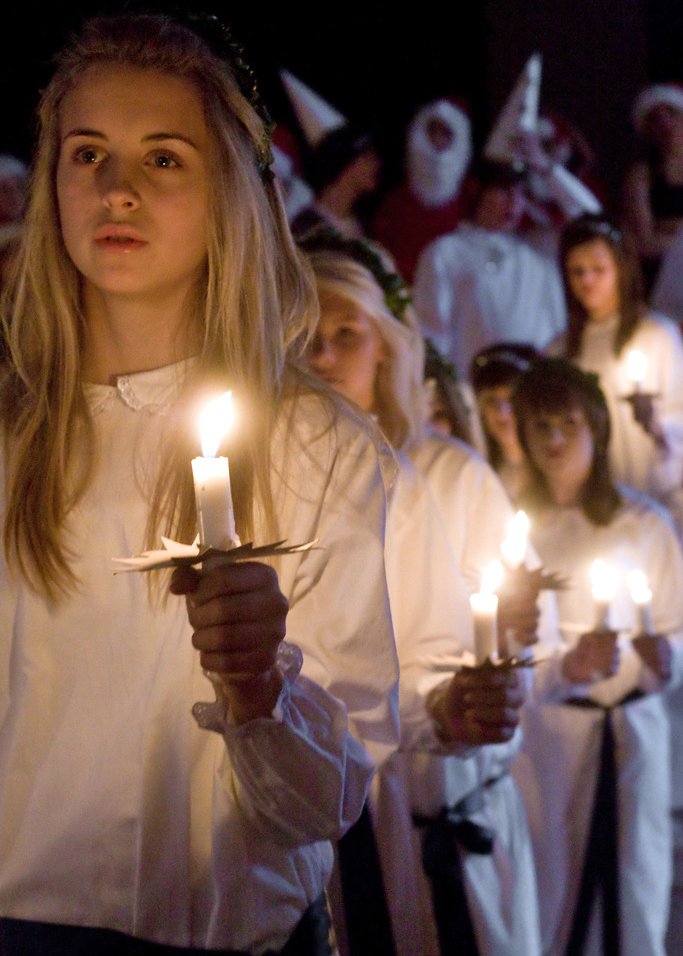 Saint Lucy's DayA December festival of light and song held across Scandinavia and Italy to honour a Christian martyr.
 FastelavnA pre-Lenten carnival in Northern Europe where children dress up, sing for treats, and break candy-filled barrels.
 RisalamandeA chilled Danish Christmas rice dessert with cream, chopped almonds and cherry sauce
Good reading and sources
- Christmas in Norway on WikipediaEncyclopedia
- More photos on Wikimedia CommonsPhotos and video
- Wikidata recordOpen data
The facts on this page come from the Wikipedia article "Christmas in Norway", written by its contributors and used under the CC BY-SA 4.0 licence, and from its Wikidata record (CC0). EveryParampara rewrote the text in its own words, with AI assistance, and compares every page with the article to make sure no passage is copied. It may be reused under the same CC BY-SA 4.0 licence with a link back.
It may contain mistakes. Traditions differ from one family, village and community to the next, and the people who keep them know them best. If something is wrong, tell us. Last refreshed 2026-10-04.
More from Norway
All the traditions of Norway 🇬🇧 United Kingdom and 3 moreShielingÀirigh
Seasonal summer pasture living and traditional dairying in the Scottish hillsSeasonal
🇬🇧 United Kingdom and 3 moreShielingÀirigh
Seasonal summer pasture living and traditional dairying in the Scottish hillsSeasonal
 🇩🇰 Copenhagen, Denmark and 1 moreHygge
A Danish word for unhurried time at home with others, kept with candles and cookingHome
🇩🇰 Copenhagen, Denmark and 1 moreHygge
A Danish word for unhurried time at home with others, kept with candles and cookingHome
 🇳🇴 Norway and 3 moreJulebukkingGå julebukk
A Scandinavian Christmas custom where masked visitors go door to door for songs and treats.Festival
🇩🇪 Germany and 5 moreAdvent calendarAdventskalender
A daily countdown to Christmas using doors, images, or small gifts.Festival
🇳🇴 Norway and 3 moreJulebukkingGå julebukk
A Scandinavian Christmas custom where masked visitors go door to door for songs and treats.Festival
🇩🇪 Germany and 5 moreAdvent calendarAdventskalender
A daily countdown to Christmas using doors, images, or small gifts.Festival
The same idea elsewhere
Midwinter and the longest night compared 🇨🇳 Shanghai, China and 1 moreJiaozi餃子
Crescent Chinese dumplings filled with meat or vegetables, eaten for fortune and feastsTable custom · Breakfast
🇨🇳 Shanghai, China and 1 moreJiaozi餃子
Crescent Chinese dumplings filled with meat or vegetables, eaten for fortune and feastsTable custom · Breakfast
 🇳🇿 New ZealandMatariki
The Māori New Year marked by the midwinter rising of the Pleiades clusterSeasonal
🇳🇿 New ZealandMatariki
The Māori New Year marked by the midwinter rising of the Pleiades clusterSeasonal
 🇮🇷 Yazd, Iran and 1 moreSadehسده
An ancient midwinter festival of fire, light, and the approach of springFestival · Feasts and festival meals
🇮🇷 Yazd, Iran and 1 moreSadehسده
An ancient midwinter festival of fire, light, and the approach of springFestival · Feasts and festival meals
 🇵🇪 Cusco, PeruQoyllur Rit'iQuyllurit'i
An Andean mountain pilgrimage uniting indigenous star lore and Catholic devotionSpiritual
🇵🇪 Cusco, PeruQoyllur Rit'iQuyllurit'i
An Andean mountain pilgrimage uniting indigenous star lore and Catholic devotionSpiritual