Seasons, harvest and the calendarEuropeChristianPagan and ancient
Jul
A midwinter holiday of feast tables, doorstep gift givers, and candlelit mornings

Jul is the Swedish midwinter holiday celebrated from Advent through mid-January, centring on Christmas Eve gatherings. Families share a multi-course buffet of fish, ham, and spiced dishes, welcome an in-person visit from the gift-bearing Jultomten, and mark the season with candlelit morning church services.
When is Jul marked?
Jul is kept as part of Christmas Eve, which is on Thursday, 24 December 2026.
Jul is Sweden's winter holiday, stretching from the start of Advent to mid-January. While the season honors the Christian Nativity and Saint Lucy, it retains roots in ancient midwinter feasts that marked the turning of the sun. Families celebrate primarily on Christmas Eve with a lavish smorgasbord, gift giving delivered directly by Jultomten, and early morning church services, closing the festive period with tree-clearing parties on Saint Knut's Day.
Solstice rites and history
Long before Christian times, Scandinavian communities marked the winter solstice with midwinter blót rites, offering sacrifices to seek blessings from the Norse deities for emerging crops. Celebrants hailed Odin under the name Jólner and gathered to feast and brew ale. Written records from around the year 900 describe this gathering as drinking Jul. When Sweden accepted Christianity, the older sacrificial practices were banned, but the custom of hearty eating and drinking persisted. Over time, the seasonal celebration absorbed the Christian story of the Nativity while maintaining the communal hospitality and winter light that had defined Nordic solstice gatherings for centuries.
The Christmas Eve feast
The focal point of celebration is the julbord, a grand buffet served in sequential courses. Diners begin with pickled herring, sour cream, and chives before progressing to cured fish such as gravlax and hot lutfisk. Cold sliced meats follow, centred on a mustard-glazed Christmas ham alongside dark wort bread and pâtés. The warm selection features meatballs, small sausages, ribs, and Janssons frestelse, a rich potato bake layered with sprats and cream. The meal concludes with cheeses and sweets, including gingerbread biscuits and spiced rice pudding. A single almond is hidden in the pudding pot, bringing luck or a prize to whoever finds it.
The gift bearer Jultomten
Swedish gift giving is overseen by Jultomten, a character born from the blending of Santa Claus with the ancient Nordic tomte. Traditional folklore described the tomte as a small, bearded guardian spirit who protected the family farmstead and reflected the presence of past ancestors. Today, Jultomten arrives in human guise rather than down a chimney. On Christmas Eve, a relative or neighbour slips away, dresses in red robes with a false beard, and knocks on the front door carrying a sack of presents. He asks if there are good children present before distributing parcels directly into the hands of expectant household members.
Spruce trees and Saint Knut
Holiday preparations begin in late November with Advent candles and the Feast of Saint Lucy on 13 December, when processions carry candlelight into schools and workplaces. Homes are adorned with red tulips, straw ornaments, and indoor spruce trees trimmed with paper decorations and apples. Before dawn on Christmas Day, worshipers gather for Julotta, an early morning service traditionally reached by sleigh across snowy countryside. Celebrations last until Saint Knut's Day on 13 January. On this twentieth day after Christmas, households hold lively tree-clearing gatherings where children eat the last candies hanging from the branches before the spruce is discarded.
How Jul is kept
December opens with Advent traditions and Saint Lucy's procession on 13 December. On Christmas Eve, families gather around a decorated spruce for the multi-course julbord feast. Later in the evening, an adult disguised as Jultomten knocks at the door to distribute gifts in person. Many attend the pre-dawn Julotta church service on Christmas morning. Festivities continue through two public holidays and conclude on 13 January with Saint Knut parties, where children plunder the final sweets from the tree before it is thrown out.
When and where
The festive period starts with the first Advent in late November and reaches its height on Christmas Eve, 24 December. The holiday season officially wraps up twenty days later on Saint Knut's Day, 13 January.
Jul is observed throughout Sweden in homes, schools, community venues, and Lutheran parish churches. Pre-dawn Christmas Day services remain especially meaningful across rural parishes, where congregations historically gathered by horse-drawn sleigh.
What Jul means
Originally held to welcome lengthening daylight at the winter solstice and seek blessings for spring crops, Jul combines ancient seasonal survival with Christian joy. Its iconic visitor, the tomte, recalls farmstead guardian spirits linked to ancestral lineages, symbolising protection, seasonal hospitality, and family continuity.
On the table
- Julbord
- Julskinka (Christmas ham)
- Lutfisk
- Janssons frestelse
- Risgrynsgröt (rice pudding)
- Pepparkakor
- Julmust
- Vörtbröd


Days Jul is marked
Questions people ask about Jul
When is Jul marked?
Jul is kept as part of Christmas Eve, which is on Thursday, 24 December 2026.
What is Jul?
Jul is the Swedish Christmas celebration, running from Advent through mid-January. It merges Christian observances with older Nordic solstice customs, focusing on hospitality, family meals, and gift giving.
What dishes are served on a traditional julbord?
The feast begins with pickled herring and cured salmon, moves to hot fish like lutfisk, cold ham with mustard, and warm dishes such as meatballs and potato casserole, ending with spiced rice pudding.
Who brings presents during Jul?
Gifts are brought by Jultomten, a figure evolved from ancient farmstead spirits and Saint Nicholas. Instead of using chimneys, an elder dressed as the figure knocks and delivers gifts directly.
How does the holiday season end?
The season officially concludes on 13 January, Saint Knut's Day. Families strip the remaining sweets from their decorated spruce during tree-clearing parties before taking down the holiday ornaments.
See also
 Mardi GrasA festive day of parades and rich foods marking the final celebration before the Christian fasting season of Lent begins
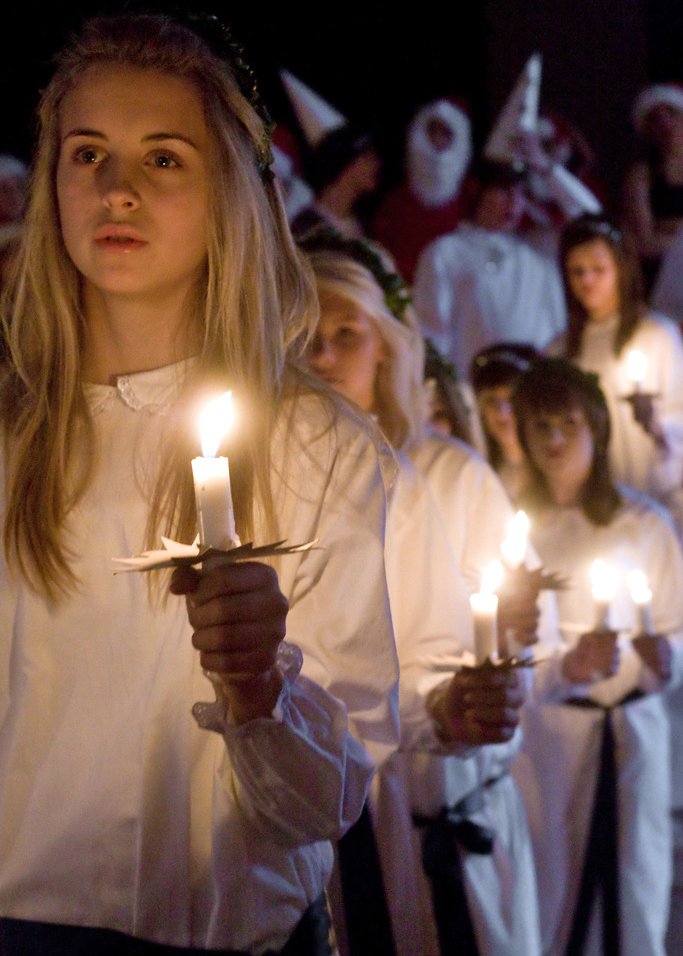 Saint Lucy's DayA December festival of light and song held across Scandinavia and Italy to honour a Christian martyr.
 Gävle goatA towering straw Yule goat built each Advent in the central square of Gävle
 FastelavnA pre-Lenten carnival in Northern Europe where children dress up, sing for treats, and break candy-filled barrels.
Good reading and sources
- Christmas in Sweden on WikipediaEncyclopedia
- More photos on Wikimedia CommonsPhotos and video
- Wikidata recordOpen data
The facts on this page come from the Wikipedia article "Christmas in Sweden", written by its contributors and used under the CC BY-SA 4.0 licence, and from its Wikidata record (CC0). EveryParampara rewrote the text in its own words, with AI assistance, and compares every page with the article to make sure no passage is copied. It may be reused under the same CC BY-SA 4.0 licence with a link back.
It may contain mistakes. Traditions differ from one family, village and community to the next, and the people who keep them know them best. If something is wrong, tell us. Last refreshed 2026-10-04.
More from Sweden
All the traditions of Sweden 🇮🇪 Dublin, Ireland and 3 moreMay Day
A traditional European festival welcoming summer with greenery, dances and bonfiresSeasonal · Feasts and festival meals
🇮🇪 Dublin, Ireland and 3 moreMay Day
A traditional European festival welcoming summer with greenery, dances and bonfiresSeasonal · Feasts and festival meals
 🇬🇧 United Kingdom and 3 moreShielingÀirigh
Seasonal summer pasture living and traditional dairying in the Scottish hillsSeasonal
🇸🇪 Stockholm, Sweden and 4 moreSaint Lucy's Day
A December festival of light and song held across Scandinavia and Italy to honour a Christian martyr.Festival · Breakfast
🇬🇧 United Kingdom and 3 moreShielingÀirigh
Seasonal summer pasture living and traditional dairying in the Scottish hillsSeasonal
🇸🇪 Stockholm, Sweden and 4 moreSaint Lucy's Day
A December festival of light and song held across Scandinavia and Italy to honour a Christian martyr.Festival · Breakfast
The same idea elsewhere
Midwinter and the longest night compared 🇵🇪 Cusco, Peru and 4 moreIntiinti (Quechua)
The Inca sun deity, honoured with temples, offerings and the June festival Inti RaymiSpiritual
🇵🇪 Cusco, Peru and 4 moreIntiinti (Quechua)
The Inca sun deity, honoured with temples, offerings and the June festival Inti RaymiSpiritual
 🇳🇿 New ZealandMatariki
The Māori New Year marked by the midwinter rising of the Pleiades clusterSeasonal
🇳🇿 New ZealandMatariki
The Māori New Year marked by the midwinter rising of the Pleiades clusterSeasonal
 🇬🇪 Tbilisi, GeorgiaChichilakiჩიჩილაკი
A shaved hazelnut branch crafted as a Georgian Christmas tree and burned at EpiphanyFestival
🇬🇪 Tbilisi, GeorgiaChichilakiჩიჩილაკი
A shaved hazelnut branch crafted as a Georgian Christmas tree and burned at EpiphanyFestival
 🇨🇳 Suzhou, China and 3 moreDongzhi冬至
A midwinter festival celebrating the return of light with family feasts and dumplingsSeasonal · Dinner
🇨🇳 Suzhou, China and 3 moreDongzhi冬至
A midwinter festival celebrating the return of light with family feasts and dumplingsSeasonal · Dinner